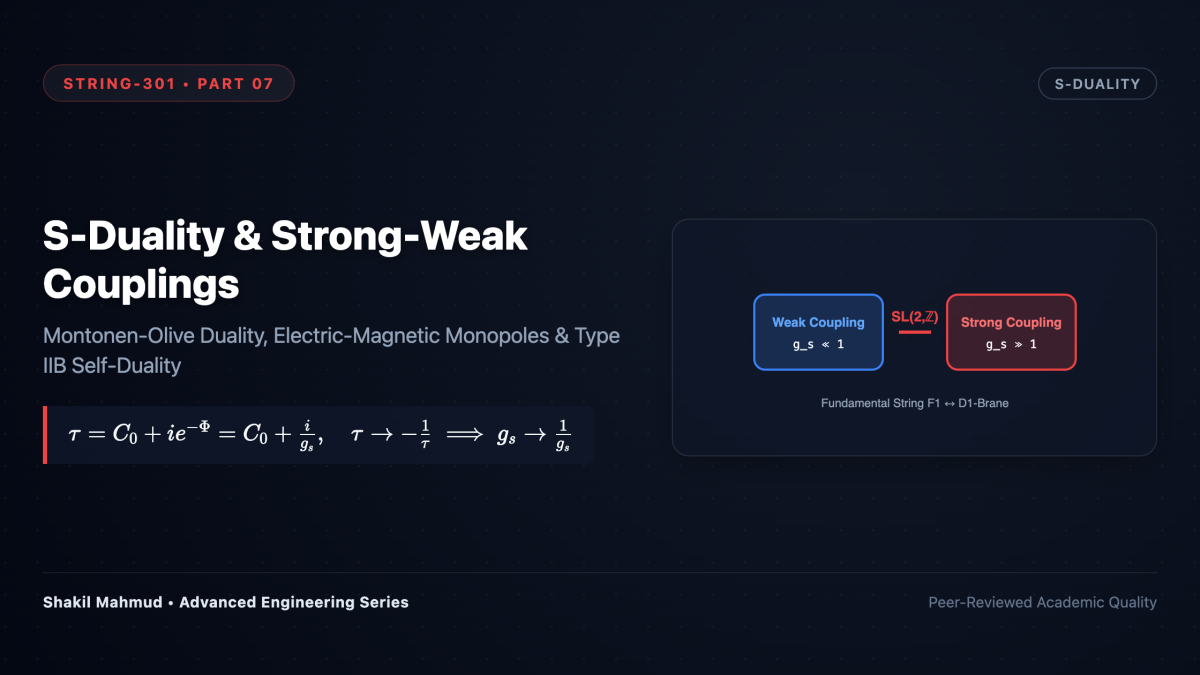
In traditional quantum field theory, perturbation theory relies strictly on the assumption that the coupling constant is small ((g ll 1)). When a theory becomes strongly coupled ((g gg 1)), calculations explode into non-computable infinity: quarks are permanently confined, and Feynman diagrams fail. S-Duality (Strong-Weak Duality) shatters this barrier: it proves that the strong-coupling regime of one theory is mathematically identical to the weak-coupling regime of another (or the same) dual theory. In this installment, we explore Montonen-Olive duality, magnetic monopoles, and the ( ext{SL}(2, mathbb{Z})) self-duality of Type IIB string theory.
1. The Dirac Quantization Condition and Montonen-Olive Duality
In 1931, Paul Dirac demonstrated that the existence of a single magnetic monopole with magnetic charge (g_m) in the universe explains the universal quantization of electric charge (q_e):
[
q_e g_m = 2pi n hbar quad (n in mathbb{Z}) quad implies quad g_m = rac{2pi n}{q_e}
]
In 1977, Claus Montonen and David Olive proposed a radical conjecture: in certain supersymmetric gauge theories (specifically (mathcal{N}=4) Super Yang-Mills), electric charges and magnetic monopoles are completely interchangeable. Defining the complexified gauge coupling parameter:
[
au quiv rac{ heta}{2pi} + rac{4pi i}{g_{ ext{YM}}^2}
]
Montonen-Olive duality asserts that the theory is invariant under the modular group ( ext{SL}(2, mathbb{Z})):
[
au o rac{a au + b}{c au + d}, quad begin{pmatrix} a & b c & d nd{pmatrix} in ext{SL}(2, mathbb{Z}) quad (ad – bc = 1)
]
The (S)-generator corresponds to ( au o -1/ au). When the theta angle vanishes (( heta = 0)):
[
au = rac{4pi i}{g_{ ext{YM}}^2} xrightarrow{quad S quad} -rac{1}{ au} = rac{i g_{ ext{YM}}^2}{4pi} quiv rac{4pi i}{ ilde{g}_{ ext{YM}}^2} implies ilde{g}_{ ext{YM}} = rac{4pi}{g_{ ext{YM}}}
]
When the original coupling is impossibly strong ((g_{ ext{YM}} o infty)), the dual coupling is extraordinarily weak (( ilde{g}_{ ext{YM}} o 0))! Strongly interacting electric charges transform into weakly interacting magnetic monopoles.
2. Type IIB Superstring Self-Duality
In 10D Type IIB superstring theory, the scalar fields consist of the dilaton (Phi) and the Ramond-Ramond 0-form axion (C_0). They combine naturally into the Axion-Dilaton Modulus ( au):
[
au quiv C_0 + i e^{-Phi} = C_0 + rac{i}{g_s}
]
Remarkably, the low-energy effective action of Type IIB supergravity is invariant under the non-perturbative ( ext{SL}(2, mathbb{Z})) global modular group:
[
au o rac{a au + b}{c au + d}
]
Under the inversion generator (S = begin{pmatrix} 0 & -1 1 & 0 nd{pmatrix}), ( au o -1/ au). If the axion vanishes ((C_0 = 0)):
[
g_s longleftrightarrow rac{1}{g_s}
]
Type IIB string theory is Self-Dual under S-duality. Under this transformation:
- The fundamental Neveu-Schwarz string (( ext{F}1)) transforms into a Dirichlet 1-brane (( ext{D}1)):
[
ext{F}1 longleftrightarrow ext{D}1
] - The NS-NS 2-form (B_2) and R-R 2-form (C_2) form a modular doublet: (begin{pmatrix} B_2 C_2 nd{pmatrix} o S begin{pmatrix} B_2 C_2 nd{pmatrix} = begin{pmatrix} -C_2 B_2 nd{pmatrix}).
- The self-dual R-R 4-form (C_4) and the D3-brane are completely invariant under S-duality.
3. Heterotic ( ext{SO}(32)) and Type I S-Duality
S-duality does not merely map a theory to itself; it maps completely different string theories to each other. In 1995, Edward Witten proved that:
[
ext{Heterotic } ext{SO}(32) ext{ at coupling } g_s quad xleftrightarrow{quad ext{S-Duality} quad} quad ext{Type I at coupling } ilde{g}_s = rac{1}{g_s}
]
The strongly coupled limit of Heterotic ( ext{SO}(32)) closed strings is precisely weakly coupled Type I open strings ending on D9-branes. S-duality conquered the stronghold of strong coupling, showing that every intractable strong-coupling limit in string theory has an exact, weakly coupled dual description.