At the conclusion of our twenty-part journey through mathematical logic, we stand at the threshold of a profound epistemic transition: the twilight of unaided human mathematical verification. Modern proofs have grown to monstrous scales—tens of thousands of pages, vast computer-assisted case enumerations, or theoretical abstractions so dizzying that no single human brain can verify them with absolute certainty. In response, mathematics is returning to its formalist roots, but with a radically new ally: Interactive Theorem Provers built on the Curry-Howard correspondence. Led by systems like Lean 4, Coq, and Isabelle, mathematical truth is transitioning into a machine-verified, open-source computational edifice.
1. The Crisis of Human Peer Review
In the twenty-first century, classical mathematical communication reached an epistemological breaking point:
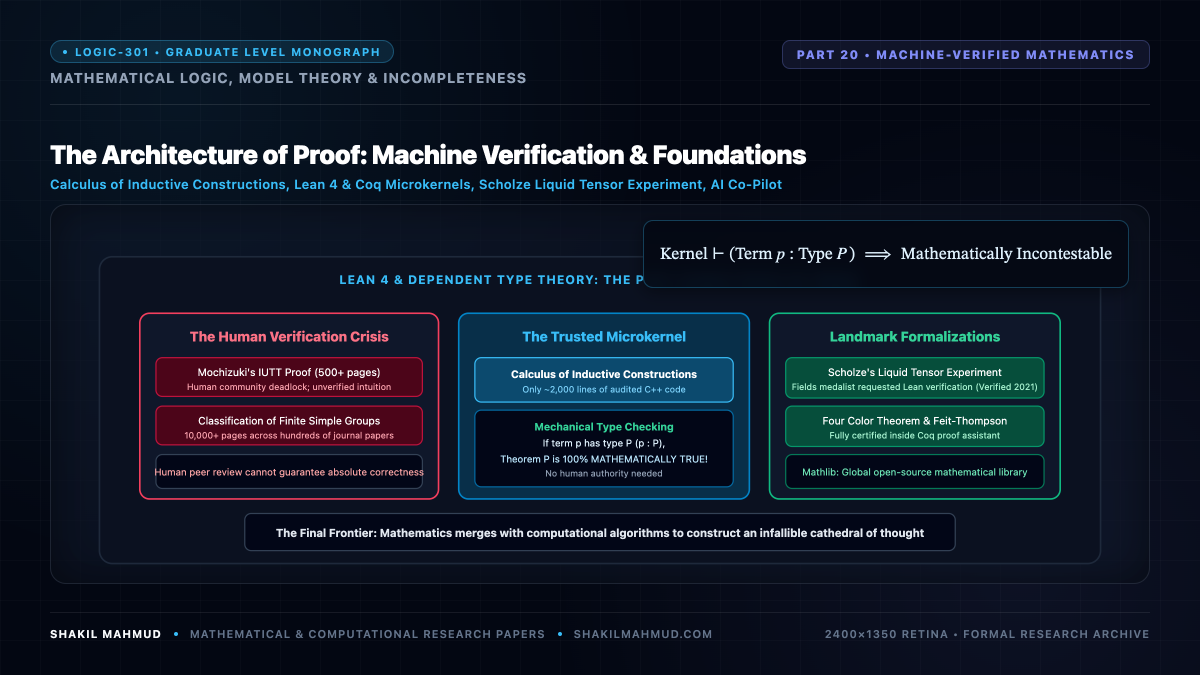
- The Classification of Finite Simple Groups: Spanning over 15,000 journal pages across hundreds of papers authored by dozens of mathematicians over decades. Small gaps routinely surfaced and took years to repair.
- The Four-Color Theorem (Appel & Haken, 1976): Relied on checking 1,936 discrete reducible planar configurations on an IBM supercomputer. Human mathematicians could not check the code by hand, provoking intense philosophical debate.
- The Kepler Conjecture (Thomas Hales, 1998): Concerning sphere packings, Hales’ proof involved 300 pages of text and gigabytes of computer calculations. A committee of 12 top referees labored for four years before reporting they were “99% certain” the proof was correct, but could not certify every line. Frustrated, Hales abandoned traditional publishing and initiated the Flyspeck Project to formalize the entire proof in HOL Light, finally achieving 100% formal verification in 2014.
- Mochizuki’s Inter-universal Teichmüller Theory (2012): Over 500 pages claiming to prove the $abc$ conjecture. A decade later, the mathematical community remains deadlocked, unable to reach consensus on whether a critical step (Corollary 3.12) is sound.
Human peer review—limited by fatigue, cognitive bias, and sociological authority—is no longer sufficient to guarantee absolute mathematical certainty.
2. The Architecture of Interactive Theorem Provers (Lean 4 & Coq)
Modern interactive theorem provers solve this crisis through an architectural separation of concerns based on the de Bruijn Criterion:
The Trusted Microkernel Architecture
The system is split into two layers:
- The Outer Shell (Elaborator & Tactics): A massive, sophisticated software suite containing parsers, AI auto-completion, tactic scripts (`ring`, `linarith`, `omega`), and automated solvers. This layer can be arbitrarily complex and contains potential software bugs without endangering mathematical truth.
- The Trusted Microkernel: A tiny, audited piece of code (often under 2,000 lines of functional C++ or OCaml) that implements solely the core typing rules of the foundational logic (such as the Calculus of Inductive Constructions).
The tactic engine does not prove theorems; it merely searches for and outputs a mathematical term $p$. The microkernel independently type-checks whether $p$ possesses the type of the theorem ($p : P$). If the kernel accepts, the theorem is infallibly verified. Even if the outer AI was flawed, a malformed proof will immediately crash at the microkernel gate.
3. The Scholze Liquid Tensor Milestone (2021)
In December 2020, Peter Scholze (Fields Medalist 2018) and Dustin Clausen developed the revolutionary theory of Condensed Mathematics and Liquid Vector Spaces. Scholze admitted that a foundational theorem (Theorem 9.4) was so complex and slippery that he feared a catastrophic hidden error had slipped past his intuition. In an extraordinary public appeal, Scholze challenged the formal mathematics community to verify the proof in Lean.
Led by Johan Commelin, an international team of mathematicians formalized the proof in Lean in just six months (the Liquid Tensor Experiment). Scholze stated:
“I was able to witness the exact moment when the machine verified the critical lemma. It gave me a degree of psychological certainty that no amount of human re-reading could ever provide. Formal verification had transformed from a distant curiosity into a practical mathematical instrument.”
4. Mathlib: The Global Digital Library of Alexandria
The crowning achievement of the formalization movement is Mathlib—a unified, hyper-connected, open-source mathematical library hosted on GitHub and powered by Lean 4. Unlike fragmented human mathematical papers where notation and definitions conflict, Mathlib requires every theorem to interface with the exact same foundational definitions.
From prime number theorems and differential geometry to Scheme Theory and algebraic topology, thousands of mathematical concepts are woven into a single, cohesive, computationally executable graph of human knowledge.
5. The Convergence: AI, Formal Logic & The Post-Human Epoch
As we conclude this series, we witness the convergence of the three great intellectual movements of history:
- First-Order Logic & Model Theory: Clarifying the limits, expressive power, and model spaces of language.
- Deep Learning & Large Language Models: Generating intuitive conjectures, creative leaps, and semantic heuristics.
- Interactive Theorem Provers: Providing an absolute, cryptographic, error-free verification kernel.
For millennia, mathematics was limited by the biological constraints of human working memory. By externalizing deduction into machine-verified type theory, mathematics has forged an indestructible bridge from the finite to the transfinite. The temple of reason, envisioned by Leibniz, Hilbert, and Gödel, is finally being constructed—not of ink and paper, but of eternal, executable code.