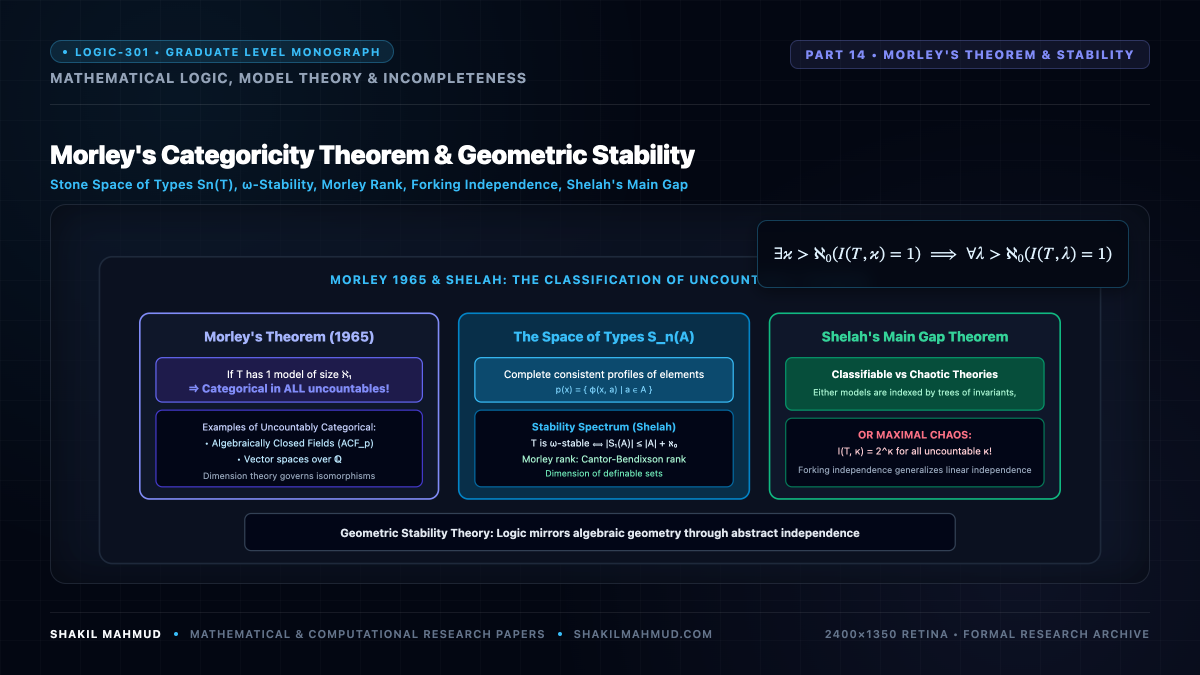
In 1965, a landmark paper by Michael Morley solved one of the deepest open questions in mathematical logic: Łoś’s Conjecture on uncountable categoricity. Morley proved that if a countable first-order theory has a unique model up to isomorphism in one uncountable cardinality, it has a unique model in all uncountable cardinalities. This singular triumph gave birth to modern Classification Theory and Saharon Shelah’s Geometric Stability Theory, revealing that mathematical universes are either governed by geometric dimensions or torn apart by maximal chaos.
1. The Spectrum Problem & Categoricity
A theory $T$ is $kappa$-categorical if it has exactly one model of cardinality $kappa$ up to isomorphism ($I(T, kappa) = 1$).
- In countable infinity ($aleph_0$), theories can behave wildly. For instance, the theory of Dense Linear Orders without Endpoints ($text{DLO}$) is $aleph_0$-categorical (Cantor’s back-and-forth theorem), but has $2^{2^{aleph_0}}$ non-isomorphic models in uncountable cardinals.
- Jerzy Łoś (1954) conjectured that in the uncountable realm, this behavior crystallizes into total rigidity: categoricity in $aleph_1$ must force categoricity across all higher infinities.
Morley’s Categoricity Theorem (1965)
Let $T$ be a countable first-order theory. If $T$ is categorical in some uncountable cardinal $kappa > aleph_0$, then $T$ is categorical in every uncountable cardinal $lambda > aleph_0$.
2. Types and the Stone Space $S_n(T)$
To prove his theorem, Morley had to invent the geometric analysis of types. Given a theory $T$ and a model $mathcal{M}$:
An $n$-type $p(x_1, dots, x_n)$ over a parameter set $A subseteq M$ is a maximal consistent set of formulas with free variables $vec{x}$ and parameters from $A$. Geometrically, a type describes the complete logical profile that an element could possibly possess.
The collection of all $n$-types over $A$ forms a compact, Hausdorff, totally disconnected topological space: the Stone Space $S_n(A)$. Morley quantified the complexity of these spaces by defining the Morley Rank—an ordinal-valued dimension for definable sets analogous to the Krull dimension in algebraic geometry.
3. $omega$-Stability and the Baldwin-Lachlan Theorem
A theory $T$ is $omega$-stable if for every countable set $A$, the space of types $S_1(A)$ is also countable ($|S_1(A)| = aleph_0$). Morley proved that if $T$ is uncountably categorical, it must be $omega$-stable.
In 1971, John Baldwin and Alistair Lachlan completely deconstructed uncountably categorical theories, proving that their models are completely determined by a single integer or cardinal dimension:
The Baldwin-Lachlan Theorem
If $T$ is uncountably categorical, every model $mathcal{M} vDash T$ is a prime elementary extension over a strongly minimal set. The models are classified up to isomorphism by a single cardinal invariant—their dimension:
[
text{dim}(mathcal{M}) in {0, 1, 2, dots, aleph_0, aleph_1, dots}
]
Classic examples of uncountably categorical theories include:
- Vector spaces over a fixed field $F$: Two vector spaces over $F$ are isomorphic if and only if they have the same dimension (cardinality of the basis).
- Algebraically Closed Fields of characteristic $p$ ($text{ACF}_p$): Two models are isomorphic if and only if they have the same transcendence degree over the prime field! Steinitz’s 1910 algebraic classification theorem was revealed to be a direct manifestation of model-theoretic categoricity.
4. Shelah’s Main Gap: Classification vs Chaos
Inspired by Morley, Saharon Shelah embarked on his monumental Classification Theory program (filling over 1,000 pages of foundational mathematics). Shelah sought to determine the number of non-isomorphic models $I(T, kappa)$ for every first-order theory $T$ and cardinal $kappa$. In 1982, Shelah established the Main Gap Theorem:
Shelah’s Main Gap Theorem
For any first-order theory $T$, exactly one of two mutually exclusive alternatives holds:
- Classifiable (Structured): The theory is superstable without the dop (dimensional order property) and has shallow depth. The models in any cardinal $kappa$ can be completely classified and cataloged by invariants (trees of ordinals). The number of models is strictly bounded: $I(T, kappa) < 2^kappa$.
- Chaotic (Non-Classifiable): The theory possesses maximal entropy. The number of models is explosive and uncontrollable:
[
I(T, kappa) = 2^kappa quad text{for all uncountable } kappa!
]
There is no middle ground. Mathematical theories either possess pristine geometric structure, or they plunge into insurmountable combinatorial chaos. Through Forking Independence, Shelah generalized linear independence and algebraic independence into a universal concept of logical orthogonality governing the entire mathematical cosmos.