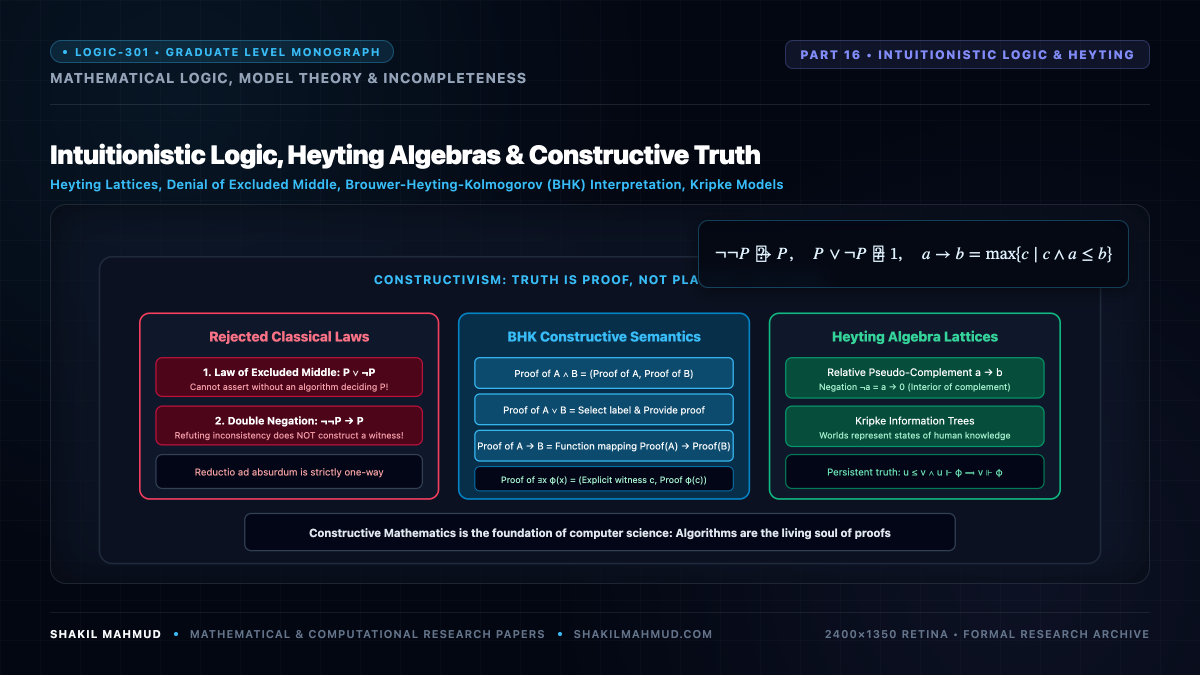
For over two millennia, classical Western logic rested upon a single undisputed axiom formulated by Aristotle: the Law of the Excluded Middle ($P lor neg P$). Every statement must be either true or false; no third possibility exists. In the early twentieth century, Dutch mathematician L.E.J. Brouwer initiated a quiet revolution called Intuitionism. Brouwer asserted that mathematical existence is synonymous with algorithmic constructibility. If you cannot explicitly calculate a witness or decide a proposition, you have no right to assert that it is true or false. Formalized by Arend Heyting in 1930, Intuitionistic Logic has emerged as the true computational logic of modern programming languages and interactive proof assistants.
1. The Rejection of Classical Tautologies
Intuitionistic logic rejects classical principles that assert existence without producing a witness:
- The Law of the Excluded Middle ($text{LEM}$):
[
P lor neg P quad (text{REJECTED!})
]
To assert $P lor neg P$ constructively, one must have an algorithm that either produces a proof of $P$ or a proof that $P$ leads to contradiction ($neg P$). For unsolved mathematical problems (such as the Riemann Hypothesis), humanity currently possesses neither proof. Therefore, asserting that the hypothesis is already either true or false in some detached Platonic void is an empty, unscientific metaphysical claim. - Double Negation Elimination ($text{DNE}$):
[
neg neg P to P quad (text{REJECTED!})
]
Proving that $neg P$ is impossible (a proof by contradiction) merely demonstrates that asserting $neg P$ is inconsistent. It does NOT construct the mathematical object claimed by $P$! Intuitionistic logic accepts $P to neg neg P$, but firmly rejects the reverse implication.
2. The Brouwer-Heyting-Kolmogorov (BHK) Interpretation
In intuitionistic logic, meaning is defined not by truth-tables, but by what constitutes a proof:
The BHK Operational Semantics
- A proof of $A land B$ is a pair $(p, q)$, where $p$ is a proof of $A$ and $q$ is a proof of $B$.
- A proof of $A lor B$ is a pair $(i, p)$, where $i in {0, 1}$: if $i = 0$, $p$ is a proof of $A$; if $i = 1$, $p$ is a proof of $B$. (Explicit witness of which disjunct holds!)
- A proof of $A to B$ is a computable construction (an effective algorithm) $f$ that transforms any proof of $A$ into a proof of $B$.
- A proof of $neg A$ is a proof of $A to bot$ (an algorithm that converts any hypothetical proof of $A$ into a proven contradiction).
- A proof of $exists x , phi(x)$ is a pair $(c, p)$, where $c$ is a concrete mathematical object and $p$ is a proof of $phi(c)$. (Non-constructive existence is abolished!)
- A proof of $forall x , phi(x)$ is an algorithm that, given any domain element $d$, outputs a proof of $phi(d)$.
3. Heyting Algebras (The Algebraic Semantics)
While classical logic corresponds to Boolean algebras, intuitionistic logic corresponds to Heyting Algebras. A Heyting algebra is a bounded lattice $(H, land, lor, to, 0, 1)$ equipped with a binary operation of relative pseudo-complement (implication) $a to b$, defined as the greatest element $c$ such that $c land a le b$:
[
c le (a to b) iff c land a le b
]
The pseudocomplement (negation) is $neg a = (a to 0)$.
Topology as a Heyting Algebra
Let $X$ be a topological space. The collection of all open sets $mathcal{O}(X)$ forms a canonical Heyting algebra where:
- Meet $U land V = U cap V$ (Intersection of open sets).
- Join $U lor V = U cup V$ (Union of open sets).
- Top element is $X$, bottom element is $emptyset$.
- Implication is the interior of the set-theoretic conditional: $U to V = text{Int}((X setminus U) cup V)$.
- Negation is the topological exterior: $neg U = text{Int}(X setminus U)$.
Notice that for an open set $U$, $U lor neg U = U cup text{Int}(X setminus U) neq X$ in general! For example, in $mathbb{R}$, if $U = mathbb{R} setminus {0}$, then $neg U = emptyset$, so $U cup neg U = mathbb{R} setminus {0} neq mathbb{R}$. The Excluded Middle fails geometrically!
4. Kripke Semantics for Intuitionism
In 1965, Saul Kripke introduced relational semantics for intuitionistic logic based on partially ordered information states:
A Kripke model is a triple $mathcal{M} = (W, le, Vdash)$, where $W$ is a set of “states of knowledge” (or research stages) ordered by $le$. If $w le v$, state $v$ represents a future state where more knowledge has been gained.
The defining rule is monotonicity of truth (persistence):
[
w le v text{ and } w Vdash P implies v Vdash P
]
Once a proposition is proved, it remains verified for all eternity. Implication and negation look across all future accessible states:
[
w Vdash A to B iff forall v ge w ; (v Vdash A implies v Vdash B)
]
[
w Vdash neg A iff forall v ge w ; (v notVdash A)
]
Negation means: “In no conceivable future state of knowledge will $A$ ever be verified.” This captures with crystalline precision the evolving nature of human and machine mathematical discovery.