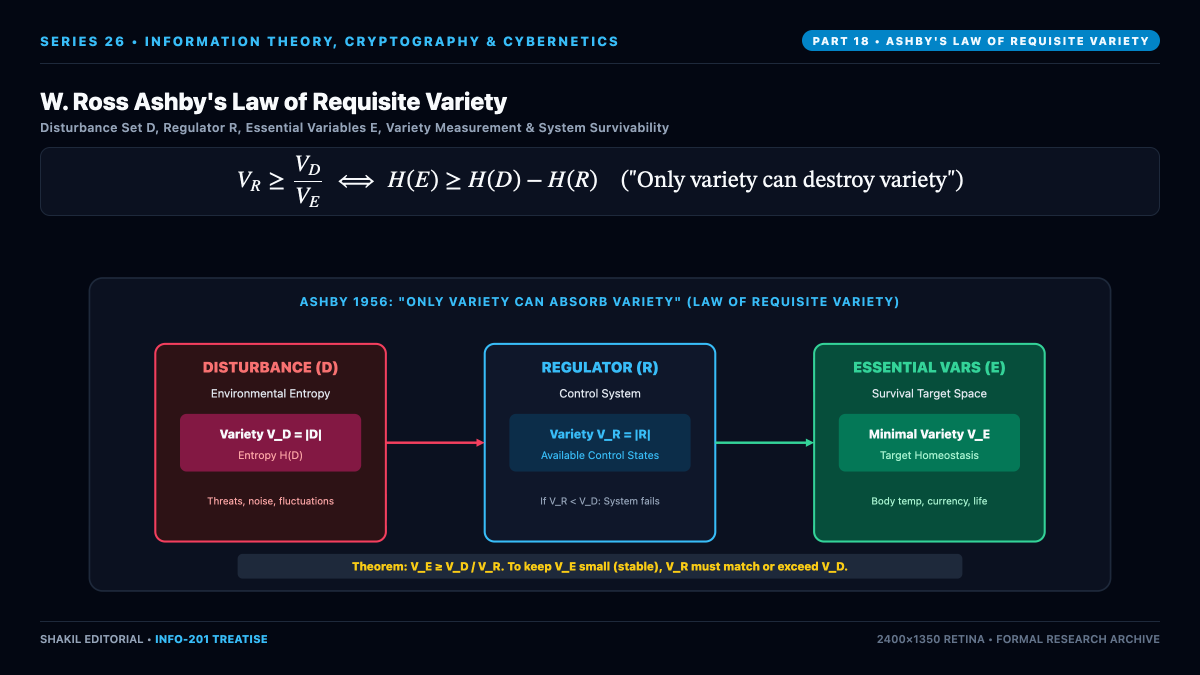
If Claude Shannon formulated the fundamental limit of communication channels and Alan Turing defined the fundamental limit of computation, British cybernetician and psychiatrist William Ross Ashby formulated the fundamental law governing every system of control, management, and governance in the universe. In his 1956 masterwork “An Introduction to Cybernetics,” Ashby proved a mathematical theorem that has come to be known as Ashby’s Law of Requisite Variety, aphoristically stated: “Only variety can destroy variety.” This deceptively simple statement proves that an autonomous agent, biological organism, or machine intelligence can survive in a complex environment only if its internal decision-making repertoire equals or exceeds the environmental disturbances threatening it.
1. Formal Definition of Variety as Information Entropy
Ashby defined the Variety ($V$) of a finite set as the number of distinct elements or states it can assume. If an operational set contains $N$ distinct possible states, its variety is simply $V = N$. When measured logarithmically, variety is precisely Shannon’s Hartley-measure of information:
[
mathcal{V} = log_2(V) = log_2(N) quad text{bits}
]
When the states occur with non-uniform probabilities $p_i$, the variety is generalized to Shannon entropy $mathcal{V} = H(p) = -sum p_i log_2 p_i$. Variety measures the capacity of a system to differentiate, act, and choose.
2. Mathematical Formulation of the Law of Requisite Variety
Consider a cybernetic survival game played between three interacting entities:
- Disturbances ($D$): The set of perturbations originating from the external environment (predators, weather extremes, market crashes, hardware faults, bacterial pathogens). Its variety is $V_D$.
- Regulator ($R$): The active control agent (an animal’s brain, a thermostat, a central bank, an operating system scheduler). Its variety (number of available actions or defense strategies) is $V_R$.
- Essential Variables ($E$): The critical survival parameters that must remain within strict physiological boundaries for the system to survive (blood pH between $7.35$ and $7.45$, core temperature $37^circtext{C}$, financial solvency, buffer occupancy). The outcome state space is $E = f(D, R)$. Its variety is $V_E$.
The goal of regulation is to keep the essential variables $E$ tightly confined to an acceptable, minimal subset $E_{text{safe}}$: that is, to make $V_E$ as small as possible!
Ashby’s Theorem:
Ashby proved that the variety of outcomes in the essential variables $V_E$ is mathematically lower-bounded by:
[
V_E ge frac{V_D}{V_R}
]
In logarithmic informational entropy terms, for any deterministic channel:
[
H(E) ge H(D) – H(R)
]
Rearranging this inequality yields the immortal Law of Requisite Variety:
[
V_R ge frac{V_D}{V_E} iff H(R) ge H(D) – H(E)
]
If you desire complete, perfect stability in your vital survival parameters—meaning $V_E = 1$ ($H(E) = 0$, zero variation in essential outcomes)—the inequality reduces strictly to:
[
V_R ge V_D iff H(R) ge H(D)
]
The variety of the regulator must be at least as large as the variety of the disturbances!
A regulator cannot protect against a disturbance it cannot distinguish or counteract. If an environment throws $1,000$ distinct threats at a system, and the system’s controller can only execute $10$ distinct defensive responses, the remaining $990$ states of entropy will inevitably breach the system, driving $V_E$ out of its safe homeostatic envelope.
3. Universal Applications: From Biology to Artificial Intelligence
Ashby’s law is a universal physical conservation principle governing complexity:
- The Mammalian Immune System: Pathogens exhibit immense combinatorial variety ($V_D$). To survive, the adaptive immune system must generate an equally staggering variety of antibodies through V(D)J genetic recombination, matching $V_R ge V_D$.
- Autonomous Vehicle Driving: An AI driving in city traffic faces pedestrians, cyclists, ice patches, and unpredictable motorists. A simple rule-based system fails because its variety is tiny. Deep neural networks with billions of parameters succeed precisely because their high-dimensional parameter space provides the requisite variety ($V_R$) to absorb the chaotic manifold of traffic entropy.
- Software Architecture & Fault Tolerance: In planetary distributed systems, chaotic hardware failures (network partitions, bit flips, rack outages) represent $V_D$. Resiliency frameworks (such as Kubernetes operators, Paxos state machines, and Raft consensus) succeed only when their state-transition graphs possess sufficient variety to absorb all possible asynchronous interleavings.
Ashby proved that governance, survival, and intelligence are not matters of physical force; they are strict games of information variety matching.