If Gödel’s Incompleteness Theorems established that mathematics cannot certify itself from within, where must thought go to find higher truth? The answer lies in Large Cardinal Axioms. Postulating the existence of transfinite infinities so colossal that their existence cannot be proven within $text{ZFC}$, the large cardinal hierarchy provides an astonishingly linear, one-dimensional ladder of consistency strength. Through non-trivial elementary embeddings $j: V to M$, these titanic cardinals reach down from the transfinite heavens to calibrate undecidable propositions on the real numbers.
1. The Inaccessible Cardinal
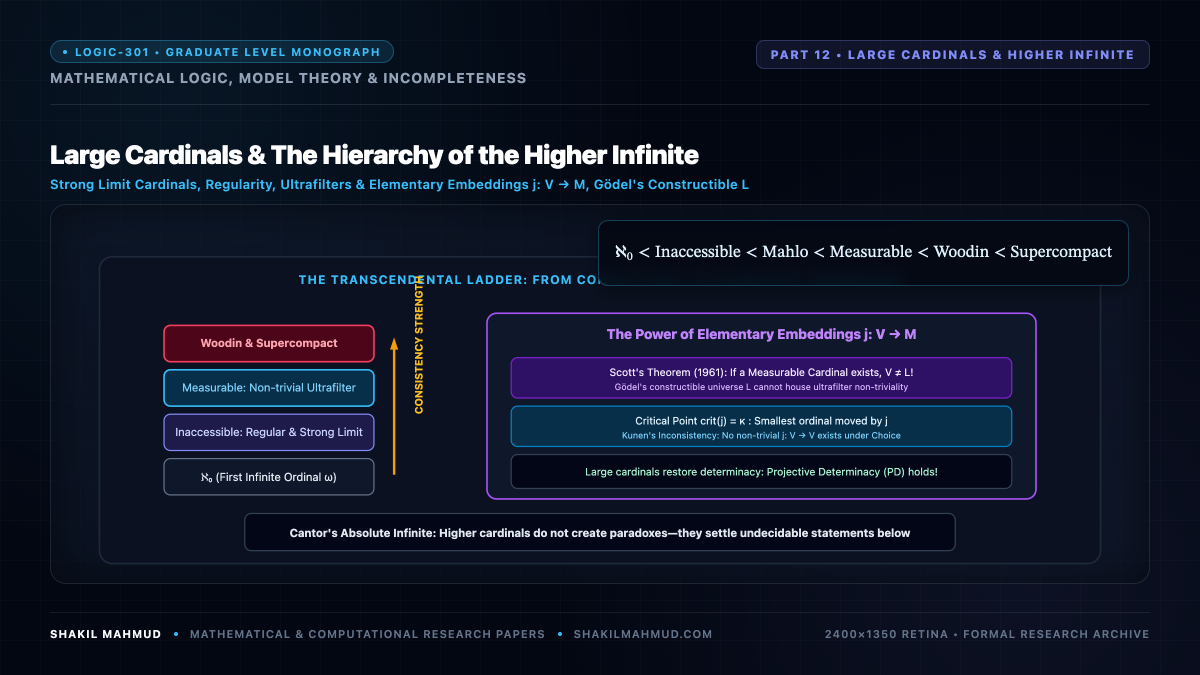
The base rung of the large cardinal ladder is the Inaccessible Cardinal (Felix Hausdorff, 1908). A cardinal $kappa > aleph_0$ is strongly inaccessible if:
- Regular: $text{cf}(kappa) = kappa$ (It cannot be reached as the union of fewer than $kappa$ sets of cardinality strictly less than $kappa$).
- Strong Limit: For all $lambda < kappa$, $2^lambda < kappa$ (The power set operation cannot escape $kappa$).
Why can $text{ZFC}$ never prove that an inaccessible cardinal exists?
The Inaccessibility Theorem
If $kappa$ is strongly inaccessible, then the cumulative stage $V_kappa$ is a genuine set model of all the axioms of $text{ZFC}$ ($V_kappa vDash text{ZFC}$).
If $text{ZFC}$ could prove the existence of an inaccessible cardinal $kappa$, $text{ZFC}$ would prove that it has a model $V_kappa$, which would allow $text{ZFC}$ to prove its own consistency $text{Con}(text{ZFC})$—directly violating Gödel’s Second Incompleteness Theorem! Thus, the existence of an inaccessible cardinal is strictly stronger than $text{ZFC}$.
2. Measurable Cardinals & Ultrafilters
In 1930, Stanislaw Ulam introduced Measurable Cardinals while investigating measure theory. A cardinal $kappa$ is measurable if there exists a non-trivial, ${0, 1}$-valued, $kappa$-additive measure on the power set $mathcal{P}(kappa)$.
In modern logic, this is formulated via ultrafilters: $kappa$ is measurable if there exists a non-principal $kappa$-complete ultrafilter $mathcal{U}$ on $kappa$. Taking the ultrapower of the universe $V$ modulo $mathcal{U}$ produces an elementary embedding:
[
j: V to M cong text{Ult}(V, mathcal{U})
]
where $M$ is a transitive class model. The smallest ordinal moved by $j$ is called the critical point: $text{crit}(j) = kappa$. The embedding $j$ preserves all truth ($V vDash phi iff M vDash j(phi)$), yet stretches the transfinite fabric: $kappa < j(kappa)$.
3. Scott’s Theorem: The Death of $V = L$ (1961)
In 1938, Gödel had conjectured that his constructible universe $L$ might be the true universe of mathematics ($V = L$). In 1961, Dana Scott proved a stunning theorem:
Scott’s Theorem
If there exists a measurable cardinal, then $V neq L$.
Gödel’s constructible universe $L$ is too narrow and rigid to contain a non-principal $kappa$-complete ultrafilter. If measurable cardinals exist, the mathematical universe is infinitely richer and more expansive than $L$.
4. The Transfinite Hierarchy: Woodin and Supercompact
Above measurable cardinals lies a breathtaking pantheon of higher infinities:
[
text{ZFC} < text{Inaccessible} < text{Mahlo} < text{Measurable} < text{Strong} < text{Woodin} < text{Supercompact} < text{Huge}
]
- Woodin Cardinals (Hugh Woodin): Defined via elementary embeddings that capture power sets up to arbitrary stages. Woodin cardinals are the exact consistency strength required to settle the theory of the projective real numbers.
- Supercompact Cardinals: Cardinals $kappa$ such that for every $lambda ge kappa$, there exists an elementary embedding $j: V to M$ with $text{crit}(j) = kappa$ and $M^lambda subseteq M$ (closed under arbitrary $lambda$-sequences).
5. Kunen’s Inconsistency Theorem (1971)
Could one postulate an elementary embedding from the entire universe into itself: $j: V to V$? In 1971, Kenneth Kunen proved that the ultimate limit had been reached:
Kunen’s Inconsistency Theorem
Under the Axiom of Choice ($text{ZFC}$), there exists no non-trivial elementary embedding $j: V to V$.
Kunen applied the Erdős-Hajnal combinatorial partition calculus to show that the critical sequence $kappa_0 = kappa, kappa_{n+1} = j(kappa_n)$ reaches a supremum $lambda = sup_n kappa_n$ where $j(lambda) = lambda$, creating an irresolvable contradiction with the well-ordering of $mathcal{P}(lambda)$.
6. Projective Determinacy: Healing Incompleteness Below
The ultimate justification for large cardinals is not mere speculation about the infinite; it is their profound power to settle concrete mathematical questions about the real numbers $mathbb{R}$.
In classical descriptive set theory, questions about projective sets of real numbers (e.g., whether all projective sets are Lebesgue measurable) were undecidable in $text{ZFC}$. In 1988, Donald Martin, John Steel, and Hugh Woodin proved:
[
text{Infinitely many Woodin Cardinals} implies text{Projective Determinacy (PD)}
]
Under Projective Determinacy, every projective set of real numbers is Lebesgue measurable, possesses the Baire property, and satisfies the perfect set property. The higher infinite does not destabilize mathematics; it brings complete structural harmony and clarity to the continuum below.