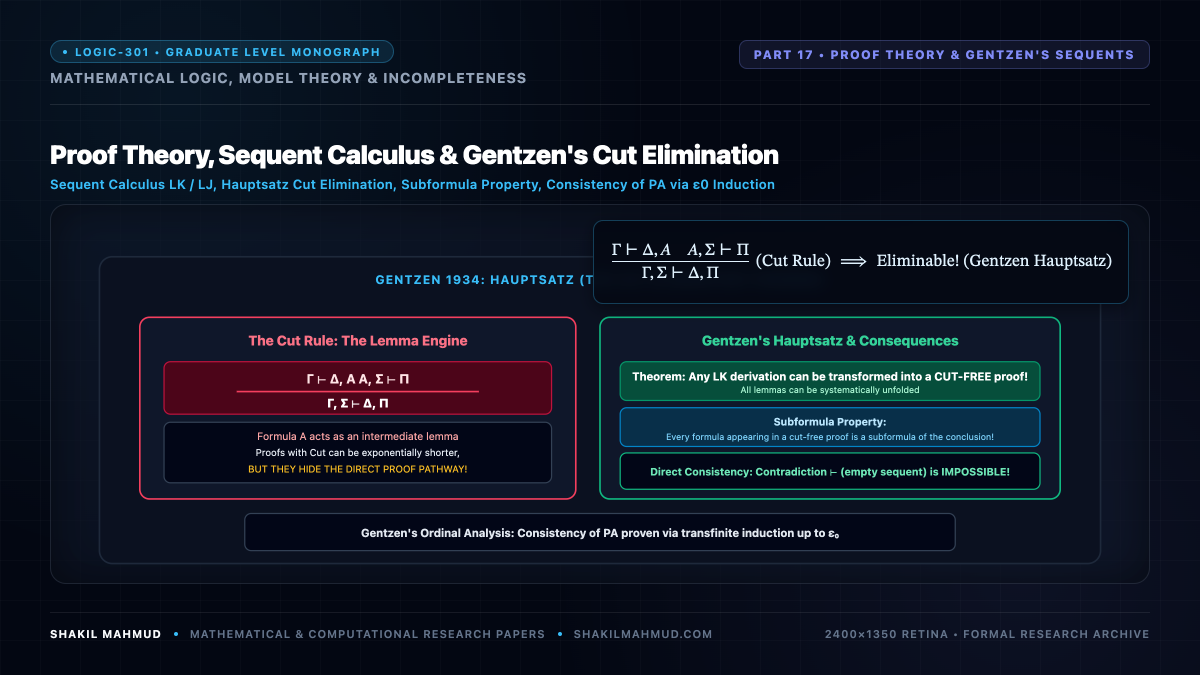
In 1934, German mathematician Gerhard Gentzen revolutionized mathematical logic by shifting the analytical spotlight from what is proved to the geometry of proof itself. Inventing both Natural Deduction and the Sequent Calculus ($mathbf{LK}$ and $mathbf{LJ}$), Gentzen established the Cut Elimination Theorem (Hauptsatz)—widely considered the deepest structural theorem in pure proof theory. By demonstrating that all mathematical lemmas can be systematically eliminated from formal proofs, Gentzen provided a constructive consistency proof for Peano Arithmetic using transfinite ordinal induction up to $varepsilon_0$.
1. The Sequent Calculus $mathbf{LK}$
In Hilbert-style systems, proofs are unstructured linear chains of formulas. Gentzen introduced the concept of a sequent:
[
Gamma vdash Delta
]
where $Gamma = langle A_1, dots, A_k rangle$ (the antecedent) and $Delta = langle B_1, dots, B_m rangle$ (the succedent) are finite multisets or sequences of formulas. Semantically, a sequent asserts: “The conjunction of all formulas in $Gamma$ implies the disjunction of all formulas in $Delta$.”
[
bigwedge_{i=1}^k A_i implies bigvee_{j=1}^m B_j
]
If $Gamma$ is empty, the antecedent is True ($1$); if $Delta$ is empty, the succedent is False ($0$). Thus, the empty sequent $vdash$ represents a naked, unadulterated contradiction ($bot$).
2. Inference Rules and The Cut Rule
In $mathbf{LK}$, every logical connective has symmetric left and right introduction rules (e.g., $landtext{L}_1, landtext{L}_2, landtext{R}, lortext{L}, lortext{R}_1, lortext{R}_2, totext{L}, totext{R}$). But presiding above them all is the master inference engine—the Cut Rule:
The Cut Rule
[
frac{Gamma vdash Delta, A quad A, Sigma vdash Pi}{Gamma, Sigma vdash Delta, Pi} quad (text{Cut})
]
The Cut rule is the formalization of the lemma in human mathematics. In the left premise, we prove an intermediate theorem $A$. In the right premise, we use $A$ as an assumption to derive $Pi$. The Cut rule combines the derivations and “cuts out” the intermediate lemma $A$, yielding the net result. Almost all mathematical proofs written by humans rely heavily on the Cut rule to prevent proofs from expanding into astronomical lengths.
3. Gentzen’s Hauptsatz (Cut Elimination Theorem)
In his 1934 masterpiece, Gentzen proved the ultimate structural property of first-order deduction:
Gentzen’s Cut Elimination Theorem (Hauptsatz)
Any derivation in the sequent calculus $mathbf{LK}$ (classical) or $mathbf{LJ}$ (intuitionistic) can be transformed via an explicit, algorithmic reduction into a CUT-FREE derivation of the exact same end-sequent!
Proof Idea: Gentzen defined an ordinal measure of proof complexity combining the degree of the cut formula (its syntactic length) and the rank of the cut (how far up the proof tree the cut occurs). He then provided explicit local rewrite rules that push the Cut rule upwards past logical connectives, replacing a complex cut on $A land B$ or $A to B$ with simpler cuts on its subformulas $A$ and $B$, until the cut is eliminated entirely at the identity axioms.
4. The Subformula Property: The Anatomy of Pure Reason
The elimination of the Cut rule unleashes a miraculous consequence:
The Subformula Property
In a cut-free derivation, every formula occurring in every sequent is a subformula of the final conclusion sequent!
When lemmas are present, a proof of $2 + 2 = 4$ could theoretically wander through the theory of complex manifolds or transfinite cardinals. But in a cut-free proof, no alien concepts are permitted to enter. The proof moves strictly by dissecting and assembling the components of the goal sentence.
Immediate Corollary: Absolute Syntactic Consistency
Can $mathbf{LK}$ derive a contradiction? A contradiction is the empty sequent $vdash$. If a proof of $vdash$ exists, by Gentzen’s Hauptsatz there must exist a cut-free proof of $vdash$. But in a cut-free proof, every formula must be a subformula of the conclusion. Since $vdash$ contains no formulas whatsoever, no rule could have produced it! Thus, a derivation of contradiction is structurally impossible. $mathbf{LK}$ is unconditionally consistent.
5. Gentzen’s Consistency of Peano Arithmetic via $varepsilon_0$
Gödel’s Second Incompleteness Theorem proved that $text{PA}$ cannot prove its own consistency using finitary methods expressible within $text{PA}$. How, then, did Gentzen prove the consistency of Peano Arithmetic in 1936?
Gentzen extended his cut-elimination algorithm to arithmetic with the induction schema. Because induction creates unbounded cycles, cut elimination does not terminate via ordinary natural number induction. Gentzen showed that the proof-reduction algorithm terminates if and only if one uses transfinite ordinal induction up to the Cantor ordinal $varepsilon_0$:
[
varepsilon_0 = sup { omega, omega^omega, omega^{omega^omega}, dots } = omega^{omega^{omega^{cdot^{cdot^omega}}}}
]
Gentzen assigned an ordinal $alpha < varepsilon_0$ to each arithmetic proof tree. Each reduction step strictly decreases the ordinal: $alpha_{n+1} < alpha_n$. Since the ordinals below $varepsilon_0$ are well-ordered (there can be no infinite descending sequence of ordinals), the reduction must terminate in a cut-free proof in a finite number of steps!
Gentzen did not contradict Gödel: $text{PA}$ cannot prove transfinite induction up to $varepsilon_0$. Gentzen precisely calibrated the exact mathematical gap: the consistency of elementary arithmetic is mathematically equivalent to the well-ordering of $varepsilon_0$. This inaugurated modern Ordinal Analysis, measuring the epistemic strength of mathematical theories by their proof-theoretic ordinals.