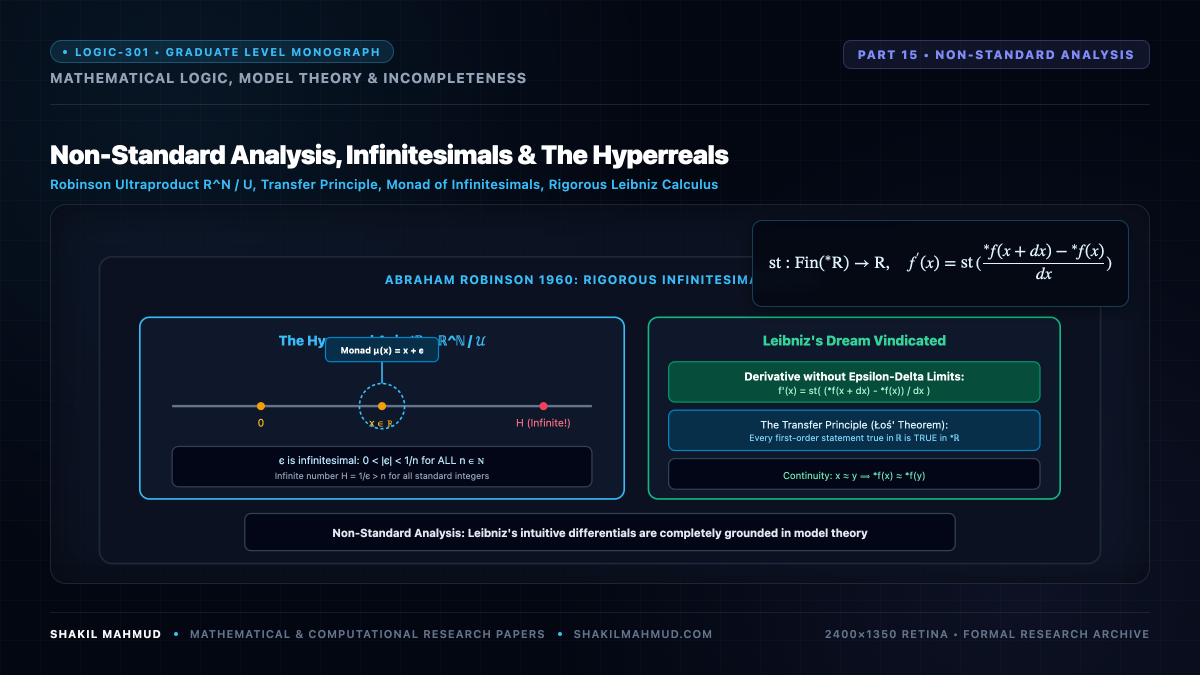
When Gottfried Wilhelm Leibniz and Sir Isaac Newton co-invented the calculus in the seventeenth century, they relied intuitively on mysterious quantities called infinitesimals—numbers that are non-zero, yet smaller than any assignable positive fraction. For over two centuries, mathematicians derided infinitesimals as logical absurdities (“ghosts of departed quantities,” in Bishop Berkeley’s scathing phrase), eventually replacing them in the nineteenth century with Weierstrass’s cumbersome $epsilon$-$delta$ limits. In 1960, Abraham Robinson achieved a miracle: using model theory and ultraproducts, he proved that infinitesimals are 100% mathematically rigorous, constructing the field of Hyperreal Numbers ${}^*mathbb{R}$.
1. The Construction of the Hyperreals ${}^*mathbb{R}$
How does one construct genuine infinitesimals without creating algebraic contradictions? Robinson used an ultrapower construction modulo a free ultrafilter $mathcal{U}$ on the natural numbers $mathbb{N}$:
- Let $mathbb{R}^mathbb{N}$ be the ring of all infinite sequences of real numbers: $vec{x} = (x_0, x_1, x_2, dots)$ with $x_n in mathbb{R}$.
- Let $mathcal{U}$ be a non-principal (free) ultrafilter on $mathbb{N}$. An ultrafilter acts as a generalized voting majority: for any subset $A subseteq mathbb{N}$, either $A in mathcal{U}$ (“$A$ has full measure”) or $mathbb{N} setminus A in mathcal{U}$ (“$A$ is negligible”).
- Define an equivalence relation $sim$ on sequences:
[
(x_n) sim (y_n) iff { n in mathbb{N} mid x_n = y_n } in mathcal{U}
] - The Hyperreal Field is the quotient:
[
{}^*mathbb{R} = mathbb{R}^mathbb{N} / mathcal{U}
]
Because $mathcal{U}$ is an ultrafilter, ${}^*mathbb{R}$ is not merely a ring; by abstract algebra, it is a genuine ordered field containing the real numbers as a subfield via the constant embedding $r mapsto [(r, r, r, dots)]$.
2. Infinitesimals and Infinite Numbers
The hyperreal field ${}^*mathbb{R}$ is a non-Archimedean field containing exotic elements that do not exist in standard $mathbb{R}$:
Classification of Hyperreal Elements
- Infinitesimal ($epsilon$): An element $epsilon in {}^*mathbb{R}$ such that $|epsilon| < r$ for every positive standard real number $r in mathbb{R}^+$.
Concrete Construction: The sequence $epsilon = [(1, 1/2, 1/3, 1/4, dots, 1/n, dots)]$. For any fixed $r > 0$, the set of indices where $1/n < r$ contains all but finitely many integers, hence belongs to $mathcal{U}$. Thus $0 < epsilon < r$! - Infinite Number ($H$): An element $H in {}^*mathbb{R}$ such that $H > r$ for every standard real $r in mathbb{R}$. If $epsilon$ is a non-zero infinitesimal, then $H = 1/epsilon$ is an infinite hyperreal integer!
Concrete Construction: $H = [(1, 2, 3, 4, dots, n, dots)]$. - Finite (Appreciable) Hyperreals: Numbers that are not infinite. Every finite hyperreal $x$ lives in a unique monad $mu(r) = { x in {}^*mathbb{R} mid x – r text{ is infinitesimal} }$.
3. The Standard Part Map ($text{st}$)
Every finite hyperreal number $x in text{Fin}({}^*mathbb{R})$ can be decomposed uniquely into a standard real part plus an infinitesimal perturbation:
[
x = r + epsilon, quad text{where } r in mathbb{R} text{ and } epsilon approx 0
]
The projection map $text{st}: text{Fin}({}^*mathbb{R}) to mathbb{R}$, which discards the infinitesimal tail $epsilon$, is called the Standard Part Map (or shadow):
[
text{st}(x) = r iff x approx r
]
4. The Transfer Principle (Łoś’ Theorem)
The supreme power of Non-Standard Analysis is the Transfer Principle, which follows directly from Jerzy Łoś’s Fundamental Theorem of Ultraproducts (1955):
The Transfer Principle
Any first-order sentence $phi$ in the language of real analysis is true in the standard real numbers $mathbb{R}$ if and only if its natural extension ${}^*phi$ is true in the hyperreal numbers ${}^*mathbb{R}$:
[
mathbb{R} vDash phi iff {}^*mathbb{R} vDash {}^*phi
]
The Transfer Principle means that whatever algebraic laws govern standard arithmetic (commutativity, associativity, field axioms, intermediate value properties) hold identically in the hyperreals.
5. Leibniz Calculus Made Rigorous
With ${}^*mathbb{R}$ and $text{st}$, Robinson eliminated the entire cumbersome apparatus of $epsilon$-$delta$ limits from calculus, restoring Leibniz’s direct, intuitive definitions:
1. Continuity
A standard function $f: mathbb{R} to mathbb{R}$ is continuous at $x_0$ if and only if:
[
forall x in {}^*mathbb{R}: quad x approx x_0 implies {}^*f(x) approx f(x_0)
]
Infinitesimally close inputs produce infinitesimally close outputs! No epsilons, no deltas.
2. The Derivative
The derivative of $f$ at $x$ is simply the standard part of the difference quotient for any non-zero infinitesimal $dx$:
[
f'(x) = text{st}left( frac{{}^*f(x + dx) – {}^*f(x)}{dx} right)
]
Example: Let $f(x) = x^2$. For non-zero infinitesimal $dx$:
[
frac{(x + dx)^2 – x^2}{dx} = frac{x^2 + 2x , dx + (dx)^2 – x^2}{dx} = 2x + dx
]
Taking the standard part:
[
text{st}(2x + dx) = 2x
]
The infinitesimal $dx$ is not discarded arbitrarily as zero; it is precisely projected by the standard part homomorphism! Leibniz’s 300-year-old intuition was completely vindicated by twentieth-century model theory.