Across the twenty treatises of this series, we have journeyed from Claude Shannon’s 1948 mathematical foundations of telegraph wires to the non-linear Galois fields of AES, the quantum limits of Holevo’s bound, and the regulatory cybernetics of living homeostasis. Now, we arrive at the grandest intellectual synthesis of all: The Computational Nature of Reality. For centuries, Western physics viewed the universe through the lens of material particles acting under dynamical forces, which subsequently evolved into the Einsteinian continuum of curved spacetime and quantum fields. In the closing decades of the twentieth century, a radical ontological inversion took place, championed by John Archibald Wheeler and Rolf Landauer: Information is not a mathematical abstraction invented by human minds to describe reality; Information is the fundamental physical fabric out of which reality is constructed.
1. Rolf Landauer’s Thesis: “Information is Physical”
In 1961, IBM Fellow Rolf Landauer published a foundational paper in the IBM Journal of Research and Development titled “Irreversibility and Heat Generation in the Computing Process.” Before Landauer, computation was treated as an abstract mathematical process existing in Platonic isolation from thermodynamics.
Landauer proved that because information is always instantiated in physical states—a voltage on a capacitor, a spin on an atom, a transcript on RNA—information processing is governed by the laws of physics. Specifically, Landauer analyzed the thermodynamic cost of logically irreversible operations (such as the binary RESET or bit erasure operation, where a bit in unknown state ${0, 1}$ is forced to $0$).
Landauer’s Principle:
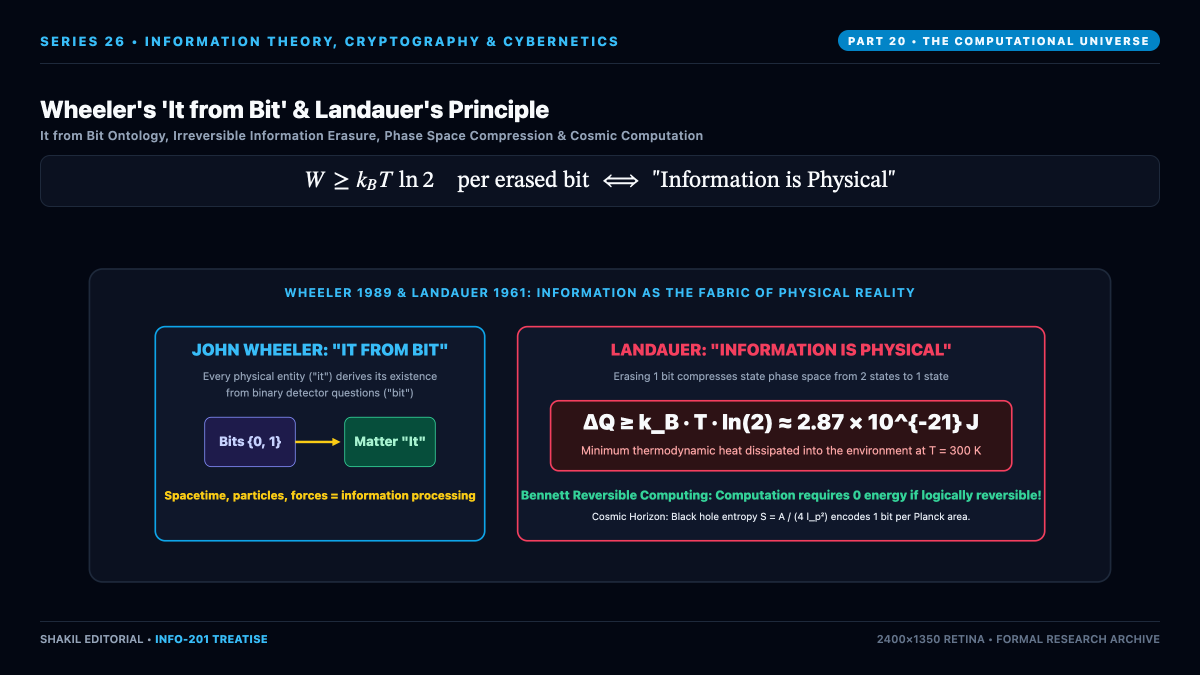
Erasing one bit of information compresses the physical phase space of the computer by a factor of 2 (reducing the microstate volume from $W_1 = 2$ to $W_2 = 1$). By Boltzmann’s formula $Delta S = k_B ln(W_2 / W_1) = -k_B ln 2$, the computer’s internal entropy decreases. To prevent violation of the Second Law of Thermodynamics ($Delta S_{text{total}} ge 0$), this entropy must be dissipated into the surrounding thermal reservoir as heat:
[
W ge k_B T ln 2 approx 2.87 times 10^{-21} text{ Joules} quad (text{at room temperature } T = 300 text{ K})
]
Landauer established that erasing information has a mandatory thermodynamic energy cost. You cannot destroy a bit without heating up the universe.
2. Charles Bennett & Reversible Computing
If erasing a bit requires $k_B T ln 2$, does all computation require energy? In 1973, Charles Bennett at IBM made a startling discovery: Logical reversibility implies thermodynamic reversibility!
If a computer executes only reversible logical gates (such as the Fredkin gate, Toffoli gate, or quantum unitary operations) where every operation can be computed backwards with zero loss of intermediate information, the computation can be performed with zero theoretical minimum energy dissipation ($W = 0$). Modern quantum computers are fundamentally reversible machines, inheriting Bennett’s zero-dissipation architecture.
3. John Archibald Wheeler’s “It from Bit” Ontology
In 1989, legendary physicist John Archibald Wheeler (the mentor of Richard Feynman and pioneer of black hole physics) summarized his lifetime of insight into the physical cosmos with his famous philosophical manifesto: “It from Bit.”
“It from bit. Otherwise put, every ‘it’—every particle, every field of force, even the spacetime continuum itself—derives its function, its meaning, its very existence entirely—even if in some contexts indirectly—from the apparatus-elicited answers to yes-or-no questions, binary choices, bits. All things physical are information-theoretic in origin and that this is a participatory universe.”
Wheeler argued that when we observe an electron or measure a gravitational wave, the physical particle does not exist in an objective classical sense prior to measurement. What exists fundamentally are binary measurement interactions—bits—and what we perceive as “matter,” “mass,” and “spacetime” are macroscopic informational holograms computed by the quantum universe.
The definitive mathematical proof of Wheeler’s “It from Bit” emerged from black hole thermodynamics. Jacob Bekenstein and Stephen Hawking proved that the maximum entropy $S_{BH}$ that can ever be packed into a region of space of surface area $A$ is proportional not to its volume, but strictly to its surface area measured in Planck units ($l_p = sqrt{frac{hbar G}{c^3}} approx 1.6 times 10^{-35} text{ m}$):
[
S_{BH} = frac{k_B c^3 A}{4 G hbar} = frac{k_B A}{4 l_p^2}
]
In terms of Shannon bits ($S / (k_B ln 2)$):
[
I_{text{max}} = frac{A}{4 l_p^2 ln 2} approx 1 text{ bit per } 4 text{ Planck areas}
]
This Holographic Principle (formulated by ‘t Hooft and Susskind) proves that the physical universe has a finite information storage capacity. Spacetime itself is an error-correcting quantum code emerging from quantum entanglement.
4. Epistemological Epilogue: The Horizon of Information
We stand at the threshold of a computational century. From Claude Shannon’s mathematical definition of communication to the post-quantum lattices of cybersecurity, the feedback loops of autonomous cybernetics, and the holographic fabric of quantum gravity, information theory has emerged as the unifying grammar of reality.
We are not detached observers walking across a classical mechanical stage. We are informational patterns—nodes in a vast cosmic network—measuring, encoding, and computing the universe into existence, bit by irreversible bit.