In 1878, Georg Cantor proposed the most celebrated conjecture in set theory: the Continuum Hypothesis ($text{CH}$). Cantor asserted that there exists no intermediate infinity between the countable integers $aleph_0$ and the continuous real numbers $2^{aleph_0}$; in modern symbols, $2^{aleph_0} = aleph_1$. For nearly a century, the greatest minds attempted to prove or refute it. The resolution was unprecedented: Kurt Gödel (1938) and Paul Cohen (1963) proved that the Continuum Hypothesis is entirely independent of the axioms of set theory. To prove this, Cohen invented Forcing—the most powerful technique in modern mathematical logic.
1. Cantor’s Continuum Hypothesis
Cantor proved via his famous diagonal argument that the real numbers $mathbb{R} cong mathcal{P}(mathbb{N})$ cannot be put into one-to-one correspondence with the natural numbers $mathbb{N}$. Therefore:
[
|mathbb{N}| = aleph_0 < |mathbb{R}| = 2^{aleph_0}
]
The smallest infinite cardinal strictly greater than $aleph_0$ is denoted $aleph_1$. Cantor conjectured:
[
2^{aleph_0} = aleph_1 quad (text{The Continuum Hypothesis, CH})
]
Generalized Continuum Hypothesis ($text{GCH}$) extends this to all transfinite cardinals: $2^{aleph_alpha} = aleph_{alpha+1}$. When David Hilbert presented his famous 23 unsolved mathematical problems at the 1900 International Congress of Mathematicians in Paris, the Continuum Hypothesis took pride of place as Problem #1.
2. Gödel’s Half: The Constructible Universe $L$ (1938)
Kurt Gödel took the first decisive step by proving that $text{CH}$ cannot be disproved from $text{ZFC}$:
[
text{Con}(text{ZFC}) implies text{Con}(text{ZFC} + text{CH})
]
Gödel constructed an “inner model” of set theory, the Constructible Universe $L$. While von Neumann’s $V_{alpha+1} = mathcal{P}(V_alpha)$ takes all arbitrary subsets, Gödel restricted the construction strictly to first-order definable subsets:
[
L_0 = emptyset, quad L_{alpha+1} = text{Def}(L_alpha), quad L_lambda = bigcup_{beta < lambda} L_beta
]
In $L$, no “wild” or non-definable sets exist. Gödel proved that $L$ satisfies all axioms of $text{ZFC}$, and within $L$, both the Axiom of Choice and the Generalized Continuum Hypothesis are universally true ($L vDash text{ZFC} + text{GCH}$). Thus, $text{CH}$ is consistent with $text{ZFC}$.
3. Cohen’s Triumph: The Method of Forcing (1963)
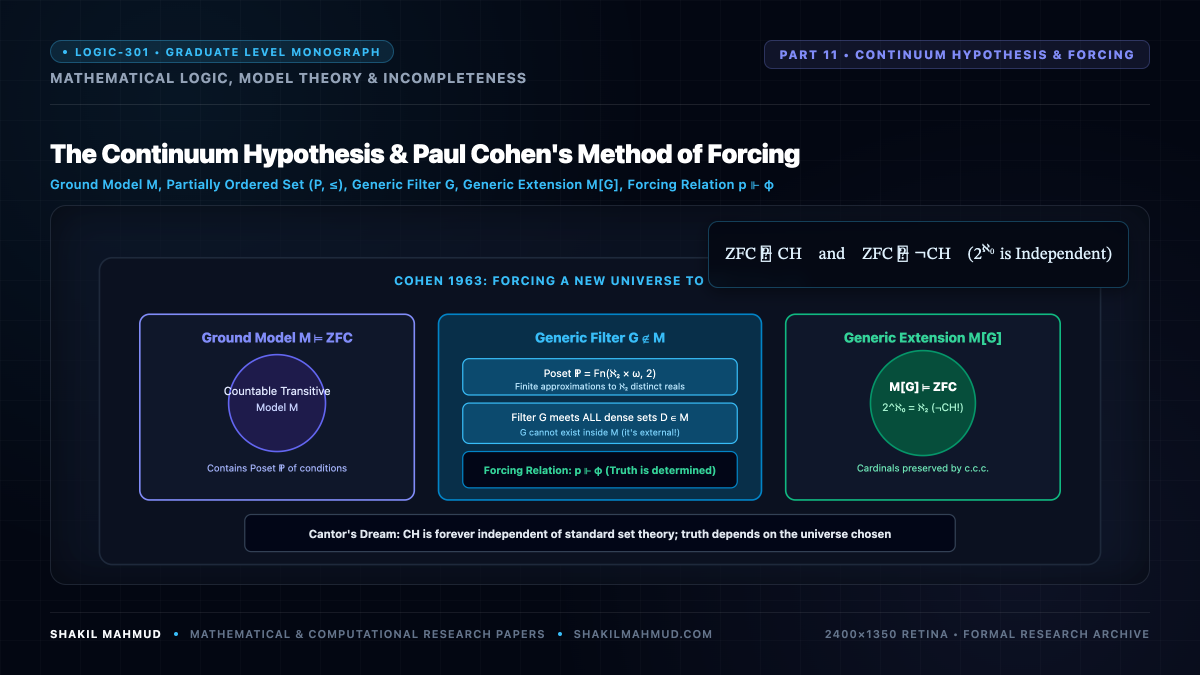
To prove that $text{CH}$ cannot be proved, Paul Cohen had to construct a model of $text{ZFC}$ in which $2^{aleph_0} ge aleph_2$. But by the Downward Löwenheim-Skolem theorem, any model contains reals; how can one surgically insert $aleph_2$ new real numbers into an existing universe without collapsing the cardinal hierarchy?
Cohen invented the concept of Forcing:
Step 1: The Ground Model $M$
Begin with a countable transitive model $M vDash text{ZFC}$.
Step 2: The Partially Ordered Set (Poset) $mathbb{P}$
Define a poset $(mathbb{P}, le)$ inside $M$ whose elements represent finite approximations of the new objects we wish to add. To add $aleph_2$ new reals, let $mathbb{P} = text{Fn}(aleph_2 times omega, 2)$, the set of all finite partial functions from $aleph_2 times omega$ into ${0, 1}$. A condition $p in mathbb{P}$ is an agreement about finitely many bits of the new real numbers.
Step 3: The Generic Filter $G$
A subset $G subseteq mathbb{P}$ is a filter if it is compatible and upward-closed. It is $M$-generic if it intersects every dense subset $D subseteq mathbb{P}$ that belongs to $M$.
Because $M$ is countable, the number of dense subsets in $M$ is countable. By a simple diagonal argument, a generic filter $G$ exists in the outside world, but $G notin M$! The filter $G$ weaves all finite approximations together into $aleph_2$ complete, mutually distinct infinite binary sequences.
Step 4: The Generic Extension $M[G]$
Adjoin $G$ to $M$ by interpreting names: $M[G] = { tau_G mid tau in M text{ is a } mathbb{P}text{-name} }$.
4. The Forcing Relation $p Vdash phi$
Cohen’s brilliant technical discovery was that truth in the unseen universe $M[G]$ is completely controlled by conditions $p in mathbb{P}$ inside the ground model $M$ through the forcing relation ($p Vdash phi$):
[
M[G] vDash phi iff exists p in G ; (p Vdash phi)
]
Furthermore, Cohen proved that $mathbb{P}$ satisfies the countable chain condition (c.c.c.), which guarantees that no cardinals are collapsed: $aleph_1^M = aleph_1^{M[G]}$ and $aleph_2^M = aleph_2^{M[G]}$.
In $M[G]$, the $aleph_2$ new reals are distinct, establishing that:
[
M[G] vDash 2^{aleph_0} ge aleph_2 quad (text{Hence, } neg text{CH}!)
]
The Independence of the Continuum Hypothesis
The Continuum Hypothesis is independent of $text{ZFC}$: it can neither be proven nor disproven from the standard axioms of set theory.
Cohen was awarded the Fields Medal in 1966—the only Fields Medal ever awarded for work in mathematical logic.