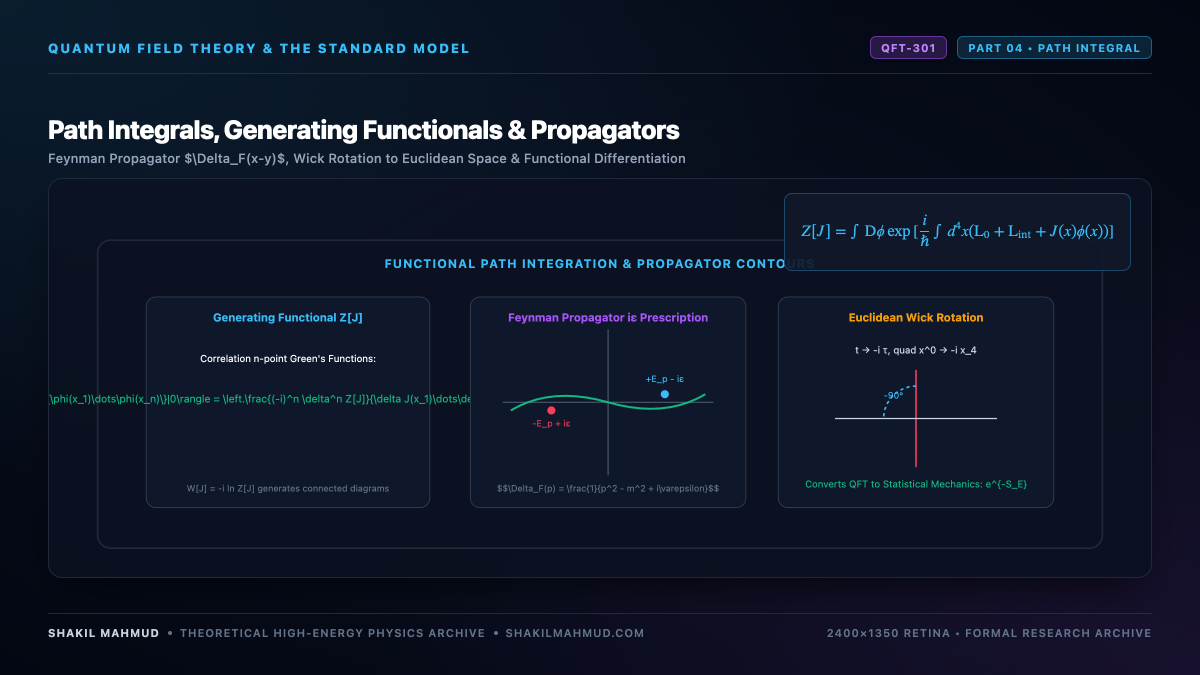
While canonical operator quantization provides direct algebraic insight into particle creation and annihilation, it obscures manifest Lorentz covariance through equal-time slicing. In 1948, Richard Feynman revolutionized quantum physics by formulating the Functional Path Integral. Rather than following a single classical trajectory, a quantum system explores every conceivable field configuration across spacetime simultaneously, each weighted by a complex quantum phase factor $e^{i S[phi]/hbar}$. This functional formulation provides the mathematical bedrock for modern non-Abelian gauge theories, instantons, and non-perturbative lattice physics.
1. The Path Integral Formulation of Quantum Fields
Generalizing Feynman’s single-particle path integral $int mathcal{D}x(t) e^{iS/hbar}$ to an infinite-dimensional field continuum $phi(x)$, the vacuum-to-vacuum transition amplitude in the presence of an external classical source $J(x)$ is represented by the Generating Functional $Z[J]$:
[
Z[J] equiv langle 0 | 0 rangle_J = int mathcal{D}phi , expleft( i int d^4x left[ mathcal{L}(phi, partial_mu phi) + J(x)phi(x) right] right)
]
where the functional measure $mathcal{D}phi equiv prod_x dphi(x)$ integrates over all field configurations throughout spacetime. The functional integral satisfies the normalization condition $Z[0] = 1$.
2. Green’s Functions via Functional Differentiation
The profound computational power of $Z[J]$ is that all time-ordered vacuum expectation values (correlation functions or $n$-point Green’s functions) are obtained by taking functional derivatives with respect to the source $J(x)$:
[
langle 0 | T{ phi(x_1) phi(x_2) dots phi(x_n) } | 0 rangle = left. frac{1}{i^n Z[0]} frac{delta^n Z[J]}{delta J(x_1) delta J(x_2) dots delta J(x_n)} right|_{J=0}
]
Furthermore, the logarithm of the partition function defines the generating functional for connected Green’s functions $W[J] = -i ln Z[J]$, eliminating disconnected vacuum bubble diagrams automatically.
3. Exact Gaussian Integration and The Feynman Propagator
For a free scalar field, the action is quadratic in $phi$:
[
S_0[phi] + int Jphi = int d^4x left( -frac{1}{2} phi (Box + m^2) phi + J phi right)
]
Completing the square via the field shift $phi'(x) = phi(x) – int d^4y , Delta_F(x – y) J(y)$ allows the infinite-dimensional functional Gaussian integral to be evaluated exactly:
[
Z_0[J] = expleft( -frac{1}{2} int d^4x , d^4y , J(x) Delta_F(x – y) J(y) right)
]
where the kernel $Delta_F(x – y)$ is the Green’s function of the Klein-Gordon operator, satisfying $(Box_x + m^2)Delta_F(x – y) = -i delta^{(4)}(x – y)$. This is the legendary Feynman Propagator:
[
Delta_F(x – y) = int frac{d^4p}{(2pi)^4} frac{i}{p^2 – m^2 + ivarepsilon} e^{-ip cdot (x – y)}
]
The infinitesimal contour pole displacement $+ivarepsilon$ guarantees that positive-frequency particle modes propagate forward in time ($t > 0$) while negative-frequency antiparticle modes propagate backward in time ($t < 0$), enforcing causal boundary conditions.
4. Euclidean Wick Rotation and Statistical Field Theory
The oscillatory phase factor $e^{iS}$ often creates convergence subtleties in functional integration. By analytically continuing time to imaginary values (the Wick Rotation):
[
t to -i tau, quad x^0 to -i x_4
]
the Minkowski metric signature $(+1, -1, -1, -1)$ transforms into a positive-definite 4D Euclidean metric $(+1, +1, +1, +1)$. The quantum phase factor transforms into a damped real exponential:
[
e^{i S_M / hbar} longrightarrow e^{-S_E / hbar}
]
This establishes an exact mathematical equivalence between $D$-dimensional quantum field theory and $(D+1)$-dimensional classical statistical mechanics, where Planck’s constant $hbar$ plays the exact role of thermal temperature $k_B T$. This duality enables non-perturbative numerical simulations of Quantum Chromodynamics on high-performance supercomputing lattices.