How do hundreds of thousands of starlings coordinate in a murmuration to execute breathtaking, predator-evading aerial choreographies without a central leader, how do decentralized ants construct architectural marvels, and why do well-intentioned individuals seeking mild cultural diversity end up generating hyper-segregated urban neighborhoods? The answers emerge through Agent-Based Modeling (ABM)—a bottom-up computational methodology where macroscopic social and biological complexity arises spontaneously from microscopic interactions among autonomous, rule-following agents.
1. The Philosophy of Agent-Based Systems
Traditional macroeconomic and thermodynamic paradigms rely on top-down differential equations assuming homogenous representative agents and equilibrium states. In contrast, Agent-Based Modeling operates on three non-reductionist principles:
- Heterogeneity: Agents possess unique internal states, thresholds, and memory histories.
- Local Information: No individual agent possesses global knowledge or central control; actions are governed exclusively by local sensory neighborhoods.
- Emergence: System-level macroscopic order is not programmed explicitly into individual agents; it emerges as an irreducible collective property of decentralized interactions.
2. The Reynolds Flocking Model (Boids)
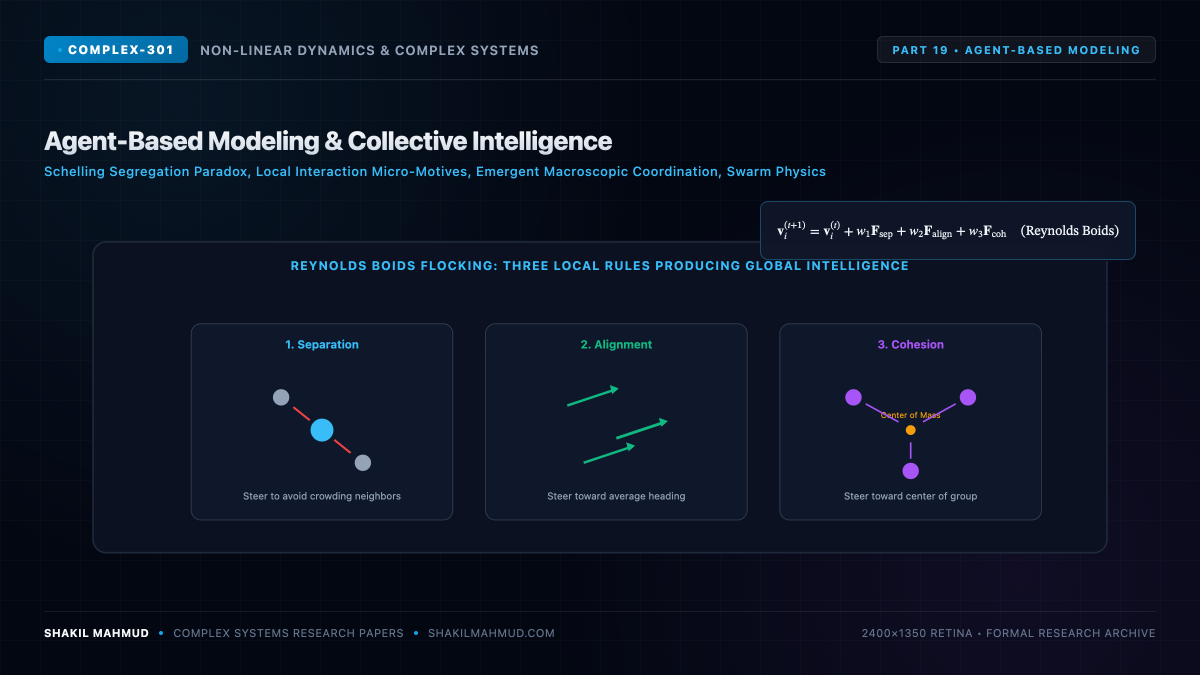
In 1986, Craig Reynolds demonstrated that the astonishingly lifelike collective behavior of bird flocks, fish schools, and animal herds could be simulated with extreme fidelity using three simple steering vector heuristics applied to each agent $i$:
[
mathbf{v}_i^{(t+1)} = mathbf{v}_i^{(t)} + w_1 mathbf{F}_{text{separation}} + w_2 mathbf{F}_{text{alignment}} + w_3 mathbf{F}_{text{cohesion}}
]
where:
- Separation (Collision Avoidance): Steer to avoid crowding local flockmates:
[
mathbf{F}_{text{separation}} = -sum_{j in N_i} frac{mathbf{r}_j – mathbf{r}_i}{|mathbf{r}_j – mathbf{r}_i|^2}
] - Alignment (Velocity Matching): Steer towards the average heading of local flockmates:
[
mathbf{F}_{text{alignment}} = frac{1}{|N_i|} sum_{j in N_i} mathbf{v}_j – mathbf{v}_i
] - Cohesion (Flock Centering): Steer to move toward the average position of local flockmates:
[
mathbf{F}_{text{cohesion}} = left(frac{1}{|N_i|} sum_{j in N_i} mathbf{r}_jright) – mathbf{r}_i
]
By simply balancing these three local forces, the synthetic flock flows smoothly around obstacles, splits dynamically to evade predators, and rejoins seamlessly without any central commander.
3. Thomas Schelling’s Segregation Paradox
In 1971, Nobel laureate Thomas Schelling formulated a cellular agent-based model to study racial segregation in urban centers. Agents of two groups inhabit an $N times N$ grid. Each agent desires only that at least a mild fraction $B$ (e.g., $B = 30%$) of its immediate neighbors share its own identity. If this modest tolerance threshold is satisfied, the agent is happy; otherwise, it moves to the nearest vacant site.
The Micro-Motives vs. Macro-Behavior Paradox: Even when every single agent actively prefers living in an integrated neighborhood (demanding that only 30% of neighbors be similar to them), the simulation invariably self-organizes into massive, hyper-segregated monocultures where average neighborhood similarity exceeds 80%. Schelling proved mathematically that macroscopic segregation does not require individual malice or extreme prejudice; even mild individual homophily undergoes an unstoppable dynamic feedback loop that drives extreme systemic polarization.
4. Stigmergy and Swarm Intelligence
In social insects (such as termites building multi-meter cathedral mounds or ants forging optimal foraging highways), communication occurs via Stigmergy: indirect coordination mediated through modifications of the physical environment. An ant deposits a chemical pheromone $sigma(mathbf{r}, t)$ on the substrate. Other ants bias their random walk toward higher pheromone concentrations, reinforcing the chemical trail:
[
frac{partial sigma}{partial t} = D_sigma nabla^2 sigma – mu sigma + sum_{k} q_k delta(mathbf{r} – mathbf{r}_k(t))
]
Through positive feedback (pheromone reinforcement) balanced by negative feedback (pheromone evaporation $mu$), the colony collectively solves NP-hard combinatorial optimization problems, finding the absolute shortest path through labyrinthine terrains without any individual insect knowing the global map.