In 1928, Paul Dirac sought a relativistic wave equation that was linear in both spatial and temporal derivatives to avoid the negative probability densities plaguing the second-order Klein-Gordon equation. Dirac’s stroke of genius was to realize that relativistic linearity could only be achieved if the coefficients of the equation were not scalar numbers, but non-commuting elements of a $4 times 4$ Clifford algebra. In solving this mathematical puzzle, Dirac inadvertently uncovered the intrinsic spin of the electron, unified relativity with quantum mechanics, and predicted the existence of Antimatter.
1. Linearization and the Clifford Algebra
Dirac postulated a first-order relativistic Hamiltonian equation of the form:
[
i frac{partial psi}{partial t} = left( -i boldsymbol{alpha} cdot boldsymbol{nabla} + beta m right) psi
]
For any plane-wave solution to satisfy the relativistic dispersion relation $E^2 = mathbf{p}^2 + m^2$, iterating the Hamiltonian must reproduce the Klein-Gordon operator $(partial_t^2 – nabla^2 + m^2)psi = 0$. Equating operator coefficients imposes the anticommutation conditions:
[
alpha_i alpha_j + alpha_j alpha_i = 2 delta_{ij} I, quad alpha_i beta + beta alpha_i = 0, quad beta^2 = I
]
Multiplying by $beta$ and defining the four Dirac Gamma Matrices $gamma^0 equiv beta$ and $gamma^i equiv beta alpha_i$, the equation takes its manifestly Lorentz covariant form:
[
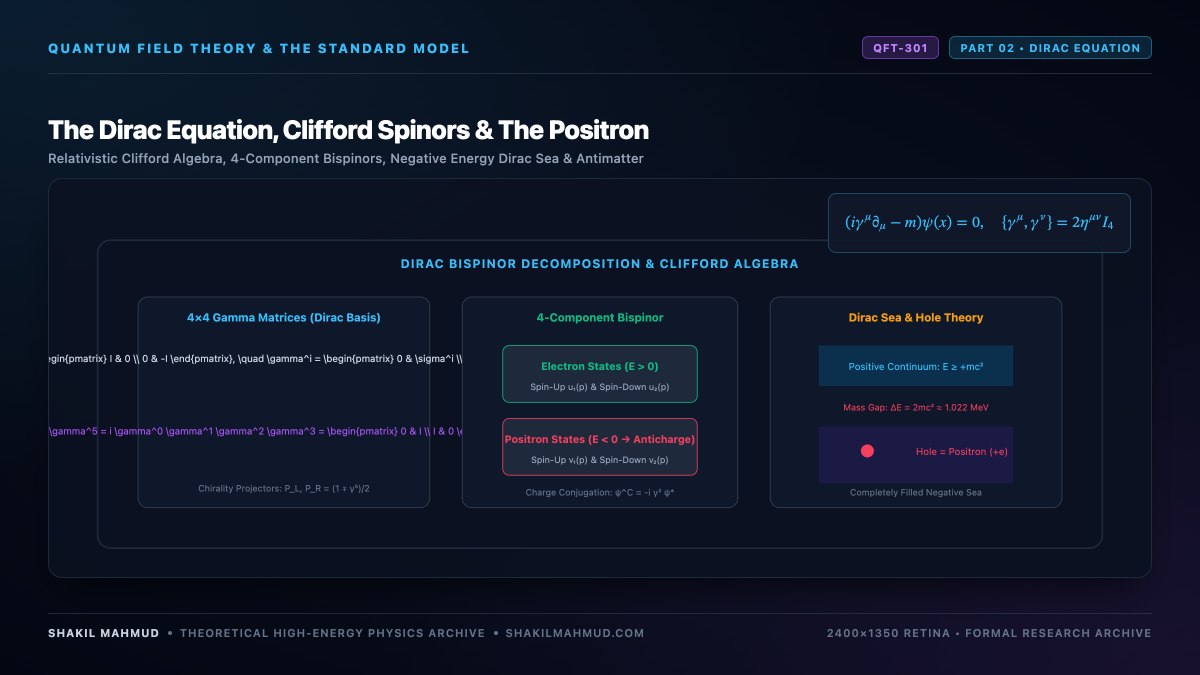
(i gamma^mu partial_mu – m)psi(x) = 0
]
where the gamma matrices generate the spacetime Clifford Algebra:
[
{gamma^mu, gamma^nu} equiv gamma^mu gamma^nu + gamma^nu gamma^mu = 2 eta^{munu} I_4
]
Because the metric signature is $(+1, -1, -1, -1)$, the minimum matrix dimension required to represent this algebra in $3+1$ dimensions is $4 times 4$. In the Dirac-Pauli representation:
[
gamma^0 = begin{pmatrix} I_2 & 0 \ 0 & -I_2 end{pmatrix}, quad gamma^i = begin{pmatrix} 0 & sigma^i \ -sigma^i & 0 end{pmatrix}
]
where $sigma^i$ are the standard $2 times 2$ Pauli matrices.
2. 4-Component Spinors and Lorentz Transformations
The wavefunction $psi(x)$ is not a 4-vector under Lorentz transformations; it is a Dirac Bispinor living in the $(1/2, 0) oplus (0, 1/2)$ reducible representation of the Lorentz group $operatorname{SO}(1, 3)$. Under an infinitesimal Lorentz transformation $x’^mu = x^mu + omega^mu{}_nu x^nu$, the spinor transforms as:
[
psi'(x’) = expleft( -frac{i}{4} omega_{munu} sigma^{munu} right) psi(x), quad sigma^{munu} equiv frac{i}{2} [gamma^mu, gamma^nu]
]
Evaluating the spatial rotation generator $Sigma^k = frac{1}{2} varepsilon^{ijk} sigma^{ij} = begin{pmatrix} sigma^k & 0 \ 0 & sigma^k end{pmatrix}$ proves that $psi$ automatically carries intrinsic angular momentum $S = hbar / 2$. Spin-1/2 is not an ad hoc postulate; it is a necessary geometric consequence of relativistic spacetime symmetry.
3. Positive and Negative Energy Solutions & The Positron
Fourier transforming $psi(x)$ into momentum space yields four linearly independent basis eigenspinors for each 3-momentum $mathbf{p}$:
- Two Positive-Energy Solutions ($E = +E_mathbf{p}$): Representing spin-up and spin-down electrons with basis spinors $u_s(mathbf{p}) e^{-ip cdot x}$ ($s = 1, 2$).
- Two Negative-Energy Solutions ($E = -E_mathbf{p}$): Representing basis spinors $v_s(mathbf{p}) e^{ip cdot x}$ ($s = 1, 2$).
Dirac initially resolved the destabilizing threat of electrons cascading indefinitely into negative-energy states by invoking the Pauli exclusion principle: postulating that the vacuum consists of a completely filled “sea” of negative-energy electrons (the Dirac Sea). An unoccupied state in this sea would behave as a bubble or hole with positive energy and opposite charge: the Positron ($e^+$), discovered experimentally by Carl Anderson in 1932.
4. Canonical Quantization with Anticommutators
In modern Quantum Field Theory, the Dirac sea picture is superseded by canonical field quantization. The Dirac field is expanded in terms of operator modes:
[
psi(x) = int frac{d^3p}{(2pi)^3 sqrt{2E_mathbf{p}}} sum_{s=1,2} left( b_mathbf{p}^s u_s(mathbf{p}) e^{-ip cdot x} + d_mathbf{p}^{sdagger} v_s(mathbf{p}) e^{ip cdot x} right)
]
where $b_mathbf{p}^s$ annihilates an electron and $d_mathbf{p}^{sdagger}$ creates a positron. Crucially, enforcing microcausality and positive vacuum energy requires Equal-Time Anticommutation Relations:
[
{psi_alpha(mathbf{x}, t), psi_beta^dagger(mathbf{y}, t)} = delta_{alphabeta} , delta^{(3)}(mathbf{x} – mathbf{y}), quad {b_mathbf{p}^r, b_mathbf{q}^{sdagger}} = {d_mathbf{p}^r, d_mathbf{q}^{sdagger}} = (2pi)^3 delta^{rs} delta^{(3)}(mathbf{p} – mathbf{q})
]
This provides the rigorous field-theoretic proof of the Spin-Statistics Theorem: half-integer spin fields must be quantized with anticommutators, naturally enforcing Fermi-Dirac statistics and the stability of atomic matter.