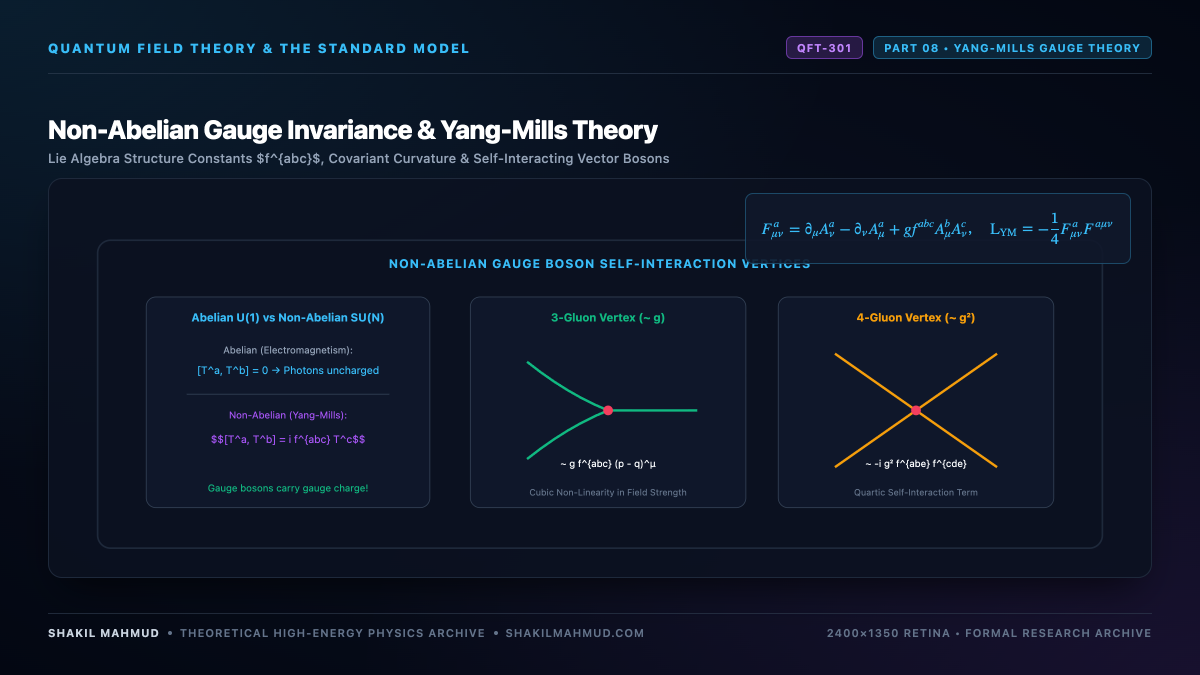
In 1954, Chen-Ning Yang and Robert Mills posed a profound question: what happens if the local phase rotation of a field is not a simple commutative phase angle $e^{ialpha(x)} in U(1)$, but an arbitrary multi-component matrix transformation belonging to a non-Abelian Lie group such as $SU(2)$ or $SU(3)$? The answer was Yang-Mills Theory—the geometric master key to the modern Standard Model. In non-Abelian gauge theories, the gauge bosons themselves carry gauge charge, forcing force-carriers to interact directly with one another, giving rise to asymptotic freedom, confinement, and nuclear structure.
1. Non-Abelian Lie Groups and Local Transformations
Consider a multiplet of matter fields $psi(x) = (psi_1, dots, psi_N)^T$ transforming under a compact, semi-simple Lie group $G$ (such as $SU(N)$):
[
psi(x) longrightarrow U(x) psi(x) = expleft( i g sum_{a=1}^{dim(G)} alpha^a(x) T^a right) psi(x)
]
where $T^a$ are Hermitian Lie algebra generators satisfying the commutation relations:
[
[T^a, T^b] = i f^{abc} T^c, quad operatorname{Tr}(T^a T^b) = T_R delta^{ab}
]
The completely antisymmetric real coefficients $f^{abc}$ are the Structure Constants of the Lie algebra. For $SU(2)$, $f^{abc} = varepsilon^{abc}$ and $T^a = sigma^a / 2$; for $SU(3)$, $f^{abc}$ are Gell-Mann’s $f$-coefficients and $T^a = lambda^a / 2$.
2. The Non-Abelian Covariant Derivative and Curvature
Because $U(x)$ depends on spacetime position $x$, the ordinary derivative $partial_mu psi$ fails to transform covariantly. We introduce a Lie-algebra-valued gauge field $A_mu(x) = A_mu^a(x) T^a$ and define the Non-Abelian Gauge Covariant Derivative:
[
D_mu equiv partial_mu – i g A_mu = partial_mu – i g A_mu^a T^a
]
Demanding that $D_mu psi to U(x) D_mu psi$ dictates the non-linear gauge transformation rule for $A_mu$:
[
A_mu longrightarrow U A_mu U^dagger – frac{i}{g} (partial_mu U) U^dagger
]
For an infinitesimal transformation $U approx I + i g alpha^a T^a$, the individual gauge field components transform as:
[
A_mu^a longrightarrow A_mu^a + partial_mu alpha^a + g f^{abc} A_mu^b alpha^c = A_mu^a + D_mu^{ab} alpha^b
]
The field strength tensor is obtained as the geometric curvature of the connection $[D_mu, D_nu] = -i g F_{munu}$:
[
F_{munu}^a = partial_mu A_nu^a – partial_nu A_mu^a + g f^{abc} A_mu^b A_nu^c
]
The quadratic non-linear term $g f^{abc} A_mu^b A_nu^c$ is the mathematical signature of non-Abelian physics: it proves that the gauge field carries its own charge.
3. The Yang-Mills Lagrangian and Self-Interactions
The gauge-invariant Yang-Mills Lagrangian density is constructed from the gauge trace:
[
mathcal{L}_{text{YM}} = -frac{1}{2} operatorname{Tr}(F_{munu} F^{munu}) = -frac{1}{4} F_{munu}^a F^{amunu}
]
Expanding the squared field strength reveals the radical difference from Maxwell’s theory:
[
mathcal{L}_{text{YM}} = -frac{1}{4} (partial_mu A_nu^a – partial_nu A_mu^a)^2 – g f^{abc} (partial_mu A_nu^a) A^{bmu} A^{cnu} – frac{1}{4} g^2 f^{abe} f^{cde} A_mu^a A_nu^b A^{cmu} A^{dnu}
]
In addition to the kinetic term, the Lagrangian contains Cubic (3-boson) and Quartic (4-boson) self-interaction vertices! Photons in QED do not carry electric charge and cannot scatter off each other at tree level. In contrast, gluons in QCD carry color charge, and weak $W^pm$ bosons carry weak charge, interacting directly among themselves.
4. Quantization, Faddeev-Popov Ghosts & BRST Symmetry
In the path integral quantization of non-Abelian gauge fields, gauge orbits have non-trivial geometry. Ludvig Faddeev and Victor Popov showed that gauge-fixing $mathcal{F}^a(A) = 0$ introduces a functional determinant $detleft(frac{delta mathcal{F}^a}{delta alpha^b}right)$ that must be represented by anticommuting scalar fields—the Faddeev-Popov Ghost Fields $c^a, bar{c}^a$:
[
mathcal{L}_{text{ghost}} = bar{c}^a partial^mu D_mu^{ab} c^b = bar{c}^a partial^mu (partial_mu delta^{ab} – g f^{abc} A_mu^c) c^b
]
Although ghosts violate the spin-statistics theorem (anticommuting spin-0 fields), they exist solely inside virtual loops to cancel unphysical longitudinal gauge polarizations. The combined gauge-fixed action possesses a global quantum supersymmetry known as BRST Symmetry (Becchi-Rouet-Stora-Tyutin), providing the rigorous proof that non-Abelian Yang-Mills theories are renormalizable and unitary.