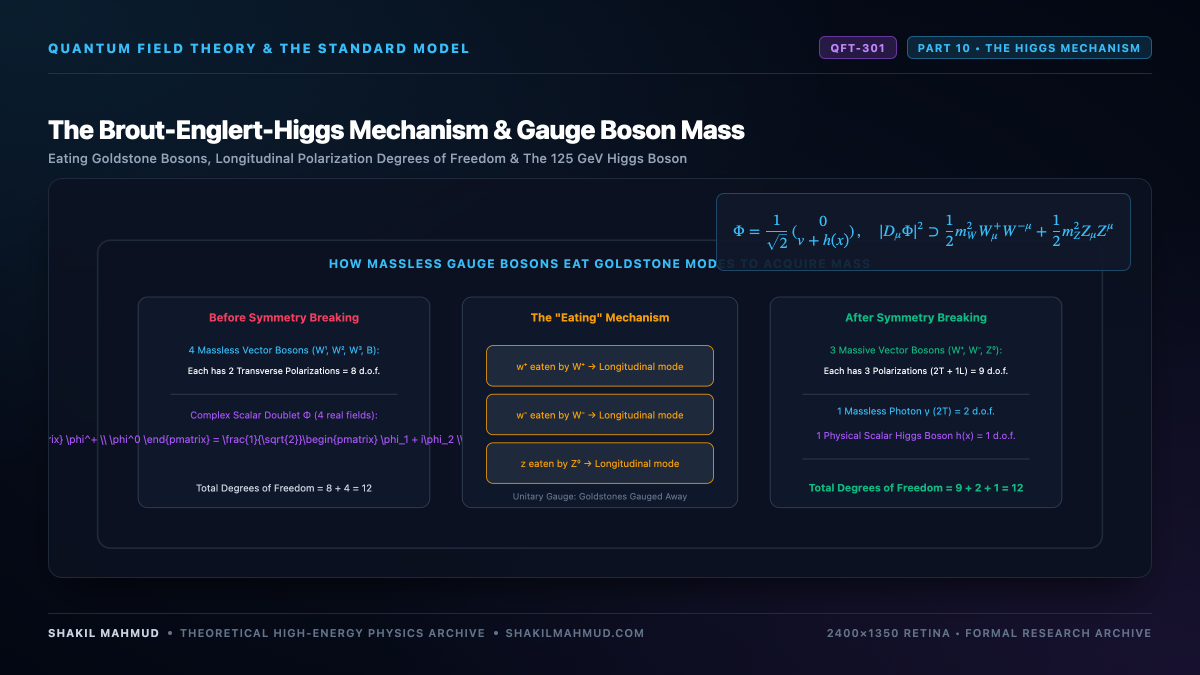
If unbroken local gauge invariance strictly forbids mass terms for vector gauge bosons ($m^2 A_mu A^mu$ violates gauge symmetry), how do the weak force mediators ($W^pm$ and $Z^0$) acquire enormous physical masses nearly 100 times heavier than a proton? In 1964, Robert Brout, François Englert, and Peter Higgs solved this existential paradox. When a local gauge symmetry undergoes spontaneous symmetry breaking, the would-be massless Goldstone bosons are “eaten” by the gauge fields, becoming the physical longitudinal polarizations required for vector bosons to acquire mass while preserving renormalizability: The Higgs Mechanism.
1. The Abelian Higgs Model
To witness the mechanism in its purest mathematical form, consider a complex scalar field $phi(x)$ coupled to a local $U(1)$ gauge field $A_mu(x)$:
[
mathcal{L} = |D_mu phi|^2 – frac{1}{4} F_{munu} F^{munu} – V(phi), quad D_mu = partial_mu + i e A_mu
]
with the symmetry-breaking Mexican hat potential $V(phi) = -mu^2 |phi|^2 + lambda |phi|^4$. Parameterizing the field in polar coordinates around the vacuum expectation value $v = sqrt{mu^2 / lambda}$:
[
phi(x) = frac{1}{sqrt{2}} left[ v + h(x) right] e^{i theta(x) / v}
]
where $h(x)$ is the radial Higgs mode and $theta(x)$ is the would-be Goldstone phase. Under a local gauge transformation:
[
phi'(x) = e^{-i theta(x) / v} phi(x) = frac{1}{sqrt{2}} [v + h(x)], quad A_mu'(x) = A_mu(x) + frac{1}{e v} partial_mu theta(x)
]
This gauge choice is the Unitary Gauge. The phase field $theta(x)$ has completely vanished from the theory! In its place, the covariant kinetic term evaluates to:
[
|D_mu phi|^2 = left| left( partial_mu + i e A_mu’ right) frac{v + h}{sqrt{2}} right|^2 = frac{1}{2} (partial_mu h)^2 + frac{1}{2} e^2 v^2 A_mu’^2 + e^2 v h A_mu’^2 + frac{1}{2} e^2 h^2 A_mu’^2
]
2. Degree of Freedom Accounting: Eating Goldstone Bosons
Compare the particle spectrum before and after spontaneous symmetry breaking:
| Regime | Particles Present | Polarization d.o.f. | Total d.o.f. |
|---|---|---|---|
| Unbroken Phase ($v=0$) | 1 Massless Vector $A_mu$ 1 Complex Scalar $phi$ |
2 Transverse 2 Real Scalars |
2 + 2 = 4 |
| Broken Phase ($v > 0$) | 1 Massive Vector $A_mu’$ ($M_A = e v$) 1 Real Higgs Scalar $h$ ($m_h = sqrt{2lambda} v$) |
3 (2 Transverse + 1 Longitudinal) 1 Real Scalar |
3 + 1 = 4 |
The massless Goldstone mode did not disappear into nothingness; it was absorbed into the gauge field as its longitudinal polarization state. A massless vector boson travels at $c$ and can only oscillate transversely; a massive vector boson travels subluminally, permitting a frame where it is at rest and demanding three polarization states ($S_z = -1, 0, +1$).
3. Renormalizability and the ‘t Hooft Gauge
While the Unitary gauge makes physical particles obvious, the massive vector propagator scales as $sim k_mu k_nu / (M^2 k^2)$ at high momentum, obscuring whether loop integrals converge. In 1971, Gerard ‘t Hooft proved that spontaneously broken gauge theories are strictly renormalizable by introducing the $R_xi$ Gauge-Fixing Condition:
[
mathcal{L}_{text{GF}} = -frac{1}{2xi} left( partial_mu A^mu – xi e v theta right)^2
]
In the ‘t Hooft-Feynman gauge ($xi = 1$), the vector propagator decays as $sim 1/k^2$ in the ultraviolet, rendering all multi-loop Feynman integrals power-counting renormalizable. Renormalizability and gauge symmetry are preserved simultaneously.
4. The Discovery of the 125 GeV Higgs Boson
On July 4, 2012, the ATLAS and CMS collaborations at CERN’s Large Hadron Collider announced the historic discovery of the Higgs boson with mass $m_H approx 125.09 text{ GeV}$. Observed decaying into diphoton ($gammagamma$) and four-lepton ($ZZ^* to 4l$) channels, the scalar boson confirmed the existence of the non-zero vacuum condensate filling all of space, proving that mass in our universe is an emergent dynamical property of broken electroweak symmetry.