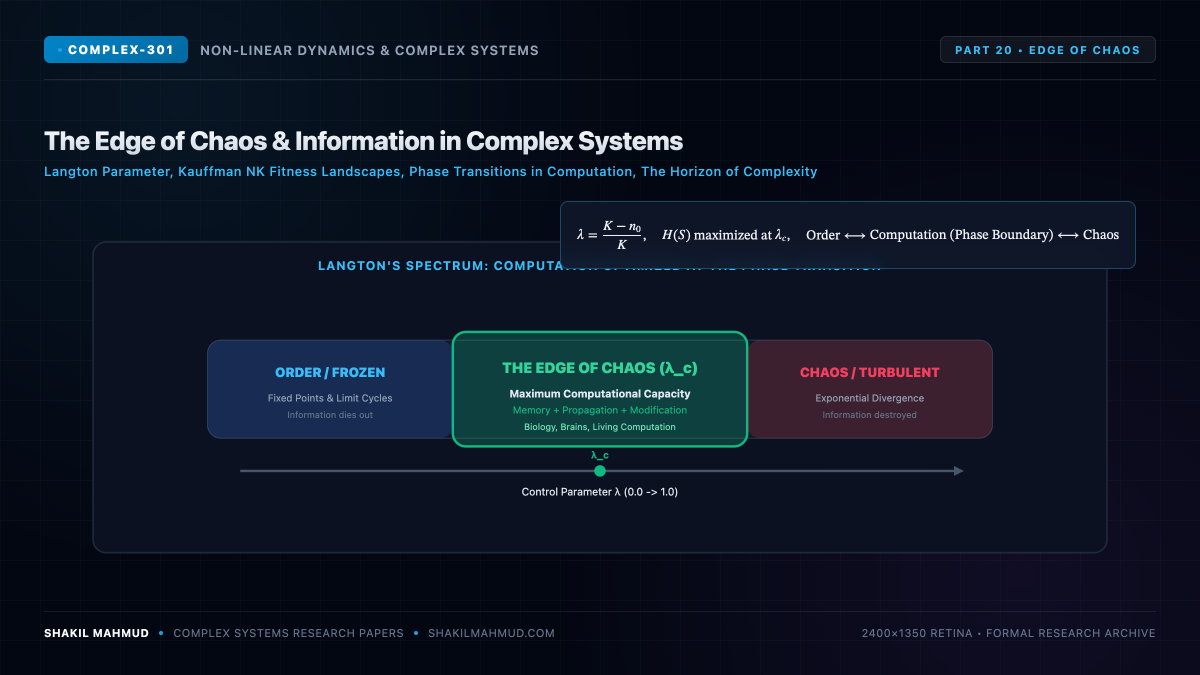
Where in the vast mathematical space of dynamical systems does living, thinking, adaptive matter reside? If a system is too rigid and ordered, information freezes into frozen crystal lattices unable to compute or evolve; if a system is too chaotic, turbulent fluctuations tear coherent information apart before it can be transmitted or stored. In the culminating synthesis of complex systems science, Christopher Langton and Stuart Kauffman identified that life, computation, and intelligence thrive at a razor-thin critical boundary: The Edge of Chaos.
1. Christopher Langton’s $lambda$ Parameter
In 1990, artificial life pioneer Christopher Langton introduced a tuning metric $lambda in [0, 1]$ to survey the rule space of cellular automata. For an automaton with $k$ states and neighborhood size $n$, let $s_0$ be an arbitrarily chosen quiescent state. The parameter $lambda$ represents the fraction of transitions that map to a non-quiescent state:
[
lambda = frac{k^n – n_0}{k^n}
]
where $n_0$ is the number of transitions resulting in $s_0$. As $lambda$ is tuned continuously from $0$ to $1 – 1/k$:
- Ordered Regime ($lambda to 0$): Dynamics freeze into homogeneous static fixed points (Class 1) or brief periodic cycles (Class 2). Perturbations decay exponentially.
- Chaotic Regime ($lambda to 1 – 1/k$): Dynamics dissolve into turbulent, pseudo-random noise (Class 3). The largest Lyapunov exponent $lambda_{max} > 0$, destroying long-range correlations.
- The Phase Transition at $lambda_c approx 0.273$: Exactly at the critical threshold between order and chaos, Class 4 complex dynamics emerge! Here, transient lifetimes diverge toward infinity, spatial correlation lengths span the entire lattice, and mutual information reaches its absolute maximum.
2. Information-Theoretic Foundations of Complexity
Why is the edge of chaos uniquely suited for computation and life? The answer lies in information theory. Any computational process requires three fundamental capabilities:
- Information Storage (Memory): Preserving bits over extended time horizons. (Maximized in the ordered phase).
- Information Transmission (Communication): Propagating signals across macroscopic distances without decay. (Maximized at the critical boundary).
- Information Processing (Computation): Combining and transforming bits non-linearly. (Maximized near the transition).
Using Shannon Entropy $H(X) = -sum p(x) log_2 p(x)$ and Excess Entropy (Mutual Information between past and future time series):
[
I(X_{text{past}}; X_{text{future}}) = H(X_{text{past}}) + H(X_{text{future}}) – H(X_{text{past}}, X_{text{future}})
]
physicists proved that while raw entropy increases monotonically into the chaotic regime, structural complexity and transfer entropy peak sharply at the critical edge of chaos.
3. Stuart Kauffman’s $NK$ Boolean Fitness Landscapes
In evolutionary biology, Stuart Kauffman formulated the $NK$ model of gene regulatory networks. An organism is modeled as a network of $N$ genes, where each gene’s expression is regulated by $K$ other genes through random Boolean logic gates. The dynamical stability depends critically on the connectivity parameter $K$:
[
K_c = 2
]
- When $K = 1$, the genomic network is subcritical; mutations cannot propagate, freezing evolutionary adaptation.
- When $K > 2$, the genomic network is chaotic; a single point mutation triggers an uncontrolled cascade of expression flips, scrambling the organism’s morphology.
- When $K = K_c = 2$, the network sits precisely at the critical boundary. The number of stable dynamical attractors scales as $sqrt{N}$—matching the biological number of distinct cell types in an organism as a function of genome size. Life tunes its genetic networks to the edge of chaos to achieve maximal phenotypic evolvability while preserving physiological homeostasis.
4. Epilogue: The Unified Architecture of Complexity
From deterministic chaos and strange attractors to Turing morphogenesis, scale-free networks, and critical information processing, COMPLEX-301 reveals the underlying unity of nature. Complex systems are neither entirely predictable machines nor completely disordered noise; they are self-organizing webs of information flowing along the fragile, fertile boundary between order and chaos—the true physical home of consciousness, life, and the evolving universe.