Why does ordinary quantum mechanics fail when particles approach the speed of light? In non-relativistic quantum theory, the number of particles is strictly conserved, and time enters as an external evolution parameter $t$ while spatial coordinates $mathbf{x}$ are promoted to operators. But Einstein’s special relativity dictates that energy and mass are interconvertible ($E = mc^2$); when kinetic energies exceed $2mc^2$, particles are spontaneously created and annihilated from the vacuum. To reconcile quantum mechanics with special relativity and causality, physics must promote space and time to equal coordinate status $(x^mu)$, demoting particles from fundamental entities to localized excitations of an underlying, space-filling continuum: The Quantum Field.
1. The Klein-Gordon Lagrangian and Classical Equation of Motion
The simplest relativistic field is a real scalar field $phi(x) = phi(mathbf{x}, t)$, transforming as a trivial scalar under the Lorentz group ($phi'(x’) = phi(x)$). The relativistic action is the four-dimensional spacetime integral of the Lagrangian density $mathcal{L}(phi, partial_mu phi)$:
[
S[phi] = int d^4x , mathcal{L} = int d^4x left( frac{1}{2} (partial_mu phi)(partial^mu phi) – frac{1}{2} m^2 phi^2 right)
]
where we adopt natural units ($hbar = c = 1$) and the Minkowski metric signature $eta_{munu} = operatorname{diag}(+1, -1, -1, -1)$. Applying the principle of stationary action $delta S = 0$ yields the Euler-Lagrange field equation:
[
partial_mu left( frac{partial mathcal{L}}{partial (partial_mu phi)} right) – frac{partial mathcal{L}}{partial phi} = 0 implies (partial_mu partial^mu + m^2)phi(x) = 0
]
Defining the d’Alembertian wave operator $Box equiv partial_mu partial^mu = frac{partial^2}{partial t^2} – nabla^2$, we recover the iconic Klein-Gordon Equation:
[
(Box + m^2)phi(x) = 0
]
2. Canonical Quantization: Promoting Fields to Operators
To quantize the field canonically, we construct the conjugate momentum density $pi(mathbf{x}, t)$ via functional differentiation:
[
pi(mathbf{x}, t) equiv frac{partial mathcal{L}}{partial dot{phi}(mathbf{x}, t)} = dot{phi}(mathbf{x}, t)
]
The classical Hamiltonian density is obtained through the Legendre transform $mathcal{H} = pi dot{phi} – mathcal{L}$:
[
H = int d^3x , mathcal{H} = int d^3x left( frac{1}{2} pi^2 + frac{1}{2} (nabla phi)^2 + frac{1}{2} m^2 phi^2 right)
]
Following Paul Dirac’s canonical quantization postulate, classical Poisson brackets are replaced by equal-time commutators between field operators:
[
[phi(mathbf{x}, t), pi(mathbf{y}, t)] = i , delta^{(3)}(mathbf{x} – mathbf{y}), quad [phi(mathbf{x}, t), phi(mathbf{y}, t)] = [pi(mathbf{x}, t), pi(mathbf{y}, t)] = 0
]
3. Mode Decomposition and The Ladder Operator Algebra
Because the Klein-Gordon equation is linear, any operator configuration can be expanded into a Fourier continuum of relativistic plane waves:
[
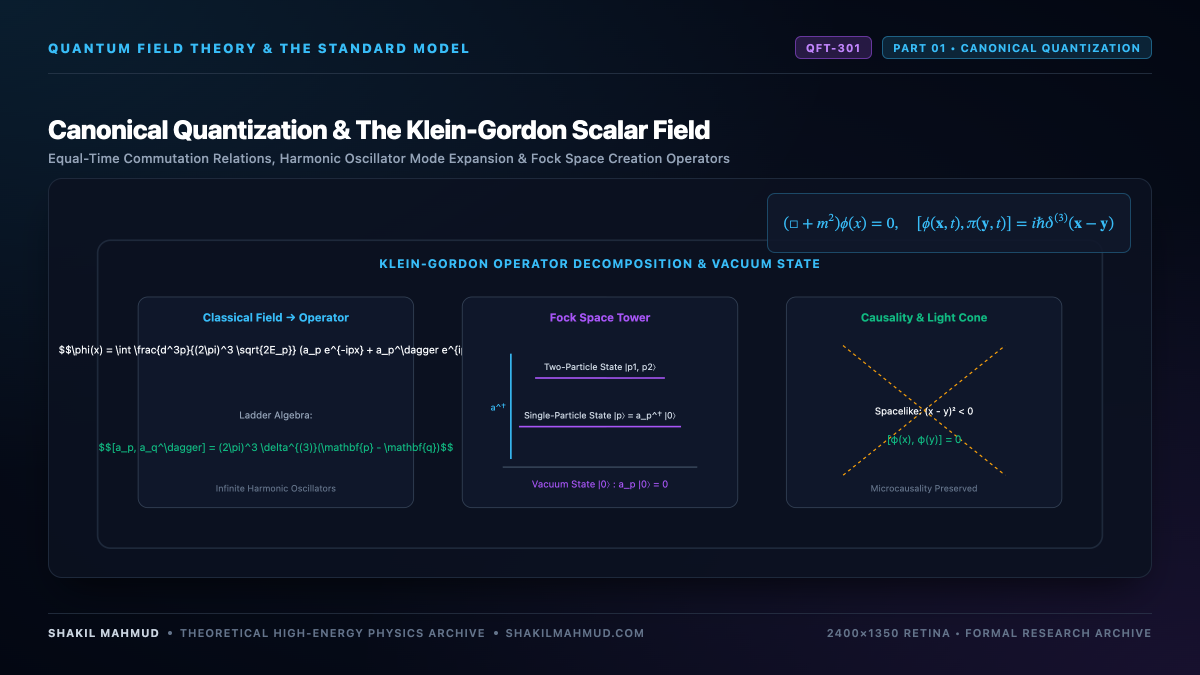
phi(mathbf{x}, t) = int frac{d^3p}{(2pi)^3 sqrt{2 E_mathbf{p}}} left( a_mathbf{p} e^{-i p cdot x} + a_mathbf{p}^dagger e^{i p cdot x} right)
]
where $p cdot x = E_mathbf{p} t – mathbf{p} cdot mathbf{x}$, and $E_mathbf{p} = sqrt{mathbf{p}^2 + m^2}$ is the relativistic dispersion on the mass shell ($p^2 = m^2$). The equal-time commutation relations force the creation and annihilation operators to satisfy the continuous bosonic ladder algebra:
[
[a_mathbf{p}, a_mathbf{q}^dagger] = (2pi)^3 delta^{(3)}(mathbf{p} – mathbf{q}), quad [a_mathbf{p}, a_mathbf{q}] = [a_mathbf{p}^dagger, a_mathbf{q}^dagger] = 0
]
Substituting the mode expansion into the Hamiltonian yields an infinite collection of decoupled quantum harmonic oscillators:
[
H = int frac{d^3p}{(2pi)^3} E_mathbf{p} left( a_mathbf{p}^dagger a_mathbf{p} + frac{1}{2} [a_mathbf{p}, a_mathbf{p}^dagger] right) = int frac{d^3p}{(2pi)^3} E_mathbf{p} a_mathbf{p}^dagger a_mathbf{p} + E_0
]
The divergent zero-point vacuum energy $E_0 = frac{1}{2} int d^3p , E_mathbf{p} delta^{(3)}(0)$ is subtracted via normal ordering $:H:$, defining the ground state vacuum $|0rangle$ by $a_mathbf{p} |0rangle = 0$ for all $mathbf{p}$.
4. Fock Space and Microcausality
Acting with creation operators on the vacuum constructs the entire multi-particle Hilbert space—the Fock Space:
[
|p_1, p_2, dots, p_nrangle = sqrt{2E_1} dots sqrt{2E_n} , a_{mathbf{p}_1}^dagger dots a_{mathbf{p}_n}^dagger |0rangle
]
Because $[a_mathbf{p}^dagger, a_mathbf{q}^dagger] = 0$, states are automatically symmetric under particle exchange, proving that spin-0 scalar fields rigorously obey Bose-Einstein statistics.
Crucially, relativistic causality requires that measurements performed at spacelike separations ($(x – y)^2 < 0$) cannot influence each other. Evaluating the field commutator across spacetime:
[
[phi(x), phi(y)] = D(x – y) – D(y – x) = int frac{d^3p}{(2pi)^3 2E_mathbf{p}} left( e^{-ip(x-y)} – e^{ip(x-y)} right)
]
When $(x – y)$ is spacelike, a Lorentz boost can invert the sign of the spatial vector while preserving spacelike separation. The two terms cancel identically:
[
[phi(x), phi(y)] = 0 quad text{for } (x – y)^2 < 0
]
This guarantees Microcausality: the quantum vacuum prevents any superluminal signaling, establishing the foundational mathematical consistency of relativistic quantum field theory.