Can the staggering complexity of the physical cosmos—from the crystalline geometry of snowflakes to the universal laws of thermodynamics and fluid mechanics—arise from discrete, local computational rules operating on a lattice of bits? In the early 1980s, Stephen Wolfram systematically investigated Elementary Cellular Automata (ECA), revealing that even the simplest possible deterministic discrete dynamical systems can spontaneously exhibit four fundamental universality classes of dynamical behavior, culminating in universal Turing computation.
1. Elementary Cellular Automata (ECA) Mechanics
An Elementary Cellular Automaton consists of a one-dimensional array of binary cells $s_i^{(t)} in {0, 1}$ indexed by integer $i in mathbb{Z}$ at discrete time steps $t in mathbb{N}_0$. The update rule $Phi$ computes the next state of cell $i$ based exclusively on its own current state and its nearest left and right neighbors:
[
s_i^{(t+1)} = Phileft(s_{i-1}^{(t)}, s_i^{(t)}, s_{i+1}^{(t)}right)
]
Because there are $2^3 = 8$ possible 3-cell neighborhood configurations $(111, 110, dots, 000)$, there are precisely $2^{2^3} = 2^8 = 256$ distinct elementary local update rules. Under the Wolfram code convention, each rule is uniquely indexed by the decimal integer representation of its 8-bit output sequence:
[
R = sum_{k=0}^7 Phi(operatorname{bin}_3(k)) cdot 2^k in [0, 255]
]
2. Wolfram’s Four Dynamical Universality Classes
By simulating all 256 rules from disordered random initial configurations, Wolfram discovered that regardless of the initial microstate, the asymptotic dynamics invariably collapse into four universal qualitative classes:
- Class 1 (Convergence to Uniform Fixed Point): Trajectories rapidly evolve into a spatially homogeneous, static state (e.g., Rule 0, Rule 32). In dynamical systems terminology, this corresponds to a unique global point attractor with zero topological entropy.
- Class 2 (Periodic and Nested Structures): Evolution separates into isolated, simple periodic structures or traveling stripes (e.g., Rule 4, Rule 108). This corresponds to simple limit cycles or low-dimensional invariant tori. Information remains strictly localized.
- Class 3 (Deterministic Chaos and Aperiodicity): Patterns exhibit pseudo-random, aperiodic, and scale-invariant fractal cascades (e.g., Rule 30, Rule 90). Rule 30 generates such high cryptographic entropy along its central vertical column that it served as the core pseudorandom number generator for Mathematica. In dynamical terms, Class 3 represents strange attractors with positive Lyapunov exponents and sensitive dependence on initial conditions.
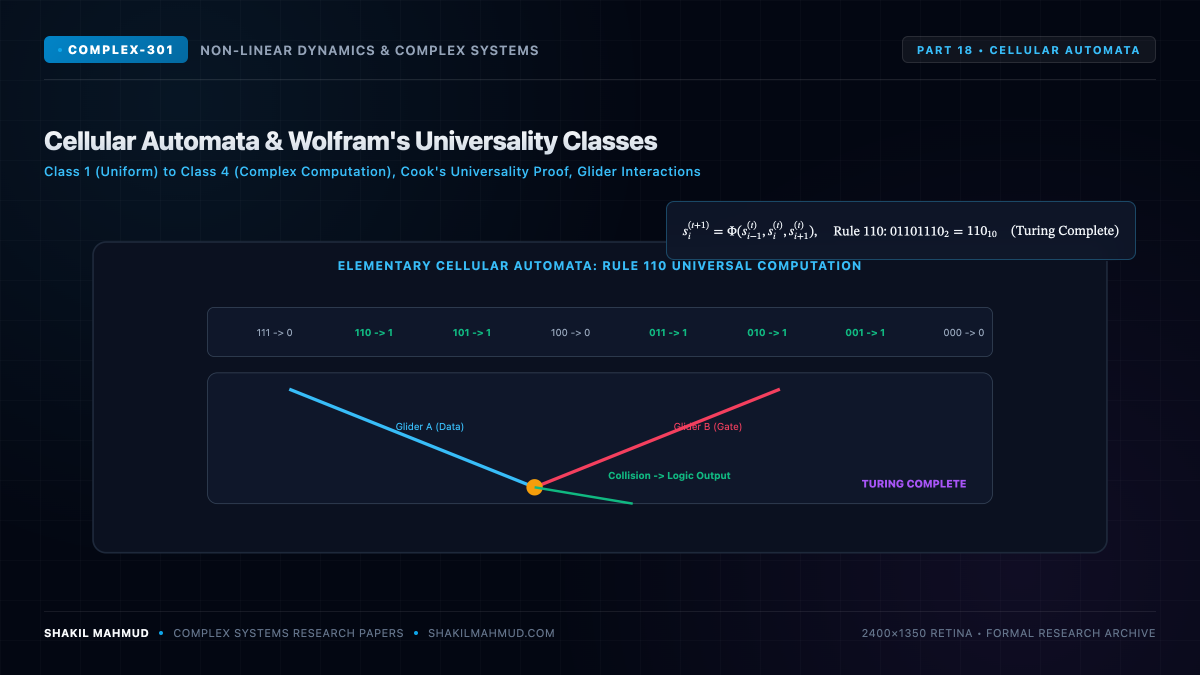
- Class 4 (Complex Computation and Coherent Structures): Dynamic evolution forms propagating localized structures (“gliders”) that travel across space, interact, collide, and perform logical operations (e.g., Rule 110, Conway’s Game of Life). Wolfram conjectured that Class 4 systems are capable of universal computation.
3. Matthew Cook’s Universality Proof for Rule 110
In 2004, Matthew Cook proved Wolfram’s conjecture: Rule 110 is Turing complete. The binary update table for Rule 110 ($01101110_2 = 110_{10}$) is:
| $s_{i-1} s_i s_{i+1}$ | 111 | 110 | 101 | 100 | 011 | 010 | 001 | 000 |
|---|---|---|---|---|---|---|---|---|
| $s_i^{(t+1)}$ | 0 | 1 | 1 | 0 | 1 | 1 | 1 | 0 |
Cook demonstrated that the periodic background of Rule 110 can support dozens of distinct localized glider structures traveling at varying rational velocities. By meticulously orchestrating glider collisions, Cook embedded a Cyclic Tag System into Rule 110, which in turn can simulate any 2-tag system, Turing machine, or modern digital supercomputer.
4. Computational Irreducibility
The Turing completeness of simple systems implies the profound philosophical principle of Computational Irreducibility: if a physical process is performing universal computation, there exists no shortcut mathematical formula or closed-form analytical solution capable of predicting the state of the system at time $t$ faster than simply simulating each microscopic step in real time. Laplacian determinism survives, but Laplacian predictability is destroyed by computational equivalence.