How does light interact with matter at the subatomic scale? Classical electrodynamics formulated by James Clerk Maxwell described electromagnetic fields as continuous waves. However, quantizing the vector potential $A_mu(x)$ presents a profound theoretical challenge: the photon is a massless spin-1 particle possessing strictly two physical transverse polarizations, whereas the 4-vector potential possesses four mathematical components. Resolving this redundancy requires the profound geometric principle of Local Gauge Invariance, giving birth to Quantum Electrodynamics (QED)—the most precisely tested theory in the history of human science.
1. The Maxwell Lagrangian and Gauge Redundancy
The classical electromagnetic field is described by the anti-symmetric Faraday field strength tensor $F_{munu} = partial_mu A_nu – partial_nu A_mu$. The free Maxwell action is given by:
[
S[A] = int d^4x left( -frac{1}{4} F_{munu} F^{munu} right)
]
The action is invariant under the infinite-dimensional group of local Abelian $U(1)$ gauge transformations:
[
A_mu(x) to A_mu(x) – frac{1}{e} partial_mu alpha(x)
]
Because $partial_mu A_nu – partial_nu A_mu$ contains no time derivative of the temporal component $A_0$ ($partial_0 A_0 – partial_0 A_0 = 0$), the conjugate momentum to $A_0$ vanishes identically:
[
pi^0 = frac{partial mathcal{L}}{partial dot{A}_0} equiv 0
]
This primary constraint indicates that $A_0$ is not a dynamical degree of freedom, but a Lagrange multiplier enforcing Gauss’s Law $boldsymbol{nabla} cdot mathbf{E} = rho$. Consequently, naive canonical commutation relations $[hat{A}_mu, hat{pi}^nu] = i delta_mu^nu delta^{(3)}(mathbf{x} – mathbf{y})$ are mathematically impossible without gauge fixing.
2. Covariant Gauge Fixing and the Gupta-Bleuler Formalism
To preserve explicit Lorentz covariance, Fermi modified the Lagrangian by introducing a gauge-fixing term with parameter $xi$:
[
mathcal{L} = -frac{1}{4} F_{munu} F^{munu} – frac{1}{2xi} (partial_mu A^mu)^2
]
In the Feynman gauge ($xi = 1$), the equation of motion simplifies to the uncoupled wave equation $Box A_mu = 0$. However, quantizing four independent components creates an unphysical Hilbert space with states of negative norm (ghosts), because $[hat{a}_0(mathbf{p}), hat{a}_0^dagger(mathbf{q})] = -(2pi)^3 delta^{(3)}(mathbf{p} – mathbf{q})$ carries an anomalous minus sign due to the Minkowski metric $eta_{00} = +1, eta_{ii} = -1$.
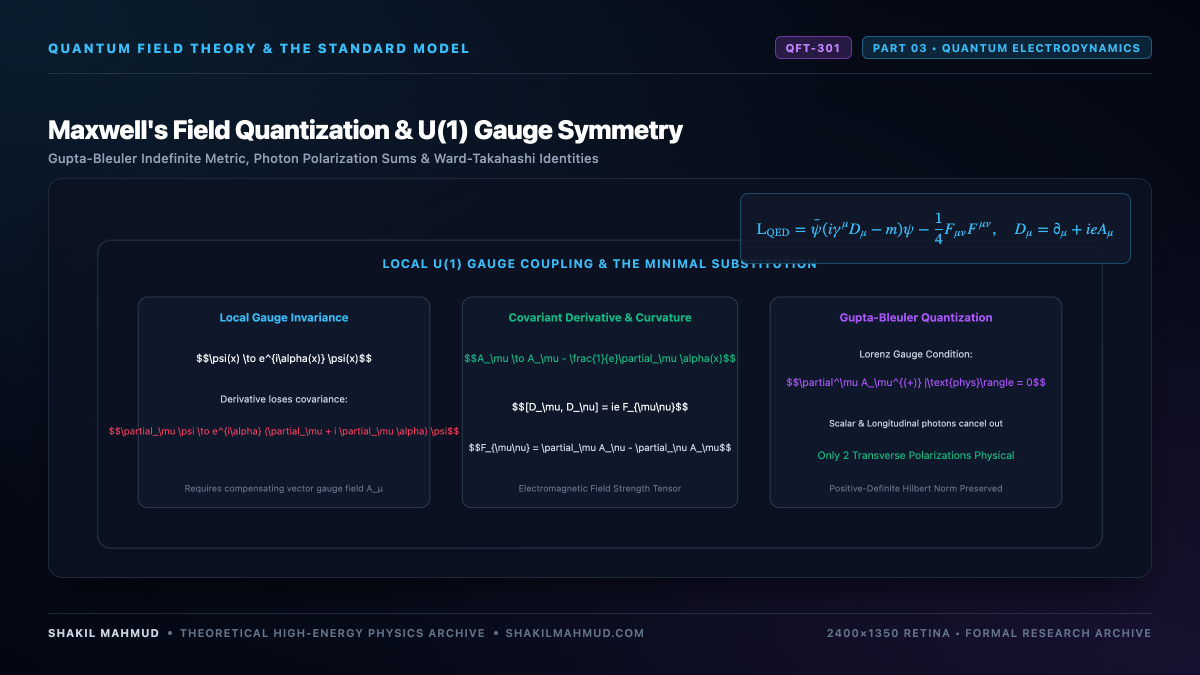
The Gupta-Bleuler quantization condition resolves this anomaly by demanding that physical states $|text{phys}rangle$ satisfy the weak Lorenz gauge constraint for the positive-frequency annihilation operator:
[
partial^mu A_mu^{(+)}(x) |text{phys}rangle = 0
]
This condition guarantees that the negative-norm scalar photons and longitudinal photons cancel each other out in all physical expectation values $langle text{phys}| dots |text{phys}rangle$, leaving strictly two physical transverse polarizations ($lambda = 1, 2$) with positive-definite Hilbert norm.
3. Minimal Coupling and The QED Master Lagrangian
To couple the photon field to Dirac fermions (electrons), we require the complete Lagrangian to be invariant under local $U(1)$ phase transformations $psi(x) to e^{ialpha(x)} psi(x)$. Replacing the ordinary derivative with the Gauge Covariant Derivative $D_mu$:
[
D_mu equiv partial_mu + i e A_mu
]
yields the complete, foundational QED Lagrangian:
[
mathcal{L}_{text{QED}} = bar{psi}(i gamma^mu D_mu – m)psi – frac{1}{4} F_{munu} F^{munu} = bar{psi}(islpartial – m)psi – frac{1}{4} F_{munu} F^{munu} – e bar{psi}gamma^mupsi A_mu
]
The interaction term $mathcal{L}_{text{int}} = -j^mu A_mu = -e (bar{psi} gamma^mu psi) A_mu$ represents the universal minimal coupling between the electromagnetic vector potential and the conserved Dirac electromagnetic current $j^mu = e bar{psi}gamma^mupsi$.
4. The Ward-Takahashi Identity
Local gauge invariance enforces profound conservation laws at the quantum level. The Ward-Takahashi Identity dictates that any physical photon transition amplitude $mathcal{M}(k) = varepsilon_mu(k) mathcal{M}^mu(k)$ must vanish when the polarization vector is replaced by the photon 4-momentum $k_mu$:
[
k_mu mathcal{M}^mu(k) = 0
]
This identity guarantees that longitudinal and unphysical photon states decouple completely from scattering amplitudes, ensuring current conservation and the mathematical renormalizability of Quantum Electrodynamics.