If asymmetric cryptography provides the locked doors of the digital world, Cryptographic Hash Functions provide the tamper-evident wax seals. A cryptographic hash function transforms an arbitrary-length digital document—whether a 10-byte text string or a 10-terabyte disk image—into a compact, fixed-size binary fingerprint (digest), typically 256 or 512 bits. In 1979 and 1989, Ralph Merkle and Ivan Damgård independently established the foundational theorem proving that arbitrary-length collision-resistant hashing can be constructed from fixed-size one-way compression functions, creating the architectural engine for digital signatures, Merkle trees, and modern blockchains.
1. The Three Axiomatic Security Properties
A deterministic function $H: {0, 1}^* to {0, 1}^n$ is considered cryptographically secure if and only if it satisfies three rigorous computational hardness properties:
- Preimage Resistance (One-Wayness): Given an arbitrary hash digest $y in {0, 1}^n$, it is computationally infeasible to find any message $x$ such that $H(x) = y$. An optimal brute-force attack requires on average:
[
mathcal{O}(2^n) text{ operations}
] - Second Preimage Resistance (Weak Collision Resistance): Given a specific message $x_1$, it is computationally infeasible to find a different message $x_2 neq x_1$ such that $H(x_1) = H(x_2)$. Complexity: $mathcal{O}(2^n)$.
- Collision Resistance (Strong Collision Resistance): It is computationally infeasible to find any two distinct messages $x_1 neq x_2$ such that $H(x_1) = H(x_2)$.
2. The Birthday Paradox and The $2^{n/2}$ Collision Bound
Why is collision resistance vastly harder to achieve than preimage resistance? The answer lies in probability theory and the classical Birthday Paradox.
Suppose we hash $k$ randomly chosen messages into an $n$-bit digest space ($N = 2^n$ possible outcomes). The probability that all $k$ hashes are strictly distinct is:
[
P(text{no collision}) = prod_{i=1}^{k-1} left( 1 – frac{i}{N} right) approx prod_{i=1}^{k-1} e^{-i / N} = expleft( -frac{k(k-1)}{2N} right)
]
Setting the collision probability $1 – P ge 1/2$ yields:
[
frac{k^2}{2N} approx ln 2 implies k approx sqrt{2 ln 2 cdot N} approx 1.177 sqrt{2^n} = mathcal{O}(2^{n/2})
]
Therefore, for an $n$-bit hash function, finding a collision requires only $mathcal{O}(2^{n/2})$ evaluations! An 80-bit hash (such as truncated MD5) requires merely $2^{40} approx 10^{12}$ evaluations (broken in seconds), while SHA-256 requires $2^{128} approx 3.4 times 10^{38}$ evaluations, preserving absolute security against physical universe limits.
3. The Merkle-Damgård Construction
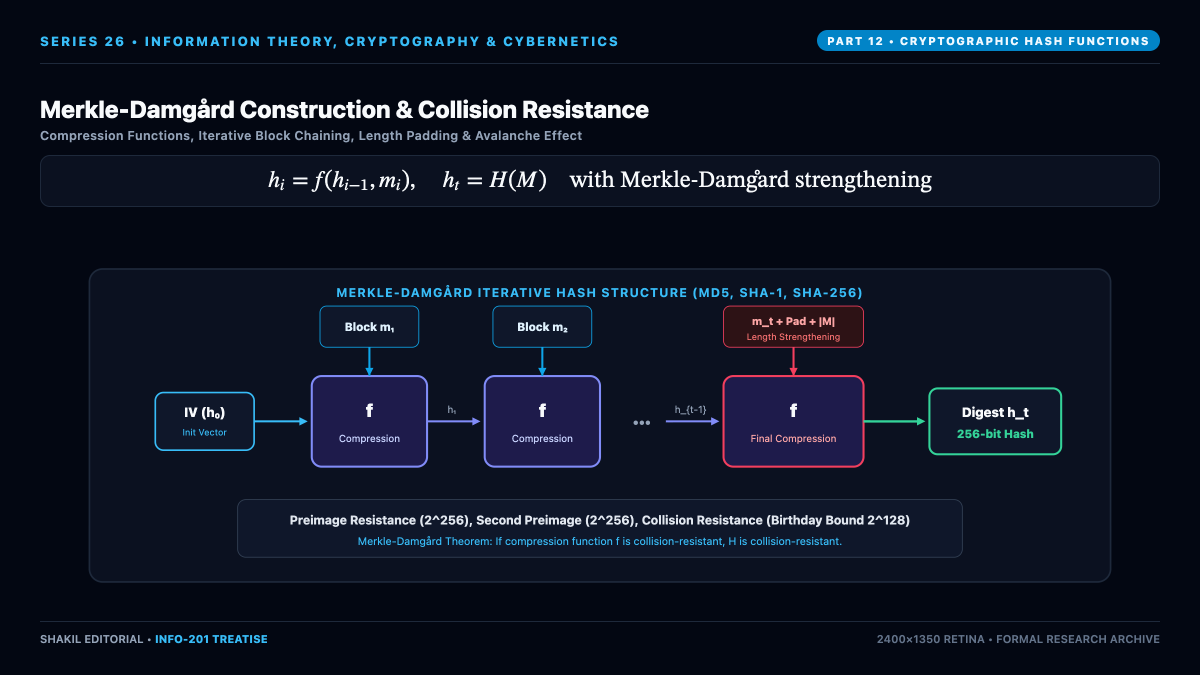
How does a hash function ingest an arbitrary stream of gigabytes? Ralph Merkle and Ivan Damgård proved that if a fixed-input compression function $f: {0, 1}^n times {0, 1}^b to {0, 1}^n$ is collision-resistant, then an iterative chaining construction extending $f$ to arbitrary input lengths is also strictly collision-resistant.
The Merkle-Damgård Protocol:
- Padding and Length Strengthening: The message $M$ of bit-length $L$ is appended with a ‘1’ bit, followed by $k$ zero bits, and finally an explicit 64-bit binary integer encoding the original message length $L$. The padded length is a multiple of block size $b$ (512 bits in SHA-256):
[
M_{text{padded}} = m_1 parallel m_2 parallel dots parallel m_t
]
The explicit length-encoding (Merkle-Damgård strengthening) is mathematically essential: it eliminates trivial collision attacks where short messages are extended. - Iterative Chaining: The internal state register is initialized to a constant Initialization Vector $h_0 = text{IV}$. For each block $i = 1, 2, dots, t$:
[
h_i = f(h_{i-1}, m_i)
] - Final Digest: The output hash is the final state: $H(M) = h_t$.
4. Inside SHA-256: Davies-Meyer and 64 Compression Rounds
In SHA-256 (part of the Secure Hash Algorithm family designed by NSA), the compression function $f$ is constructed using a Davies-Meyer block cipher:
[
h_i = E_{m_i}(h_{i-1}) oplus h_{i-1}
]
The state consists of eight 32-bit words $(A, B, C, D, E, F, G, H)$ initialized to fractional square roots of the first eight prime numbers. Each 512-bit message block is expanded into 64 words $W_0, dots, W_{63}$ and processed through 64 rounds of non-linear bitwise operations:
- Ch (Choice): $text{Ch}(E, F, G) = (E wedge F) oplus (neg E wedge G)$
- Maj (Majority): $text{Maj}(A, B, C) = (A wedge B) oplus (A wedge C) oplus (B wedge C)$
- Rotational Sums: $Sigma_0(A), Sigma_1(E)$ utilizing right bit-rotations.
The resulting feedforward XOR addition prevents inversion. Today, SHA-256 secures Bitcoin proof-of-work, Git commit trees, digital certificates, and global package integrity across the entire computational sphere.