In the same pivotal year that Claude Shannon published his communication theory, his MIT mentor and colleague Norbert Wiener published a book that captured the global intellectual imagination: “Cybernetics: Or Control and Communication in the Animal and the Machine.” Deriving the name from the Greek kybernetes (“steersman” or “governor”), Wiener synthesized information theory, neurophysiology, servomechanisms, and theoretical physics into a unified science of purposeful action. Wiener proved that purposeful behavior in animals (such as reaching for a glass of water) and machines (such as an anti-aircraft fire-control predictor or an autopilot) is governed by identical physical mathematics: the continuous sampling of error information routed through Negative Feedback Loops.
1. The Mechanical Foundations of Teleology: Purpose as Feedback
For centuries, Cartesian science rejected Aristotle’s teleology (the idea of natural purpose or goal-directed behavior) as unscientific mysticism. Wiener, alongside Arturo Rosenblueth and Julian Bigelow in their landmark 1943 paper “Behavior, Purpose and Teleology,” demonstrated that purposeful behavior is purely mechanistic. An entity achieves a goal not through mystical foresight, but by measuring the difference between its current state and its target state, feeding that difference back in reverse polarity to adjust its actuators.
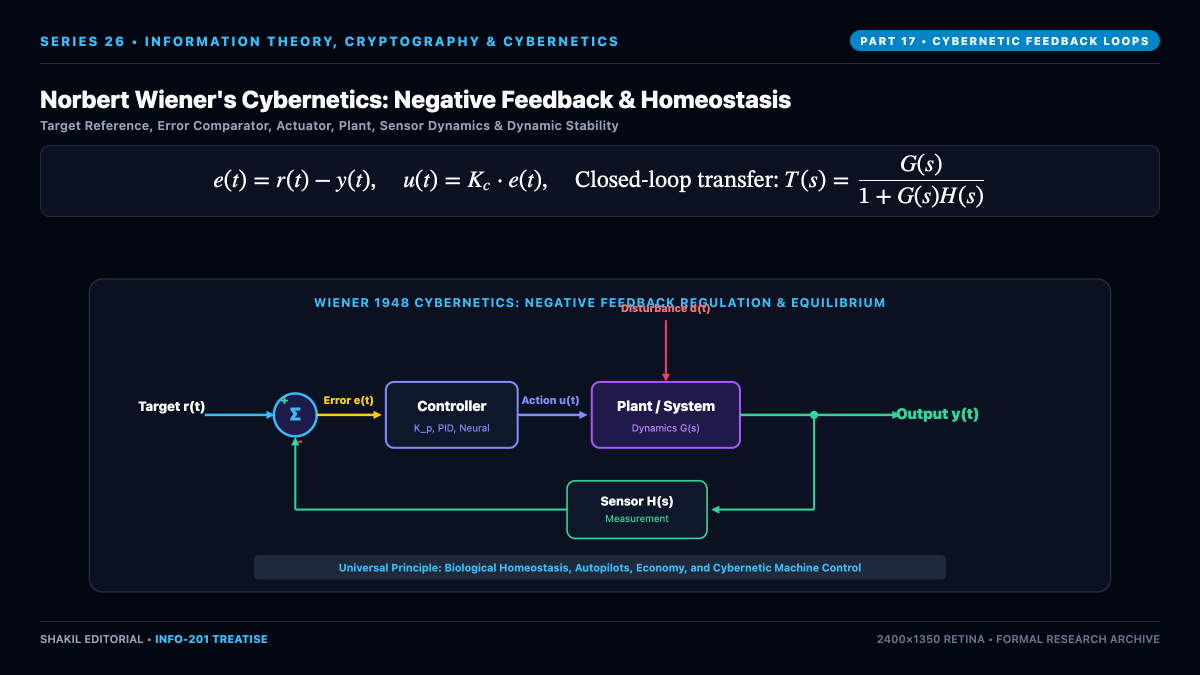
The Anatomy of a Cybernetic Control Loop:
- Reference Target $r(t)$: The desired goal or homeostatic setpoint (e.g., $37.0^circtext{C}$ core body temperature, $30,000text{ feet}$ aircraft altitude, or an autonomous vehicle lane center).
- Output State $y(t)$: The actual, measured condition of the system.
- Error Comparator $Sigma$: Computes the instantaneous error signal:
[
e(t) = r(t) – y(t)
] - Controller: Executes a functional transformation on the error signal to determine an action policy $u(t) = mathcal{K}[e(t)]$. (In classical engineering, this is modeled as Proportional-Integral-Derivative PID control: $u(t) = K_p e(t) + K_i int e(tau)dtau + K_d frac{de}{dt}$).
- Actuator & Plant $G(s)$: Physical hardware or biological musculature that exerts work on the external environment, subject to stochastic environmental disturbances $d(t)$.
- Sensory Feedback $H(s)$: Receptors (proprioceptive muscle spindles, optical cameras, gyroscopes) that measure output $y(t)$ and feed the signal back to the comparator with negative polarity.
2. Frequency-Domain Dynamics: Stability, Oscillation, and Pathology
Using Laplace transforms, the closed-loop transfer function relating reference input $R(s)$ to output $Y(s)$ is expressed by the fundamental Black feedback equation:
[
T(s) = frac{Y(s)}{R(s)} = frac{G(s)}{1 + G(s) H(s)}
]
The stability of the cybernetic system is governed entirely by the roots of the characteristic equation $1 + G(s)H(s) = 0$ (the poles of $T(s)$):
- Homeostatic Stability: If all poles lie strictly in the open left-half complex plane ($text{Re}(s) < 0$), the error decays exponentially to zero ($e(t) to 0$ as $t to infty$). Disturbances are smoothly absorbed.
- Cybernetic Pathology (Purposive Tremor): If system gain is tuned too aggressively or transmission delay $tau$ is excessive (introducing a phase shift $e^{-stau}$ that flips negative feedback into positive feedback), the system undergoes violent sinusoidal oscillations. Wiener collaborated with neurophysiologists to prove that patients suffering from cerebellar ataxia (who tremble uncontrollably when reaching for an object) suffer from the exact mathematical instability predicted by open-loop feedback phase margin collapse!
3. Information as the Negative Entropy of Life
Wiener recognized a profound thermodynamic symmetry: whereas physical entropy measures the natural decay of ordered structure into thermal equilibrium and chaos, information is the measure of organization. Living organisms are localized cybernetic engines that resist the Second Law of Thermodynamics:
“We are not the stuff that abides, but patterns that perpetuate themselves; a pattern is a message… Life is an island here and now in which the local entropy tends to decrease, where the capacity for differentiation and organization is preserved.”
By ingesting information from the environment and executing corrective feedback actions, a cybernetic organism maintains homeostatic equilibrium far from thermodynamic death. Wiener’s cybernetics bridged information theory with control engineering, establishing the conceptual lineage that directly birthed modern robotics, reinforcement learning, and autonomous artificial intelligence.