Because Claude Shannon’s One-Time Pad demands a key equal in length to the message, practical engineering requires ciphers that achieve robust security using fixed, compact secret keys (such as 128 or 256 bits). In his 1949 secrecy treatise, Shannon identified the two architectural pillars necessary to frustrate statistical cryptanalysis: Confusion (obscuring the relationship between the secret key and the ciphertext) and Diffusion (spreading the statistical influence of each individual plaintext bit across the entire ciphertext). In modern symmetric cryptography, these two imperatives are realized through two dominant designs: Feistel Networks (DES, Blowfish) and Substitution-Permutation Networks (SPNs), culminating in the worldwide standard: the Advanced Encryption Standard (AES / Rijndael).
1. Shannon’s Dual Mandate: Confusion and Diffusion
To resist frequency analysis and linear approximations, a block cipher must simulate a random permutation chosen uniformly from the symmetric group $S_{2^n}$ on $n$-bit words:
- Confusion: Implemented via non-linear substitution boxes (S-boxes). If an adversary observes a change in a single bit of the ciphertext, they cannot deduce which bit of the key was responsible. The non-linear degree must be maximized to prevent linear cryptanalysis.
- Diffusion: Implemented via permutations, bit-rotations, and matrix multiplications. If a single bit in the plaintext is flipped, the Strict Avalanche Criterion (SAC) requires that each bit of the resulting ciphertext flips with probability exactly $1/2$. After just a few rounds, all statistical correlation with natural language frequency is eradicated.
2. Horst Feistel’s Invertible Network Architecture
In the early 1970s at IBM, Horst Feistel formulated an ingenious architectural paradigm that powered the Data Encryption Standard (DES). A Feistel network splits an $2w$-bit plaintext block into two halves $(L_0, R_0) in {0, 1}^w$. For rounds $i = 1, 2, dots, r$, the state evolves according to:
[
L_i = R_{i-1}, quad R_i = L_{i-1} oplus F(R_{i-1}, K_i)
]
where $F$ is an arbitrary round function and $K_i$ is a derived round key.
Notice the structural elegance of Feistel’s construction: decryption executes the exact same circuit with the round keys reversed ($K_r, K_{r-1}, dots, K_1$):
[
R_{i-1} = L_i, quad L_{i-1} = R_i oplus F(L_i, K_i)
]
The internal round function $F$ does not need to be invertible! Even if $F$ is a one-way hash or non-invertible compression function, the overall cipher remains strictly bijective and invertible purely by virtue of the XOR group properties.
3. The Advanced Encryption Standard (AES / Rijndael)
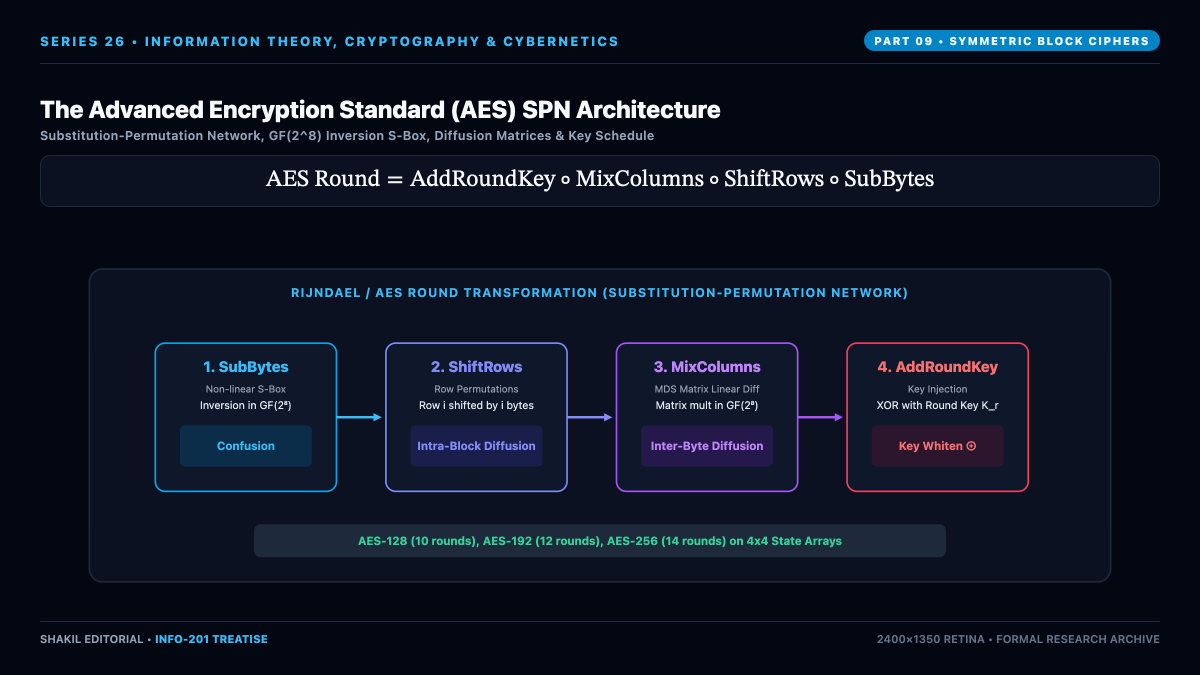
In 2001, following a multi-year public competition organized by NIST, Joan Daemen and Vincent Rijmen’s Rijndael cipher superseded DES as the Advanced Encryption Standard (FIPS 197). Abandoning the Feistel structure in favor of a pure Substitution-Permutation Network (SPN), AES processes data in a $4 times 4$ square array of bytes (128-bit state matrix).
The Four Round Operations of AES:
- SubBytes: An invertible, highly non-linear byte substitution. Each byte $a_{i,j}$ is replaced with its multiplicative inverse in the finite field $GF(2^8)$ modulo the irreducible polynomial $m(x) = x^8 + x^4 + x^3 + x + 1$ (with $0 mapsto 0$), followed by an affine bit-transformation. This non-linearity provides optimal resistance against differential cryptanalysis.
- ShiftRows: A cyclical byte permutation that shifts row $r$ left by $r$ bytes ($r in {0, 1, 2, 3}$), ensuring inter-column diffusion.
- MixColumns: A linear matrix multiplication that treats each column as a four-term polynomial over $GF(2^8)$ multiplied by $c(x) = 3x^3 + x^2 + x + 2 pmod{x^4 + 1}$. MixColumns is a Maximum Distance Separable (MDS) code operation: modifying $1$ input byte affects all $4$ output bytes of the column.
- AddRoundKey: The 128-bit state matrix is bitwise XORed with the round key $K_r$ generated by the Rijndael Key Schedule.
AES executes $10$ rounds for AES-128, $12$ rounds for AES-192, and $14$ rounds for AES-256. To this day, after a quarter-century of intense global cryptanalysis, no practical attack faster than exhaustive key search ($2^{128}$ operations) has ever succeeded against full-round AES.
4. Operational Modes: From ECB Insecurity to Authenticated AES-GCM
A block cipher encrypts only a single 128-bit block. How does one encrypt gigabytes of data securely?
- Electronic Codebook (ECB): Encrypts each block independently. Identical plaintext blocks produce identical ciphertext blocks—infamously preserving the visual outlines of images (the ECB Penguin). ECB is utterly broken.
- Cipher Block Chaining (CBC): XORs each plaintext block with the previous ciphertext block ($C_i = E_K(P_i oplus C_{i-1})$). Vulnerable to padding oracle attacks.
- Galois/Counter Mode (AES-GCM): The gold standard of modern internet security (TLS 1.3). Turns AES into a stream cipher by encrypting an incrementing counter ($C_i = P_i oplus E_K(text{IV} parallel i)$), paired with a universal hash function evaluated over $GF(2^{128})$ (GHASH) to generate an Authenticated Encryption with Associated Data (AEAD) tag that guarantees both confidentiality and mathematical tamper-resistance.