In July and October of 1948, a 32-year-old mathematician and engineer at Bell Telephone Laboratories named Claude Elwood Shannon published a two-part monograph in the Bell System Technical Journal titled “A Mathematical Theory of Communication.” In fewer than one hundred pages, Shannon did not merely solve a specific engineering problem; he invented an entire academic discipline out of thin air. Before Shannon, communication was understood as an analog, domain-specific craft—telegraphy manipulated electrical pulses, telephony carried continuous acoustic waves, and radio modulated electromagnetic carrier frequencies. Shannon demonstrated that all communication is fundamentally unified: regardless of whether the source is text, voice, music, or high-definition imagery, information can be abstracted into discrete symbols, measured in fundamental binary units called bits, and reliably transmitted across noisy physical channels up to a strict mathematical threshold.
1. The Semantic Decoupling: Information as Choice, Not Meaning
The philosophical breakthrough that enabled Shannon’s mathematical formulation was his radical decision to sever the concept of information from human meaning. In ordinary vernacular, information is conflated with semantics, wisdom, or truth. Shannon recognized that if engineering was to analyze communication quantitatively, it could not concern itself with psychological or philosophical interpretations:
“Frequently the messages have meaning; that is they refer to or are correlated according to some system with certain physical or conceptual entities. These semantic aspects of communication are irrelevant to the engineering problem. The fundamental problem of communication is that of reproducing at one point either exactly or approximately a message selected at another point.”
For Shannon, a message carries information not because it is profound or important, but because it represents a selection from an ensemble of possible choices. If a weather forecast in the Sahara Desert reports “sunny today,” it conveys almost zero information because sunny weather was nearly certain. If, however, it reports “heavy snowstorm in the Sahara,” it conveys immense information because a highly improbable choice was selected from the state space. Information is thus quantitatively identical to the reduction of prior uncertainty.
2. The General Communication System Architecture
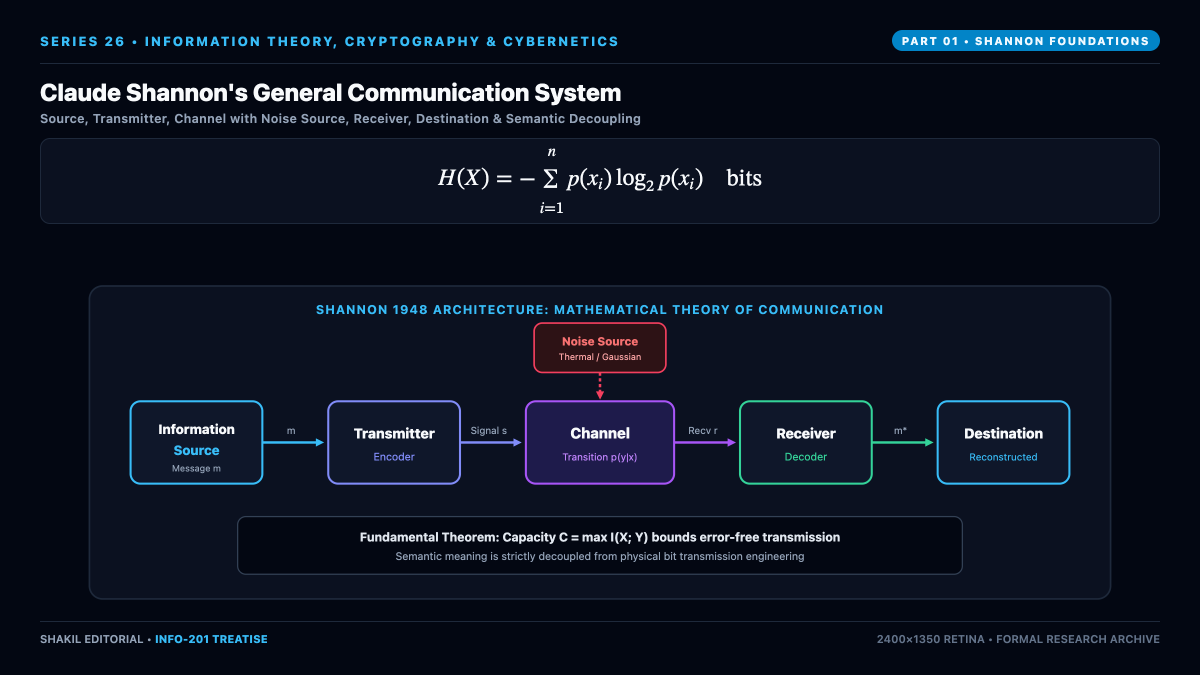
Shannon established an enduring five-stage architectural paradigm that remains the standard blueprint for all digital telecommunications, computer networks, and data storage systems:
- Information Source: Produces a message or sequence of messages to be communicated. This source is modeled mathematically as a stochastic process generating symbols ${x_1, x_2, dots}$ according to a probability distribution $p(x)$.
- Transmitter (Encoder): Operates on the message in some way to produce a physical signal suitable for transmission over the channel. The transmitter transforms the source sequence into a discrete codeword.
- The Channel: The physical medium used to transmit the signal from transmitter to receiver (copper pairs, optical fibers, atmospheric radio paths, or magnetic disk platters). The channel is inherently subject to distortion, attenuation, and noise.
- Noise Source: A stochastic physical process (thermal Johnson noise, cosmic background radiation, electromagnetic interference) that perturbs the transmitted signal, causing the received signal $y$ to differ from the transmitted signal $x$.
- Receiver (Decoder): Performs the inverse operation of the transmitter, attempting to reconstruct the original message $m$ from the corrupted received signal $y$.
- Destination: The person (or machine) for whom the message is intended.
3. The Logarithmic Measure and The Invention of the “Bit”
How should information be measured mathematically? Consider an information source choosing from $M$ equally likely alternative messages. Shannon argued that the measure of information $I(M)$ must satisfy three natural intuitive requirements:
- Monotonicity: A source with more choices must convey more information: if $M_1 > M_2$, then $I(M_1) > I(M_2)$.
- Additivity across Independent Systems: If two independent systems offer $M_1$ and $M_2$ choices respectively, the joint system offers $M_1 times M_2$ choices, and the information conveyed must be the sum of their individual choices:
[
I(M_1 cdot M_2) = I(M_1) + I(M_2)
] - Continuity: Small perturbations in the probabilities of selection must yield small continuous changes in the information measure.
The unique mathematical function satisfying Cauchy’s functional equation $f(xy) = f(x) + f(y)$ under continuity is the logarithm:
[
I(M) = K log_b(M)
]
By choosing base $b = 2$ and constant $K = 1$, the unit of information represents the decision between two equally likely alternatives ($M = 2 implies log_2(2) = 1$). Acknowledging a suggestion by his Bell Labs colleague John Tukey, Shannon named this fundamental atom of digital existence the bit—a portmanteau of binary digit.
4. Mathematical Formalization of Discrete Entropy
When the symbols in the source alphabet $mathcal{X} = {x_1, x_2, dots, x_n}$ are not equally likely, but appear with non-uniform probabilities $p_1, p_2, dots, p_n$ such that $sum_{i=1}^n p_i = 1$, how much information does the source generate on average?
The “surprisal” or self-information of observing symbol $x_i$ is inversely proportional to its likelihood: $I(x_i) = log_2(1 / p_i) = -log_2 p_i$. Taking the statistical expectation over the entire probability distribution yields the celebrated Shannon Entropy:
[
H(X) = mathbb{E}[I(X)] = -sum_{i=1}^n p(x_i) log_2 p(x_i) quad text{bits/symbol}
]
When John von Neumann learned of Shannon’s formula, he famously advised him: “You should call it entropy, for two reasons. In the first place your uncertainty function has been used in statistical mechanics under that name, so it already has a name. In the second place, and more important, no one really knows what entropy is, so in a debate you will always have the advantage!”
As we will prove in Part 02, Shannon entropy is not a loose physical analogy; it is the exact measure of information density that dictates the physical boundaries of compression, computation, and communication in our universe.