In 1975, Argentine-American mathematician Gregory Chaitin discovered one of the most mysterious and profound constants in the whole of mathematical physics: the Halting Probability, denoted by the Greek letter $Omega$ (Omega). A real number between $0$ and $1$, Chaitin’s constant encapsulates the probability that a randomly generated computer program will eventually halt. $Omega$ is maximally dense with mathematical truth: knowing the first several thousand binary digits of $Omega$ would allow you to resolve the Riemann Hypothesis, Fermat’s Last Theorem, P versus NP, and every well-posed conjecture in formal mathematics. Yet, Chaitin proved that $Omega$ is algorithmically irreducible and uncomputable, establishing an ultimate information-theoretic proof of Gödel’s Incompleteness Theorems.
1. Self-Delimiting Turing Machines and Prefix Complexity
Standard Kolmogorov complexity suffers from technical subtleties because a Turing machine reading an arbitrary program tape cannot easily discern where the program ends without an explicit end-marker. To resolve this, Chaitin introduced Prefix-Free (Self-Delimiting) Kolmogorov Complexity, denoted $K(s)$.
A prefix-free machine $M$ is a Turing machine whose valid program domain $text{Dom}(M) subset {0, 1}^*$ forms a prefix code: no valid program is a proper prefix of another. By the Kraft inequality, the sum of algorithmic probabilities over all halting programs must strictly converge:
[
sum_{p in text{Dom}(M)} 2^{-|p|} le 1
]
The prefix complexity $K(s)$ is the length of the shortest prefix-free program generating $s$. This normalization elevates algorithmic complexity into a mathematically rigorous probability measure.
2. Formulating Chaitin’s Constant $Omega$
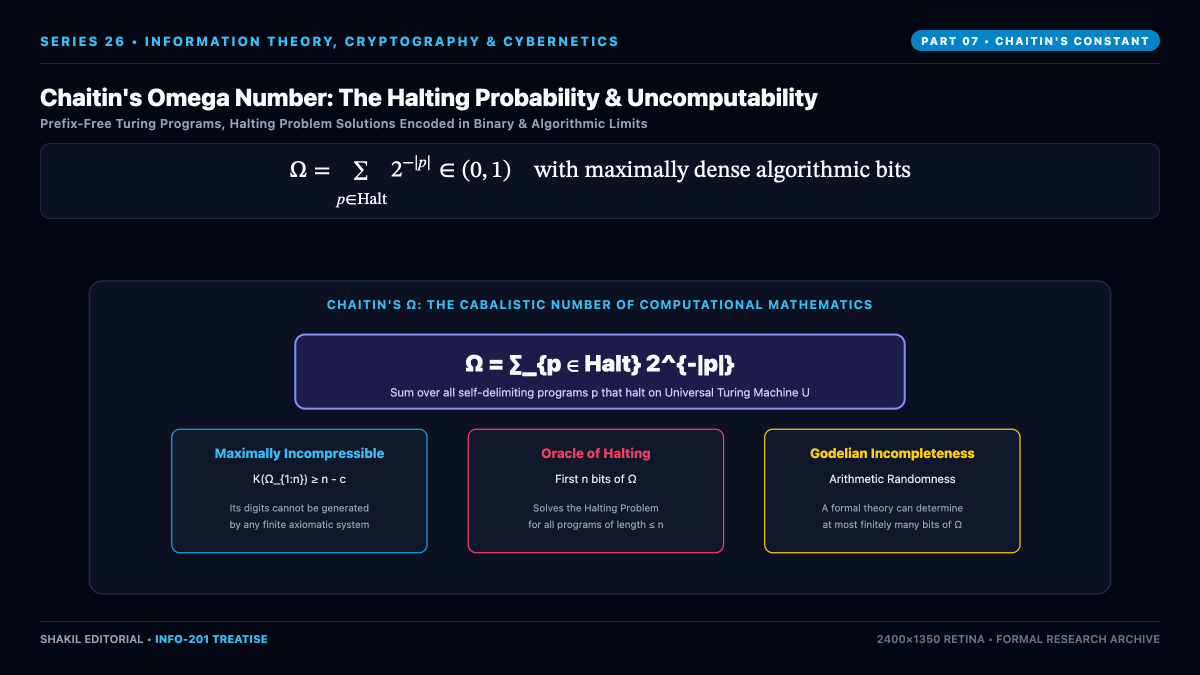
Let $U$ be a universal prefix-free Turing machine. Imagine feeding $U$ an infinite stream of random bits generated by fair coin tosses ($0$ or $1$ with probability $1/2$). The probability that this sequence begins with a valid self-delimiting program that eventually halts is Chaitin’s Halting Probability $Omega$:
[
Omega_U = sum_{p in text{Halt}_U} 2^{-|p|}
]
Because $text{Dom}(U)$ is prefix-free and not every random program halts, $Omega$ is a real number strictly bounded within the unit interval:
[
0 < Omega < 1
]
3. The Information Density of $Omega$: The Oracle of Truth
Why is $Omega$ described as the “cabalistic number of wisdom”? Because its binary digits encode the solutions to all recursively enumerable computational problems.
Suppose an oracle provides you with the first $n$ bits of the binary expansion of $Omega$, denoted $Omega_{1:n} = 0.omega_1 omega_2 dots omega_n$. You can solve the Turing Halting Problem for every program of length $le n$ through the following procedure:
- Simulate in parallel all possible programs of lengths $1, 2, dots$ on machine $U$.
- Whenever any program $p$ halts, add $2^{-|p|}$ to a running sum approximation $Omega_{approx}$.
- Continue the simulation until the running sum exceeds the lower bound provided by your oracle:
[
Omega_{approx} ge Omega_{1:n}
] - At that exact instant, no other program of length $le n$ can ever halt in the future! If any remaining program of length $le n$ were to halt later, it would add at least $2^{-n}$ to the sum, causing $Omega_{approx}$ to exceed the true value $Omega$, which is mathematically impossible.
Because mathematical conjectures—such as the Riemann Hypothesis or Goldbach’s Conjecture—can be encoded as short computer programs searching for counterexamples (many requiring fewer than $1,000$ bits), knowing the first few thousand bits of $Omega$ would instantly reveal whether counterexamples exist, deciding nearly every famous open problem in the history of mathematics!
4. The Ultimate Incompressibility & Gödel’s Horizon
The tragedy of computational mathematics is that $Omega$ cannot be computed. In fact, Chaitin proved that $Omega$ is maximally algorithmically random (Martin-Löf random):
[
K(Omega_{1:n}) ge n – c
]
Its binary digits contain zero redundancy, zero compressible patterns, and cannot be predicted by any deterministic or probabilistic algorithm better than flipping a coin.
Kurt Gödel showed in 1931 that formal mathematical systems are incomplete. Chaitin reformulated this through algorithmic information:
“A formal axiomatic system with $k$ bits of axioms cannot prove the value of more than $k + c$ bits of $Omega$.”
No matter how vast our mathematical theories (Zermelo-Fraenkel set theory ZFC with large cardinals), they embody only a finite number of bits of algorithmic complexity. They can determine at most a tiny handful of initial bits of $Omega$. Beyond that boundary lies a universe of absolute, irreducible algorithmic randomness—truth that is true for no simpler reason than itself.