Shannon’s 1948 Noisy-Channel Coding Theorem proved the mathematical existence of codes that transmit information at rates up to channel capacity with vanishingly small error probability. However, Shannon’s proof was non-constructive—it relied on random codebooks that required exponential lookup tables, rendering decoding computationally intractable. The subsequent five decades of coding theory became an epic quest to construct structured algebraic geometries that could be decoded in polynomial time while approaching Shannon’s capacity limit. This journey spans the early geometric parity spheres of Richard Hamming to the non-binary polynomials of Reed-Solomon and the sparse graph message-passing revolutions of Low-Density Parity-Check (LDPC) and Polar codes.
1. Linear Block Codes: The Algebraic Framework
An $[n, k, d]$ binary linear block code encodes $k$ message bits into an $n$-bit codeword ($n > k$) with minimum Hamming distance $d$. The code subspace $mathcal{C} subset mathbb{F}_2^n$ is a $k$-dimensional vector space over the Galois Field $mathbb{F}_2$.
Generator and Parity-Check Matrices
The code is fully specified by two linear operators:
- Generator Matrix $G in mathbb{F}_2^{k times n}$: Maps message vector $m in mathbb{F}_2^k$ to codeword $c in mathbb{F}_2^n$:
[
c = m cdot G
] - Parity-Check Matrix $H in mathbb{F}_2^{(n-k) times n}$: Orthogonal dual operator satisfying $G cdot H^T = 0 pmod 2$. A vector $r$ is a valid codeword if and only if its syndrome $s$ vanishes:
[
s = r cdot H^T = 0 pmod 2
]
If a transmission error $e in mathbb{F}_2^n$ corrupts the codeword ($r = c oplus e$), the syndrome evaluates directly to the error pattern: $s = (c oplus e) H^T = e H^T$. The minimum Hamming distance $d$ determines error performance: a code can detect up to $d – 1$ bit errors, and can correct up to $t = lfloor (d-1)/2 rfloor$ bit errors.
2. Classic Algebraic Codes: Hamming and Reed-Solomon
In 1950, Richard Hamming formulated the $[7, 4, 3]$ Hamming Code, the first perfect linear code capable of correcting any single-bit error ($t = 1$). However, magnetic disks, optical media (CDs/DVDs), and satellite transmissions suffer from correlated bursts of noise that destroy dozens of adjacent bits simultaneously.
In 1960, Irving Reed and Gustave Solomon invented Reed-Solomon (RS) Codes over higher Galois fields $mathbb{F}_{2^m} = GF(2^m)$. An $[n, k]$ RS code treats message symbols as the coefficients of a polynomial $P(x) = sum_{j=0}^{k-1} m_j x^j$ of degree $< k$. The codeword is formed by evaluating $P(x)$ at $n$ distinct field elements ${alpha_1, alpha_2, dots, alpha_n}$:
[
c = (P(alpha_1), P(alpha_2), dots, P(alpha_n))
]
By the fundamental theorem of algebra, any two distinct polynomials of degree $< k$ can intersect at most $k-1$ times. Therefore, the minimum distance between any two RS codewords is precisely:
[
d = n – k + 1
]
This achieves the theoretical ceiling known as the Singleton Bound ($d le n – k + 1$). Codes achieving this bound are termed Maximum Distance Separable (MDS). Decoded via the Berlekamp-Massey algorithm, RS codes formed the backbone of Voyager deep space telemetry and the compact disc format.
3. Modern Iterative Coding: LDPC & Tanner Graphs
Despite their elegance, classical algebraic block codes fell short of Shannon’s capacity limit by several decibels. The modern coding revolution began when Robert Gallager’s 1962 doctoral thesis on Low-Density Parity-Check (LDPC) codes was rediscovered in the late 1990s by David MacKay and Radford Neal.
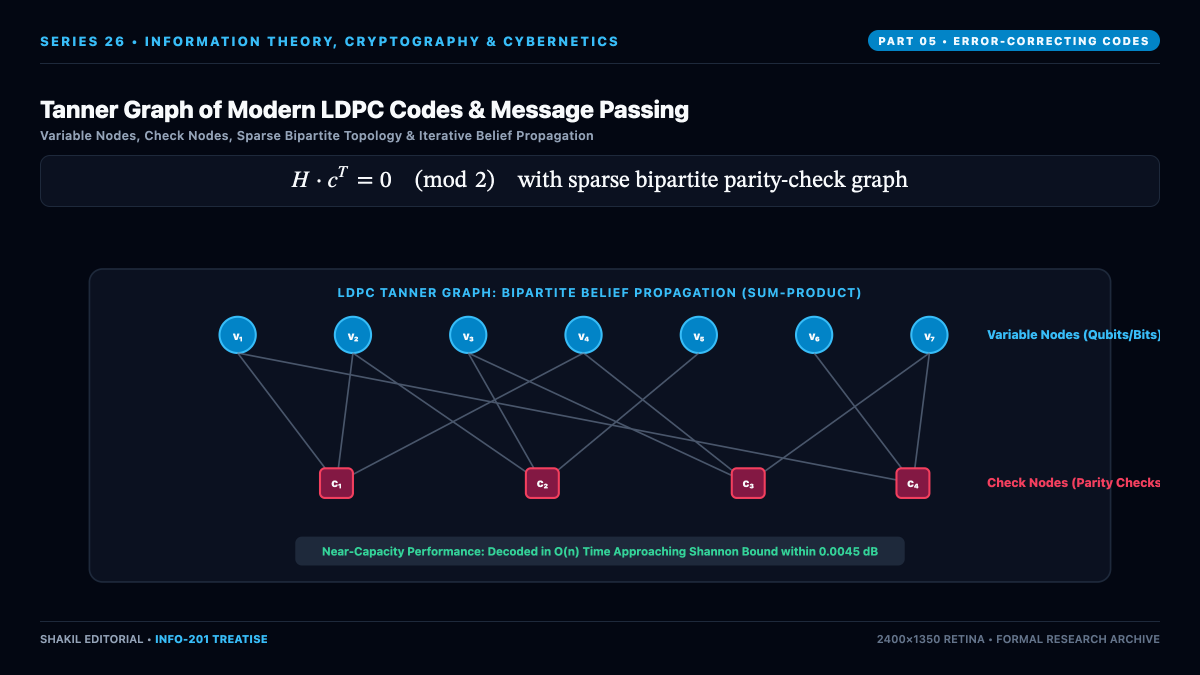
An LDPC code is defined by a parity-check matrix $H$ that is extremely sparse: the number of 1s in each row and column is small ($mathcal{O}(1)$) compared to block length $n$. This sparsity is mapped onto a bipartite Tanner Graph connecting $n$ Variable Nodes (representing code bits) to $n-k$ Check Nodes (representing parity constraints).
The Belief Propagation (Sum-Product) Algorithm
Instead of hard algebraic inversion, LDPC codes decode via iterative probabilistic message passing across the graph edges in logarithmic likelihood ratios (LLR):
[
L(v_i) = ln left( frac{mathbb{P}(v_i = 0 | y_i)}{mathbb{P}(v_i = 1 | y_i)} right)
]
In each iteration, check nodes update extrinsic parity confidence, while variable nodes update marginal bit beliefs. Operating in linear time $mathcal{O}(n)$, optimized irregular LDPC codes have been proven to operate within a staggering $0.0045 text{ dB}$ of the Shannon capacity limit, becoming the core standard for 5G New Radio, Wi-Fi 6 (802.11ax), and DVB-S2 satellite broadcasting.