Throughout the history of mathematics, proving a theorem required revealing the step-by-step argument. If you possessed a cryptographic password, proving you knew it required presenting the password or a derived hash. In 1985, Shafi Goldwasser, Silvio Micali, and Charles Rackoff published a paper that fundamentally revolutionized logic and theoretical computer science: “The Knowledge Complexity of Interactive Proof Systems.” They proved that it is mathematically possible for a Prover to convince a Verifier with $100%$ certainty that a statement is true—such as knowing the solution to a complex equation or holding a valid private key—while revealing precisely zero bits of information beyond the mere fact that the statement is true. Today, Zero-Knowledge Proofs (ZKPs), reincarnated as zk-SNARKs, constitute the cutting edge of blockchain scalability and mathematical privacy.
1. The Three Axiomatic Pillars of Zero-Knowledge
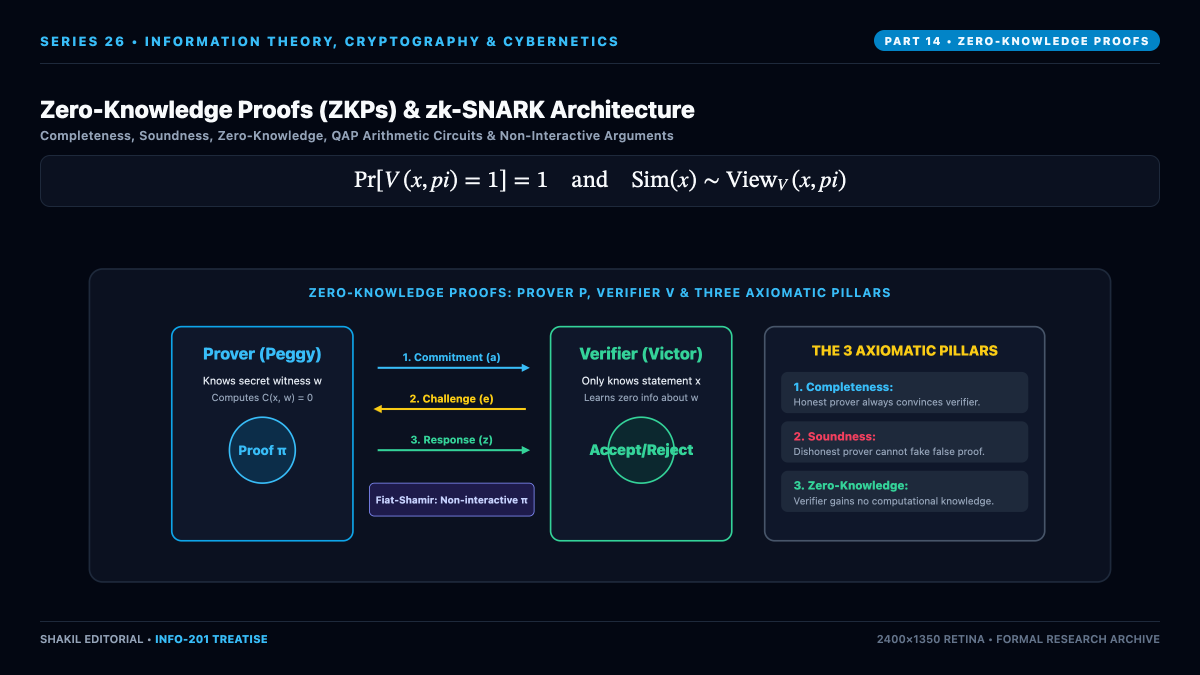
An interactive proof system between a Prover $P$ and a Verifier $V$ for a language $L in text{NP}$ is a Zero-Knowledge Proof if it satisfies three strict properties:
- Completeness: If the statement is true and both Prover and Verifier follow the protocol honestly, the Verifier always accepts:
[
mathbb{P}[V(x, pi) = 1] = 1
] - Soundness: If the statement is false, no cheating Prover $P^*$ can convince the honest Verifier except with a negligibly small probability $epsilon$:
[
mathbb{P}[V^*(x, pi) = 1] le epsilon
] - Zero-Knowledge: If the statement is true, the Verifier learns nothing beyond that fact. Formally, for every polynomial-time verifier $V^*$, there exists a polynomial-time Simulator $S$ that, given only the public statement $x$ (and no witness), can produce a transcript indistinguishable from the actual interactive view:
[
S(x) approx text{View}_{V^*}(P(w) leftrightarrow V^*(x))
]
The Simulation Paradigm is the conceptual masterpiece of modern cryptography: if a third party can fake the entire conversation without knowing the secret, then the real conversation could not possibly have leaked any secret information!
2. Canonical Construction: Graph 3-Colorability
Oded Goldreich, Silvio Micali, and Avi Wigderson proved in 1991 that every language in $text{NP}$ possesses a Zero-Knowledge Proof, using the NP-complete problem of Graph 3-Coloring.
- The Prover knows a valid 3-coloring of a graph $G = (V, E)$ using colors ${text{Red, Green, Blue}}$.
- In each round, the Prover randomly permutes the colors (e.g., Red $mapsto$ Green, Green $mapsto$ Blue, Blue $mapsto$ Red).
- The Prover places each vertex’s permuted color in an individual digital locked box (cryptographic commitment) and sends all locked boxes to the Verifier.
- The Verifier randomly selects a single edge $e = (u, v) in E$ and challenges the Prover to reveal the colors of vertices $u$ and $v$.
- The Prover unlocks only those two boxes. The Verifier checks that the two colors are distinct.
Because the colors were permuted randomly, seeing two different colors reveals zero information about the global 3-coloring. Repeating this game $M = |E|^2$ times reduces the probability of a cheating prover escaping detection to $(1 – 1/|E|)^M le e^{-|E|} to 0$.
3. zk-SNARK Architecture: From Circuits to Polynomials
While interactive proofs require hundreds of communication back-and-forth exchanges, modern distributed systems require proofs that are non-interactive, tiny in size ($approx 256 text{ bytes}$), and verified in milliseconds. This is achieved by zk-SNARKs (Zero-Knowledge Succinct Non-Interactive Arguments of Knowledge).
The 4-Stage Compilation Pipeline:
- Computation to Arithmetic Circuit: The computational statement (e.g., verifying a cryptographic transaction) is flattened into a system of basic arithmetic addition and multiplication gates over a prime field $mathbb{F}_p$.
- R1CS (Rank-1 Constraint System): The circuit gates are encoded into vector constraints of the form $(A cdot s) times (B cdot s) = C cdot s$, where $s$ is the witness vector.
- Quadratic Arithmetic Programs (QAP): Using Lagrange polynomial interpolation, the thousands of R1CS vector constraints are bundled into a single polynomial identity:
[
A(x) cdot B(x) – C(x) = H(x) cdot T(x)
]
where $T(x) = prod_{i=1}^m (x – r_i)$ is a known target polynomial. - Schwartz-Zippel & Elliptic Curve Pairings: Instead of checking the polynomial across all points, the Prover evaluates the polynomial at a secret random point $tau$ using homomorphic elliptic curve pairings (bilinear maps $e(G_1, G_2) to G_T$). By the Schwartz-Zippel lemma, if the polynomials match at a single random point $tau$, they are identical everywhere with overwhelming probability.
Using the Fiat-Shamir Heuristic, the random challenge is replaced by hashing the prover’s commitment, producing a completely non-interactive proof that can be verified on an Ethereum smart contract in less than 5 milliseconds, enabling private cryptocurrencies (Zcash) and zero-knowledge rollups (zkSync, Starknet).