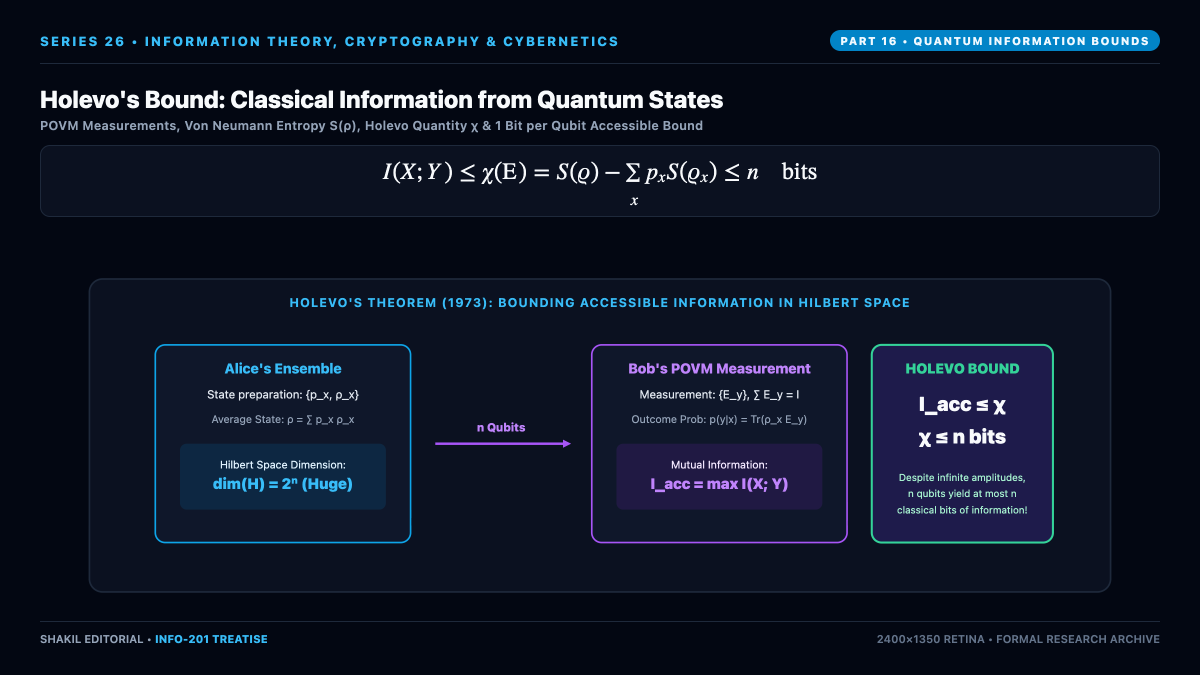
What happens when the physical carriers of information obey not the laws of classical probability, but the counter-intuitive principles of quantum mechanics? A single qubit lives in a two-dimensional complex Hilbert space $mathcal{H}_2$; an $n$-qubit register inhabits a state space of dimension $2^n$. Because continuous quantum amplitudes $alpha |0rangle + beta |1rangle$ can take an uncountably infinite continuum of values, one might naively suspect that an astronomical volume of classical data could be packed into a single quantum particle. In 1973, Soviet mathematician Alexander Holevo proved this intuition entirely false. In one of the cornerstone theorems of modern physics—Holevo’s Bound—he proved that no physical measurement can ever extract more than precisely $n$ classical bits of information from $n$ physical qubits.
1. Von Neumann Entropy: Quantum Uncertainty
In classical information theory, uncertainty is measured by Shannon entropy $H(p)$ over a probability distribution. In quantum mechanics, a mixed quantum state is represented by a Density Operator $rho$ acting on Hilbert space $mathcal{H}$, satisfying $rho = rho^dagger$, $rho ge 0$, and $text{Tr}(rho) = 1$.
In 1932, John von Neumann formulated the quantum counterpart to Shannon’s measure—the Von Neumann Entropy:
[
S(rho) = -text{Tr}(rho log_2 rho) = -sum_{i} lambda_i log_2 lambda_i
]
where $lambda_i$ are the eigenvalues of the density matrix $rho$.
Core Mathematical Properties of Quantum Entropy:
- Pure States: If the system is in a pure state $|psirangle$, then $rho = |psiranglelanglepsi|$, having eigenvalues ${1, 0, 0, dots}$. Thus, $S(rho) = 0$. Pure quantum states have zero entropy.
- Maximally Mixed State: In an $d$-dimensional Hilbert space, the maximally mixed state $rho = frac{1}{d} I$ achieves maximum entropy: $S(rho) = log_2(d)$. For $n$ qubits ($d = 2^n$), $S(rho) = n$ bits.
- Strong Subadditivity (Lieb-Ruskai Theorem, 1973): For any tripartite quantum system $mathcal{H}_A otimes mathcal{H}_B otimes mathcal{H}_C$:
[
S(rho_{ABC}) + S(rho_B) le S(rho_{AB}) + S(rho_{BC})
]
This profound inequality guarantees that quantum conditional mutual information is non-negative, serving as the mathematical backbone of quantum error correction and black hole thermodynamics.
2. Accessible Information and POVM Measurements
Suppose Alice wants to transmit classical messages $x in mathcal{X}$ to Bob. She prepares an ensemble of quantum states: with probability $p_x$, she prepares the density operator $rho_x$, resulting in the average state $rho = sum_x p_x rho_x$.
To read out Alice’s message, Bob performs a generalized quantum measurement described by a Positive Operator-Valued Measure (POVM) ${E_y}_{y in mathcal{Y}}$, where $E_y ge 0$ and $sum_y E_y = I$. By Born’s rule, Bob observes outcome $y$ with probability:
[
p(y|x) = text{Tr}(rho_x E_y)
]
The classical information transmitted between Alice and Bob is the mutual information $I(X; Y)$. The Accessible Information is the supremum of $I(X; Y)$ over all possible quantum measurements Bob could physically construct:
[
I_{text{acc}} = sup_{{E_y}} I(X; Y)
]
3. Holevo’s Theorem (Holevo’s Bound)
Evaluating $I_{text{acc}}$ is notoriously difficult because optimizing over all POVMs involves unconstrained non-linear matrices. Alexander Holevo bypassed this barrier by establishing an absolute, easily computable upper bound:
[
I_{text{acc}} le chi(mathcal{E})
]
where $chi(mathcal{E})$ is the Holevo Information (or Holevo Quantity) of the ensemble $mathcal{E} = {p_x, rho_x}$:
[
chi(mathcal{E}) = S(rho) – sum_{x} p_x S(rho_x) = Sleft( sum_x p_x rho_x right) – sum_x p_x S(rho_x)
]
Notice that for an $n$-qubit register, the maximum von Neumann entropy is bounded by the number of physical qubits: $S(rho) le n$. Because $S(rho_x) ge 0$, the Holevo quantity satisfies:
[
I(X; Y) le chi(mathcal{E}) le S(rho) le n quad text{bits}
]
This establishes the profound physical principle: You cannot encode more than $n$ classical bits into $n$ physical qubits such that they can be read out reliably by any physical measurement.
Even though an $n$-qubit quantum superposition lives in a $2^n$-dimensional Hilbert space that requires $2^n$ complex numbers to describe classically, nature strictly censors our ability to access this amplitude continuum. Measurement projects the quantum state, destroying the superposed phase information and limiting classical extraction to 1 bit per qubit.
4. Schumacher’s Quantum Source Coding Theorem
In 1995, Benjamin Schumacher formulated the quantum analog of Shannon’s Source Coding Theorem. He proved that an i.i.d. source of quantum states generated according to density operator $rho$ can be compressed into $n S(rho)$ physical qubits with fidelity approaching $1$ as $n to infty$. The von Neumann entropy $S(rho)$ is therefore the exact fundamental limit of quantum data compression, cementing quantum information theory as the true physics of computation.