Claude Shannon’s 1948 foundational theorems analyzed isolated, point-to-point communication channels: a single transmitter sending data to a single receiver across a single noisy pipe. In the modern physical universe, however, communication is fundamentally a networked, multi-terminal phenomenon. Mobile phones share overlapping electromagnetic spectra, satellite constellations relay cross-linked packets, and distributed sensor arrays monitor ecological habitats without talking to one another. To model these interconnected topologies, Network Information Theory expanded Shannon’s equations into high-dimensional geometries, yielding counter-intuitive mathematical breakthroughs such as the Slepian-Wolf Theorem, Multiple Access Channel (MAC) capacity pentagons, and Ahlswede Network Coding.
1. The Slepian-Wolf Theorem: Distributed Source Coding
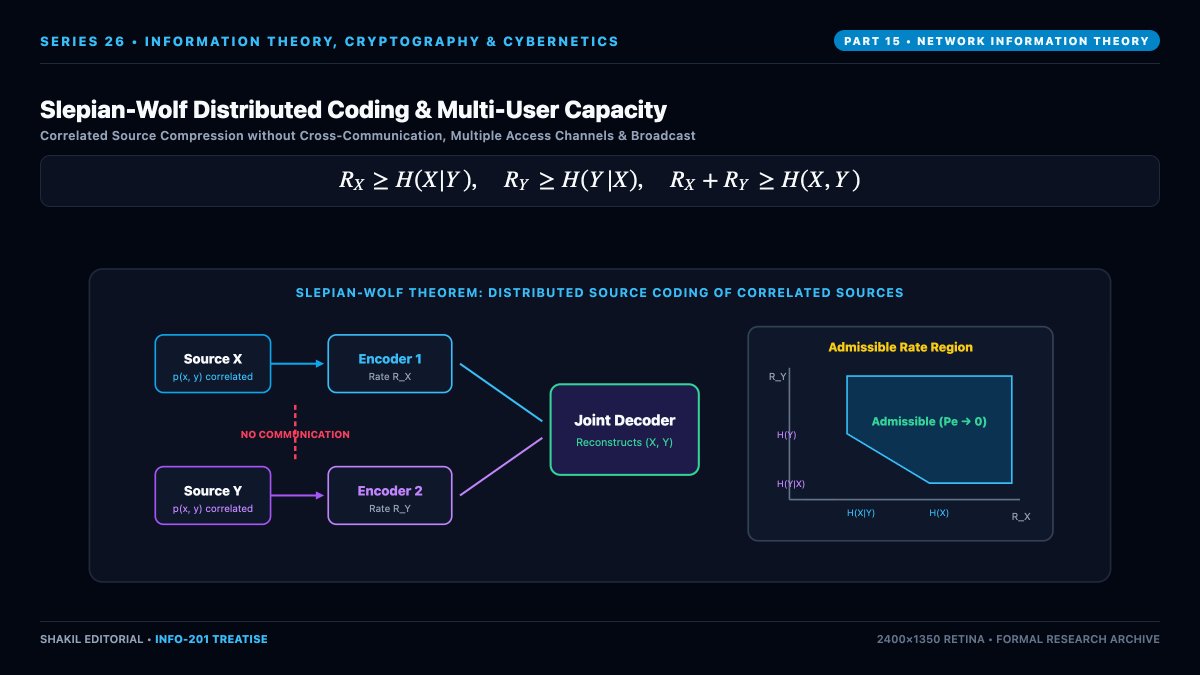
Consider two correlated information sources $X$ and $Y$ (e.g., two weather sensors separated by several kilometers measuring correlated temperatures). They send their data over separate channels to a common base station decoder. Crucially, the two encoders cannot communicate or coordinate with each other.
Common intuition suggests that because Encoder 1 knows nothing about what Encoder 2 is sending, Encoder 1 must transmit at rate $R_X ge H(X)$, and Encoder 2 must transmit at rate $R_Y ge H(Y)$, requiring a combined rate of $R_X + R_Y ge H(X) + H(Y)$.
In 1973, David Slepian and Jack Wolf published a stunning theorem that shattered this intuition: Distributed, non-communicating encoders can compress correlated data just as efficiently as if they were physically wired together in the same room!
The Slepian-Wolf Admissible Rate Region:
[
R_X ge H(X|Y), quad R_Y ge H(Y|X), quad R_X + R_Y ge H(X, Y)
]
As long as the joint decoder receives both streams, it can exploit the correlation to reconstruct both sources losslessly at the theoretical joint entropy limit $H(X, Y)$.
The Algebraic Mechanism: Random Binning
How can this occur without cross-communication? Slepian and Wolf proved this using Random Binning. Encoder 1 partitions the space of $n$-sequences $X^n$ randomly into $2^{n R_X}$ bins, and simply transmits the bin index (coset syndrome) rather than the sequence itself. Because $Y^n$ is correlated with $X^n$, the joint decoder uses $Y^n$ as side information to look inside the specified bin and uniquely identify the single sequence $X^n$ that is jointly typical with $Y^n$!
2. Multiple Access Channels (MAC): The Uplink Frontier
A Multiple Access Channel models multiple independent transmitters (e.g., millions of mobile phones) sending signals to a single base station receiver over a shared medium. For two transmitters sending messages $W_1$ and $W_2$ at rates $R_1$ and $R_2$ into a channel $p(y | x_1, x_2)$, the capacity region is a pentagon defined by three mutual information inequalities:
[
begin{aligned}
R_1 &le I(X_1; Y | X_2) \
R_2 &le I(X_2; Y | X_1) \
R_1 + R_2 &le I(X_1, X_2; Y)
end{aligned}
]
Operating on the boundary of this capacity pentagon is achieved via Successive Interference Cancellation (SIC): the base station decodes user 1 first (treating user 2 as noise), subtracts user 1’s reconstructed waveform perfectly from the received signal, and then decodes user 2 with zero interference!
3. Broadcast Channels: Downlink Superposition Coding
The dual of the MAC is the Broadcast Channel (BC), where a single transmitter (e.g., a cellular tower or TV satellite) broadcasts separate messages to multiple receivers with differing signal-to-noise ratios. Thomas Cover proved that time-division multiplexing (giving 50% time to user 1 and 50% to user 2) is strictly sub-optimal.
The optimal strategy is Superposition Coding: the transmitter superimposes the high-rate cloud code intended for the user with good channel conditions directly on top of the robust low-rate satellite code intended for the distant user with poor channel conditions. The strong user decodes the coarse message first, cancels it out via SIC, and then extracts their high-speed payload.
4. Network Coding: The Butterfly Network
In 2000, Rudolf Ahlswede, Ning Cai, Shuo-Yen Robert Li, and Raymond Yeung proved that treating network routers as mere “store-and-forward” packet switches is fundamentally sub-optimal. In the iconic Butterfly Network, two source nodes $S_1, S_2$ transmit to two receivers $R_1, R_2$ through a central bottleneck link.
By having the intermediate bottleneck router perform algebraic mixing—computing the linear XOR sum $b_1 oplus b_2$—both receivers can decode their intended messages simultaneously. Network coding achieves the Max-Flow Min-Cut capacity of graphs, representing the modern theoretical foundation of peer-to-peer streaming and cloud storage redundancy.