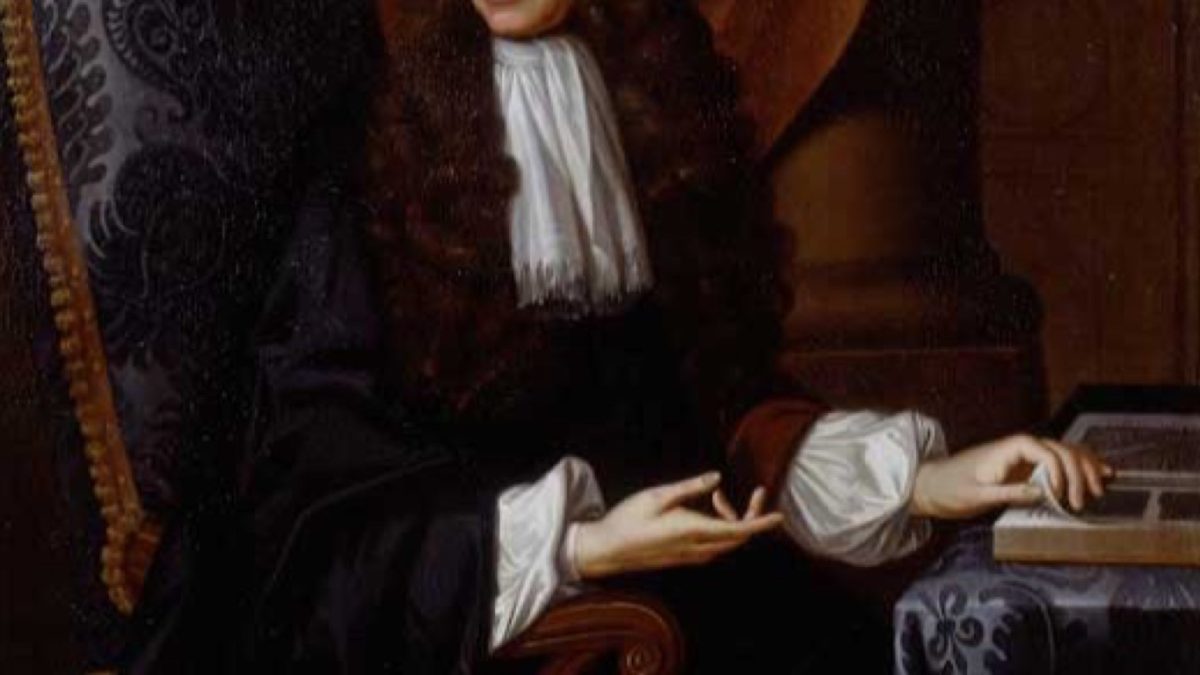
By the mid-seventeenth century, the intellectual landscape of Western Europe was convulsed by the Scientific Revolution. Galileo had trained his telescope on the Jovian moons; Descartes had proposed a mechanical universe of vortices; and William Harvey had demonstrated the mechanical circulation of the blood. Yet chemistry remained trapped in a mystical twilight. Paracelsian physicians still spoke of the tria prima (Sulfur, Mercury, Salt) as spiritual archetypes, while academic scholastics stubbornly defended Aristotle’s four qualities. Into this foggy intellectual quagmire stepped an Anglo-Irish aristocrat and devout Christian polymath: the Honourable Robert Boyle (1627–1691).
Working at Oxford with his brilliant assistant Robert Hooke, Boyle brought two revolutionary weapons to chemical inquiry: the mechanical air pump (machina Boyleana) and an uncompromising commitment to corpuscularian philosophy. In 1661, Boyle published his masterpiece, written in the form of a classical dialogue: The Sceptical Chymist: or Chymico-Physical Doubts & Paradoxes. Through the voice of Carneades, Boyle delivered a lethal broadside against both Aristotelian peripatetics and Paracelsian spagyrists.
The Deconstruction of Fire as an Analytical Tool
For centuries, alchemists had treated fire as the supreme analytical agent, assuming that heating any material decomposed it into its prime elemental constituents. Boyle subjected this dogma to experimental annihilation. He demonstrated that burning green wood yielded smoke (allegedly air), flame (fire), sap (water), and ash (earth)—yet subjecting gold or glass to the hottest furnace produced zero separation into four roots. Fire, Boyle argued, was not an impartial analytical instrument that separated pre-existing elements; it was an aggressive agent that rearranged matter, creating entirely new chemical compounds through violent thermal motion.
The Modern Definition of a Chemical Element
Having demolished the mystical four elements, Boyle offered an operational, empirically grounded definition of what constitutes a genuine chemical element—a definition that remains the cornerstone of modern chemistry to this day:
“I mean by Elements, as those Chymists that speak plainest do by their Principles, certain Primitive and Simple, or perfectly unmingled bodies; which not being made of any other bodies, or of one another, are the Ingredients of which all those call’d perfectly mixt Bodies are immediately compounded, and into which they are ultimately resolved.”
— Robert Boyle, The Sceptical Chymist (1661)
Notice the profound paradigm shift: an element was no longer an abstract metaphysical quality (like “hotness” or “dryness”), nor an inaccessible prime matter. An element was a concrete, tangible substance that resisted further decomposition by any known laboratory method. If an investigator could not break down sulfur or copper into simpler components, it had to be classified as an element until proven otherwise.
Boyle’s Law and the Mechanical Corpuscle
Boyle viewed all matter as composed of fundamental particles or “corpuscles” endowed with size, shape, and motion. To demonstrate that invisible corpuscular mechanics governed macroscopic phenomena, Boyle turned to gases. In 1662, using a J-shaped glass tube filled with mercury, Boyle measured the relationship between the volume and pressure of trapped air, discovering the celebrated physical law that bears his name:
$$mathcal{P} cdot mathcal{V} = text{constant} quad (text{at constant temperature})$$
If pressure was doubled, volume halved; if pressure halved, the volume doubled. Boyle interpreted this mechanical compressibility through corpuscular physics: air consisted of tiny, spring-like corpuscles bouncing against one another with vast empty spaces between them. Compressing the gas simply pushed these corpuscles closer together. By linking rigorous mathematics, reproducible physical measurement, and atomistic corpuscular philosophy, Robert Boyle excised the mysticism from alchemy, giving birth to the true science of chemistry.