In 1969, biochemist Cyrus Levinthal articulated a mathematical nightmare that haunted structural chemistry for half a century: Levinthal’s Paradox. A typical protein consists of a linear chain of approximately three hundred amino acids. Because each amino acid residue possesses multiple rotatable backbone dihedral angles ($phi, psi$), a folding polypeptide chain theoretically faces an astronomical number of possible conformations—on the order of $10^{300}$ states. If a protein sampled these conformations at the fastest physical rate of picoseconds ($10^{-12} text{ s}$), finding its correct native energy minimum would take longer than the age of the universe. Yet inside living cells, proteins fold into their active, nanometer-precise three-dimensional architectures within milliseconds.
For fifty years, determining the atomic structure of a single protein required years of grueling laboratory labor: growing physical crystals, hauling them to billion-dollar synchrotron particle accelerators, or freezing them in liquid ethane for cryo-electron microscopy. By 2020, through decades of collective global effort, the Protein Data Bank (PDB) contained approximately 170,000 resolved structures—a magnificent achievement, yet a pathetic drop in the ocean of hundreds of millions of uncharacterized natural proteins. The grand frontier of chemistry required an entirely new form of intelligence.
The Breakthrough: AlphaFold 2 (2020)
In November 2020, at the biannual Critical Assessment of protein Structure Prediction (CASP14), an artificial intelligence research laboratory founded in London by Demis Hassabis—Google DeepMind—astonished the world. Led by Hassabis and senior research scientist John Jumper, DeepMind unveiled AlphaFold 2.
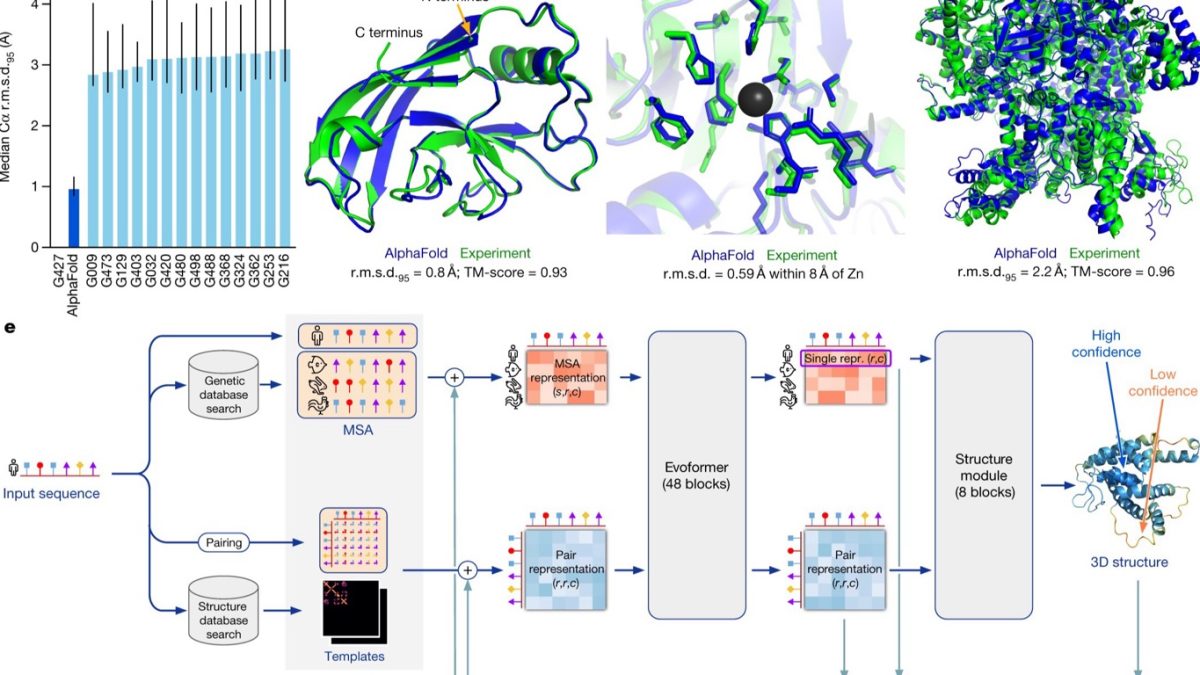
AlphaFold abandoned simplistic molecular dynamics simulations and brute-force physics equations. Instead, it treated the folding problem as a dual learning representation: an iterative Evoformer neural network that passed information bidirectionally between multiple sequence alignments (evolutionary covariation across evolutionary time) and a spatial pair representation of all inter-residue distances. An invariant 3D equivariant structure module then assembled the amino acid backbone coordinates directly in Euclidean space.
The results were stunning: AlphaFold predicted protein structures with an atomic accuracy rivaling experimental X-ray crystallography (a Global Distance Test score $>90$). Within two years, DeepMind and EMBL predicted and released the 3D atomic structures of over 214 million proteins—virtually every known protein across all cataloged life forms on planet Earth, expanding the frontiers of structural biology by a factor of more than one thousand!
De Novo Protein Design and Generative Chemistry
Alongside AlphaFold stood the revolution in de novo generative design, pioneered by David Baker at the University of Washington’s Institute for Protein Design. Armed with tools like RFdiffusion (diffusion probabilistic models adapted to 3D molecular coordinates), Baker moved chemistry from analyzing nature’s existing proteins to authoring brand-new, non-natural biomolecules from scratch.
Generative chemical AI no longer asks “How does this natural sequence fold?” It asks: “Here is a desired molecular receptor or catalytic function; invent a novel protein shape and sequence that has never existed in four billion years of evolution to perform it.” In 2024, the Nobel Prize in Chemistry was rightfully awarded to David Baker (for computational protein design) and Demis Hassabis and John Jumper (for protein structure prediction)—a historic milestone marking the moment computer science and chemistry merged into a single predictive discipline.
The Grand Synthesis: From Alchemy to AI
As we close this twenty-part odyssey through the history of chemistry, pause to consider the trajectory of human thought across two and a half millennia. We began on the sunlit hills of ancient Sicily with Empedocles, contemplating four immutable roots of earth, water, air, and fire. We walked the medieval alleys of Abbasid Baghdad with Jabir ibn Hayyan, smelling sulfur and heating nitric acid in the alembic. We weighed sealed retorts with Antoine Lavoisier, measured gas volumes with Avogadro, played chemical solitaire with Dmitri Mendeleev, aligned X-ray diffraction patterns with Rosalind Franklin, built molecular machines with Fraser Stoddart, and now generate de novo enzymes through neural vector fields.
Chemistry is not merely a catalog of the elements; it is the ultimate expressive medium of reality. It is the language through which the cosmos learned to assemble inanimate stardust into conscious, feeling beings capable of turning their minds back upon the universe to decipher the very laws of their own molecular architecture.