Throughout the twentieth century, solid-state physics and materials chemistry operated under an unshakeable mathematical theorem. In the 1930s, Nobel laureates Lev Landau and Rudolf Peierls proved that strictly two-dimensional crystalline sheets could never exist in our thermal world: thermal vibrational fluctuations (phonons) would inevitably grow larger than the interatomic spacing, tearing any atomic monolayer apart into rolled tubes, crumbled soot, or bulk crystals. A free-standing crystal consisting of a single layer of atoms was declared thermodynamically impossible.
In 2004, at the University of Manchester, two Russian-born physicists proved the world’s greatest theorists wrong using the most humble tool in the laboratory: a roll of ordinary Scotch cellophane tape. Working on their legendary “Friday Night Experiments,” Andre Geim (b. 1958) and Konstantin Novoselov (b. 1974) pressed adhesive tape against high-purity graphite crystals, repeatedly peeling the cleaved flakes apart until only single atomic layers remained, which they deposited onto a silicon wafer topped with a 300-nanometer optical oxide layer.
The Physics and Chemistry of Graphene
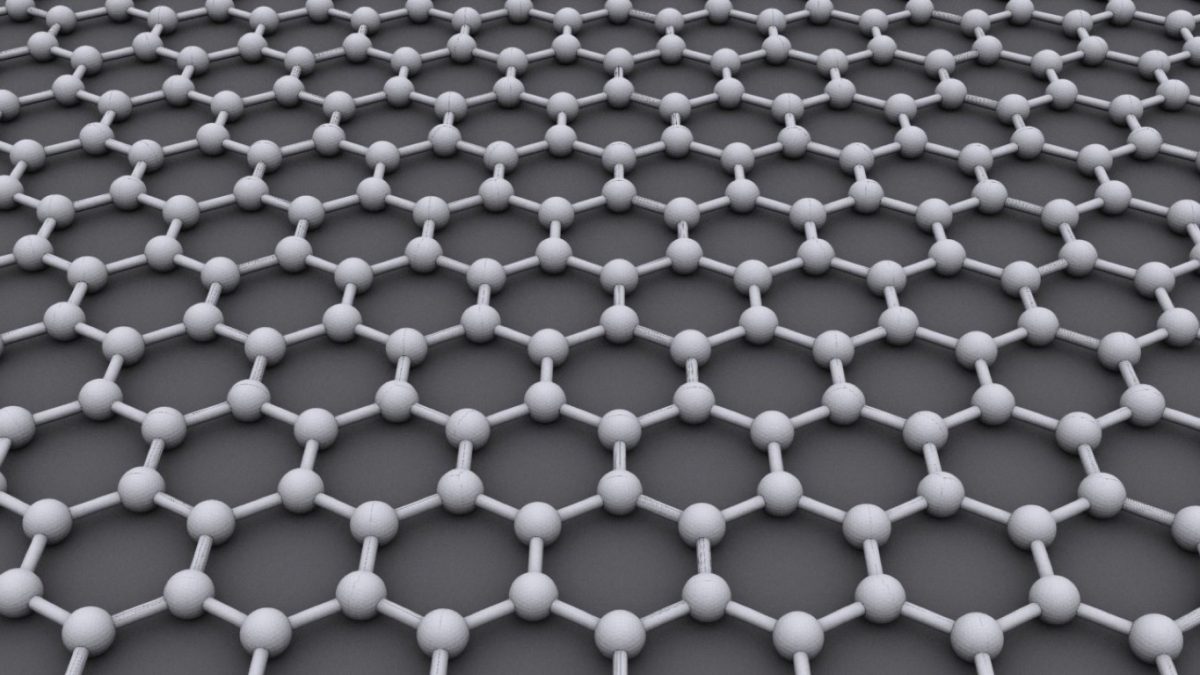
The isolated material was graphene: a strictly two-dimensional, single-atom-thick sheet of $sp^2$-hybridized carbon atoms tightly packed in a honeycomb hexagonal crystal lattice. Graphene proved to be a material of staggering extremes:
- Mechanical Strength: Graphene is the strongest material ever measured, with an intrinsic tensile strength of $130 text{ GPa}$—over two hundred times stronger than structural steel. An invisible monolayer hammock stretched across a room could support a four-kilogram cat without tearing.
- Thermal Conductivity: Graphene conducts heat at up to $5,000 text{ W/m}cdottext{K}$, outperforming diamond and copper by orders of magnitude.
- Optical Transparency: Despite being a single atom thick, graphene absorbs exactly $pi alpha approx 2.3%$ of incident light, an optical constant determined purely by the fine-structure constant of quantum electrodynamics!
- Dirac Fermions: Because of the honeycomb lattice symmetry, electrons moving through graphene lose their effective mass and behave as massless relativistic particles (Dirac fermions), traveling at one-three-hundredth the speed of light ($10^6 text{ m/s}$) with electron mobilities exceeding $200,000 text{ cm}^2/text{V}cdottext{s}$.
The 2D Nanomaterial Revolution
Geim and Novoselov’s Nobel Prize in 2010 ignited a materials gold rush. Chemistry realized that graphene was merely the first province in an undiscovered continent of two-dimensional nanomaterials. Chemists quickly isolated and synthesized:
- Hexagonal Boron Nitride (h-BN): “White graphene,” an atomically flat, thermally stable electrical insulator.
- Transition Metal Dichalcogenides (TMDs): Monolayers like molybdenum disulfide ($MoS_2$) and tungsten diselenide ($WSe_2$), possessing direct electronic bandgaps ideal for atomic-scale transistors and quantum photodetectors.
- MXenes and Phosphorene: 2D titanium carbides and black phosphorus monolayers powering ultra-fast supercapacitors and batteries.
- Twistronics: In 2018, MIT researchers discovered that stacking two layers of graphene and twisting them by the “magic angle” of exactly $1.1^circ$ creates flat electronic bands, producing correlated Mott insulators and unconventional superconductivity!
By flattening matter to the ultimate two-dimensional boundary, chemistry unlocked a quantum playground where mechanical, electronic, and chemical properties can be custom-engineered atom by atomic layer.