Throughout the millennia of human civilization, solid materials were defined by continuous density. Basalt, steel, and granite were compact, heavy, and solid. Even natural porous minerals like zeolites possessed narrow silicate channels that collapsed under thermal stress or blocked larger guest molecules. For decades, synthetic chemists dreamed of an architectural paradox: could one construct a crystalline solid consisting of rigid, geometric cages whose volume was over ninety percent empty space—a material lighter than air, yet thermally stable to hundreds of degrees?
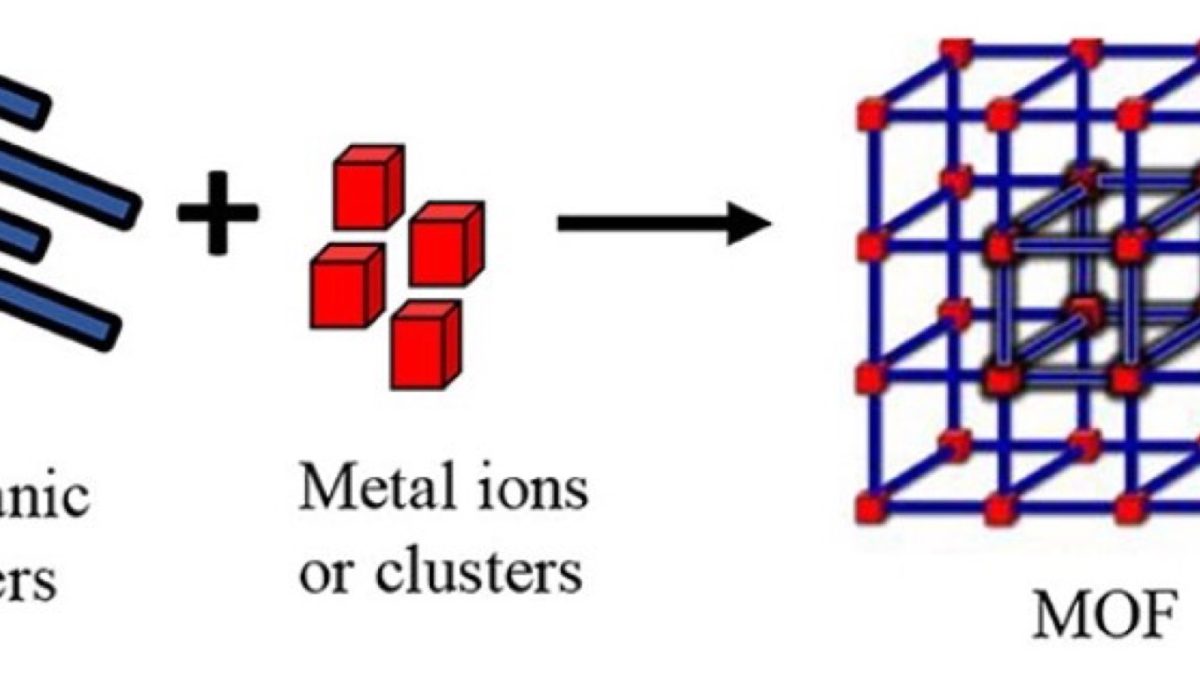
The pioneer who transformed this fantasy into reticular reality was a Jordanian-American chemist born in Amman to a refugee family: Omar M. Yaghi (b. 1965), Professor of Chemistry at the University of California, Berkeley. In the late 1990s, Yaghi broke with classical solid-state chemistry by pioneering Reticular Chemistry: the deliberate stitching of discrete molecular building blocks (organic linkers and inorganic metal clusters) into crystalline, extended open networks via strong chemical bonds.
MOF-5: The Sovereign of Open Space
In 1999, Yaghi published a landmark report in Nature announcing the synthesis of MOF-5. Using zinc oxide clusters ($Zn_4O$) as octahedral inorganic vertices connected by rigid terephthalate (benzene-1,4-dicarboxylate) organic struts, Yaghi produced an ultra-porous cubic scaffolding of breathtaking dimensions.
MOF-5 possessed a permanent, stable porosity with an unprecedented Brunauer-Emmett-Teller (BET) internal surface area exceeding $2,900 text{ m}^2text{ per gram}$. Subsequent reticular materials synthesized in Yaghi’s laboratory—such as MOF-177 and MOF-210—pushed surface areas beyond $10,000 text{ m}^2text{ per gram}$. A single sugar-cube-sized crystal of a modern MOF contains an internal surface area large enough to unfold and carpet an entire collegiate football field!
Planetary Solutions: Water from the Desert and Carbon Capture
Because the organic linkers of reticular frameworks can be customized with atomic precision, chemists can tailor the internal pore diameter, chemical affinity, and electrostatic charge of the cages:
- Atmospheric Water Harvesting: In 2017, Yaghi engineered a zirconium-based framework, MOF-801, whose pore geometry exhibits a stepped adsorption isotherm for water vapor at low relative humidity ($<20%$). Installed in a solar-powered harvester in the arid Mojave and Death Valley deserts, the MOF absorbs water molecules from dry nighttime desert air and releases liters of pure, drinkable water during the sunny day with zero external electricity.
- Carbon Capture and Storage: Amine-functionalized frameworks like MOF-205 selectively snare $CO_2$ molecules from industrial flue gases at high temperatures while ignoring nitrogen and oxygen, allowing clean, energy-efficient post-combustion decarbonization.
- Hydrogen and Methane Fuel Storage: Compressing volatile gases into the nanopores of MOFs allows clean alternative fuels to be stored at room temperature under low, safe pressures for automotive transportation.
Reticular chemistry proved that emptiness is not absence; structured nanoscale void is one of the most powerful functional materials known to science.