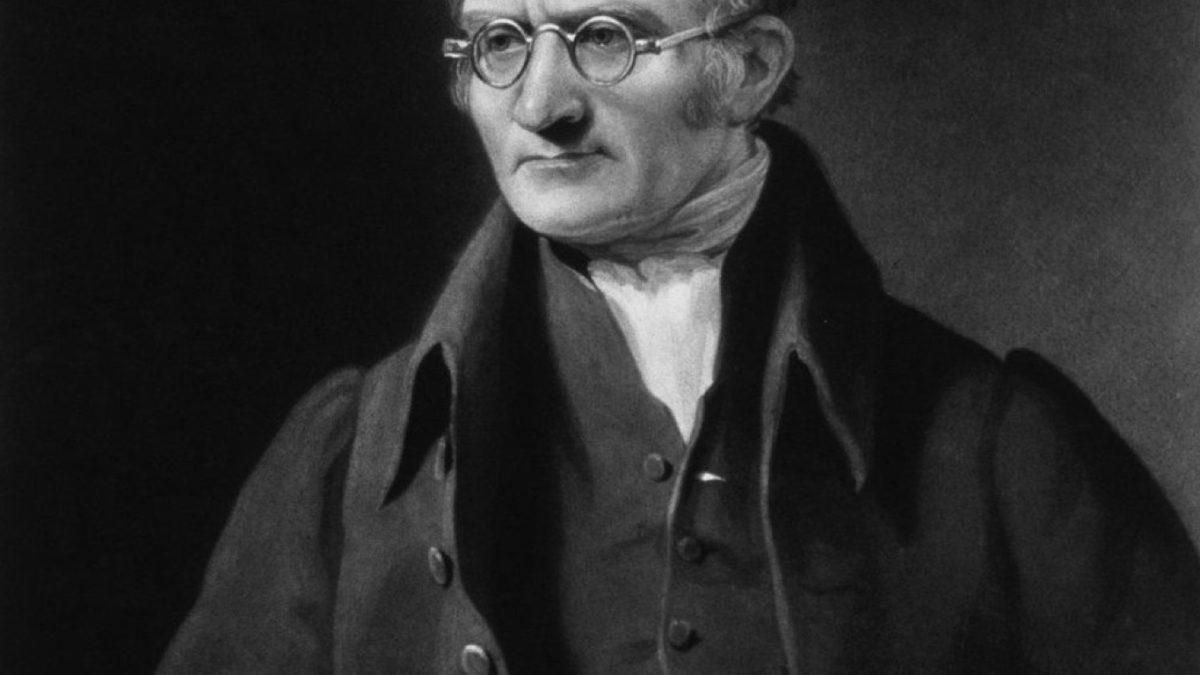
For more than twenty-two centuries, the atomic hypothesis remained a metaphysical curiosity—an elegant philosophical speculation incapable of making quantitative laboratory predictions. Lavoisier had established the conservation of mass and Proust had proved the Law of Definite Proportions (that a chemical compound always contains exactly the same elemental proportions by weight), yet no one understood why nature adhered to these strict numerical ratios. The man who unlocked the secret was a modest, color-blind English Quaker schoolmaster living in industrial Manchester: John Dalton (1766–1844).
Dalton approached chemistry not from metallurgy, but from meteorology. Fascinated by atmospheric moisture, evaporation, and the partial pressures of mixed gases (discovering Dalton’s Law of Partial Pressures in 1801), Dalton pondered why the gases of the atmosphere—nitrogen, oxygen, carbon dioxide, and water vapor—remained homogeneously mixed instead of separating into strata by density. He concluded that the particles of different gases must possess different physical sizes, repelling only particles of their own kind.
The Law of Multiple Proportions
In 1803, Dalton made a startling experimental discovery while analyzing the two gaseous oxides of carbon (carbon monoxide, $CO$, and carbon dioxide, $CO_2$) and the oxides of nitrogen. When a fixed mass of carbon reacted with oxygen, the masses of oxygen that combined with a constant 100 grams of carbon stood in a strict integer ratio of exactly 1 : 2. In carbon monoxide, 100 g of carbon combined with 133 g of oxygen; in carbon dioxide, 100 g of carbon combined with 266 g of oxygen ($266 / 133 = 2.00$).
This was the Law of Multiple Proportions. Dalton realized this mathematical relationship was impossible if matter were continuous. It made sense only if elements consisted of discrete, indivisible units: if one atom of carbon bonded with one atom of oxygen to form carbon monoxide ($C + O rightarrow CO$), and one atom of carbon bonded with two atoms of oxygen to form carbon dioxide ($C + 2O rightarrow CO_2$). Chemical reactions were not mystical fusions; they were the addition, separation, and rearrangement of whole, unbroken atoms.
The First Table of Relative Atomic Weights
In his 1808 treatise A New System of Chemical Philosophy, Dalton published the first table of relative atomic weights. Because individual atoms were far too minuscule to weigh directly, Dalton chose the lightest known element—hydrogen—as his arbitrary standard of unity ($H = 1.0$). By analyzing water and assuming (incorrectly, under his “rule of greatest simplicity”) that water was binary ($HO$), Dalton calculated that oxygen was approximately 7 or 8 times heavier than hydrogen.
- Hydrogen: $1$
- Carbon: $5$ (later refined to $12$)
- Nitrogen: $5$ (later refined to $14$)
- Oxygen: $7$ (later refined to $16$)
- Sulfur: $13$ (later refined to $32$)
Although Dalton’s simplicity assumptions led to erroneous formulas (like $HO$ for water and $NH$ for ammonia), the underlying theoretical breakthrough was monumental. For the first time in human history, atoms ceased to be abstract phantoms of philosophy: they were real, physical entities possessing distinct, invariant, and measurable relative masses.