Throughout the first half of the nineteenth century, chemistry had mastered the composition of matter: Dalton had weighed atoms, Avogadro had counted molecules, and Mendeleev had arrayed the elements in harmonic order. Yet the central question of chemical reactivity remained unanswered: Why do chemical reactions occur at all, and what dictates the direction of spontaneous change?
Early thermochemists, notably Marcellin Berthelot and Julius Thomsen, proposed the simplistic dogma that all spontaneous reactions must release heat ($Delta H < 0$). Yet nature regularly violated this rule: ammonium nitrate dissolves endothermically in water, chilling the beaker to freezing temperatures while dissolving completely and spontaneously. Clearly, enthalpy alone could not explain the driving force of the material world.
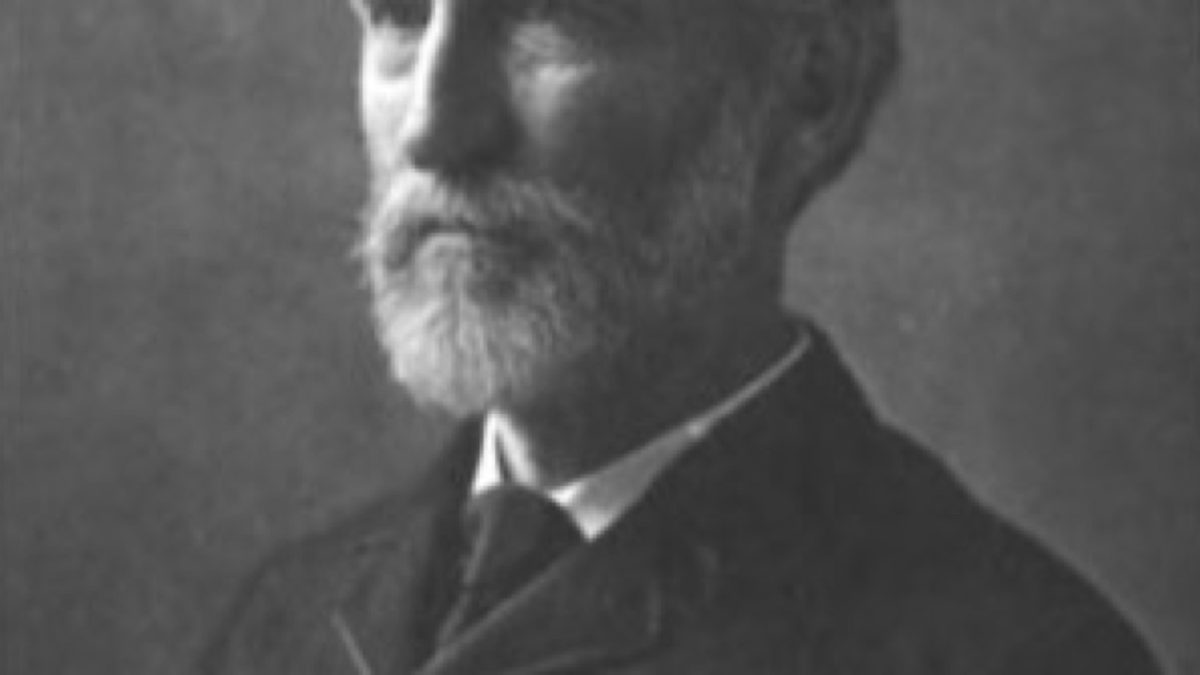
The Hermit of New Haven: Josiah Willard Gibbs
The solution came not from the great European chemical laboratories, but from a quiet, solitary bachelor living in New Haven, Connecticut: Josiah Willard Gibbs (1839–1903), Professor of Mathematical Physics at Yale University. Between 1876 and 1878, Gibbs published a 300-page mathematical monument in the obscure Transactions of the Connecticut Academy of Arts and Sciences entitled “On the Equilibrium of Heterogeneous Substances.”
Gibbs synthesized the First Law of Thermodynamics (conservation of energy) and the Second Law of Thermodynamics (entropy of an isolated system never decreases, formulated by Rudolf Clausius). He realized that for a chemical system operating at constant temperature and pressure—the universal conditions of laboratory benches, living organisms, and planetary atmospheres—spontaneity is governed by a thermodynamic potential now celebrated as Gibbs Free Energy ($mathcal{G}$):
$$Delta mathcal{G} = Delta mathcal{H} – mathcal{T} Delta mathcal{S}$$
Where $Delta mathcal{H}$ represents the enthalpy change (heat exchanged), $mathcal{T}$ is the absolute temperature in Kelvin, and $Delta mathcal{S}$ represents the entropy change (the dispersal of energy and molecular microstates). Gibbs proved with rigorous mathematical precision that a chemical process can proceed spontaneously if and only if:
$$Delta mathcal{G} < 0$$
The Chemical Potential and the Phase Rule
Gibbs introduced the concept of chemical potential ($mu_i$), defined as the change in free energy when an infinitesimal amount of substance $i$ is added to an open thermodynamic phase:
$$mu_i = left( frac{partial mathcal{G}}{partial n_i} right)_{T, P, n_{j neq i}}$$
Chemical potential acts as the true thermodynamic “voltage” or pressure of matter. Just as heat flows from high temperature to low temperature, and electrical current flows from high voltage to low voltage, matter spontaneously moves and reacts from regions of higher chemical potential to regions of lower chemical potential. When chemical potentials equilibrate ($mu_{text{reactants}} = mu_{text{products}}$), the reaction reaches thermodynamic equilibrium ($Delta mathcal{G} = 0$).
Furthermore, Gibbs deduced the celebrated Phase Rule: $F = C – P + 2$, where $F$ is the degrees of freedom, $C$ is the number of chemical components, and $P$ is the number of coexisting phases. Through pure deductive mathematics, Gibbs founded modern chemical thermodynamics, metallurgy, materials science, and physical biochemistry.