By the late 1860s, sixty-three distinct chemical elements had been isolated and cataloged by European laboratories. Yet they resembled an unruly mob of disunited facts: light, reactive alkali metals like sodium and potassium shared the textbooks with dense, unreactive transition metals like platinum and gold; pale green, poisonous chlorine gas shared space with lustrous, brittle phosphorus. Were these elements sixty-three independent, disconnected accidents of cosmic creation, or did an underlying mathematical rhythm govern their properties?
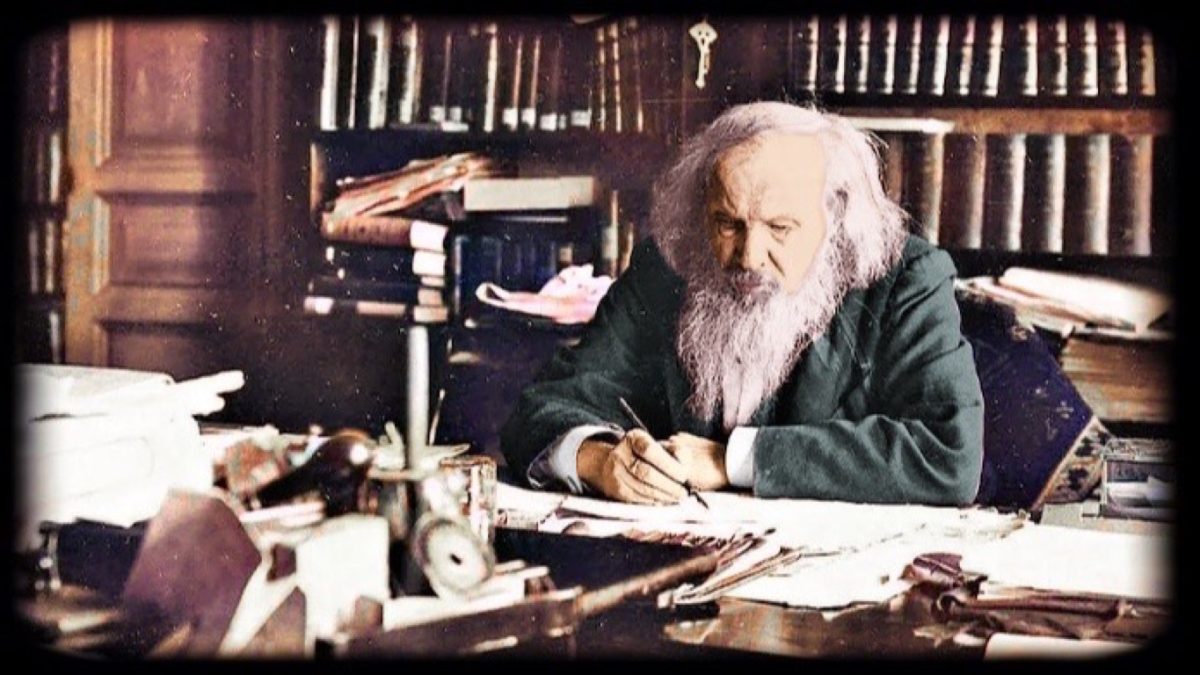
The answer came from Siberia. Dmitri Ivanovich Mendeleev (1834–1907), Professor of General Chemistry at the University of Saint Petersburg, was writing a comprehensive textbook, The Principles of Chemistry (Osnovy khimii). Frustrated by the absence of an intuitive pedagogical framework for classifying the elements, Mendeleev wrote the name, atomic weight, and chemical characteristics of each of the sixty-three elements onto individual cardboard playing cards. He played a chemical solitaire (patience) across his desk, arranging and rearranging the cards in order of ascending atomic weight while aligning elements with similar chemical valences and oxidation states.
The Flash of Insight: February 17, 1869
On February 17 (March 1, New Style), 1869, exhausted after a long night of labor, Mendeleev fell into a deep sleep at his desk. As he later recounted to his colleague Alexander Inostrantsev: “I saw in a dream a table where all the elements fell into place as required. Awakening, I immediately wrote it down on a piece of paper.”
Mendeleev formulated the Periodic Law: The properties of the chemical elements, as well as the forms and properties of their compounds, show a periodic dependence on the atomic weights of the elements. When arranged in ascending order of atomic weight, chemical properties repeated with periodic regularity: reactive metals like lithium, sodium, and potassium aligned in one column; halogens like fluorine, chlorine, bromine, and iodine aligned in another.
The Audacity of the Blank Spaces
What elevated Mendeleev from a clever cataloger (like Alexandre-Émile Béguyer de Chancourtois, John Newlands, or Julius Lothar Meyer) to an immortal scientific titan was his supreme intellectual courage. When an element’s properties refused to match its vertical column, Mendeleev did two astonishing things:
- He declared established atomic weights wrong: He insisted that tellurium ($128$) must be lighter than iodine ($127$) despite experimental measurements, and corrected the atomic weights of uranium, indium, and beryllium.
- He left blank spaces for undiscovered elements: Rather than forcing disparate elements into unnatural groupings, Mendeleev left vacant cells in his table, predicting that nature must harbor yet-undiscovered elements to fill those gaps.
The Triumph of Eka-Aluminum: The Discovery of Gallium
Most daringly, Mendeleev utilized the arithmetic averages of surrounding elements to predict the exact physical and chemical properties of three unknown elements, which he named using the Sanskrit prefix eka (meaning “one beyond”): eka-boron, eka-aluminum, and eka-silicon.
For eka-aluminum (predicted in 1871 below aluminum), Mendeleev prophesied an atomic weight around $68$, a density of approximately $5.9 text{ g/cm}^3$, a low melting point, an oxide formula of $Ea_2O_3$, and high volatility in chloride form. In 1875, French chemist Paul-Émile Lecoq de Boisbaudran spectroscopically discovered a new metallic element in zinc blende ore, naming it gallium (after Gaul, ancient France). When Lecoq measured its physical constants, the scientific world was stunned:
- Atomic weight: Predicted $approx 68$ $longrightarrow$ Gallium: $69.72$
- Density: Predicted $5.9 text{ g/cm}^3$ $longrightarrow$ Gallium: $5.91 text{ g/cm}^3$
- Melting point: Predicted very low $longrightarrow$ Gallium: $29.76^circtext{C}$ (melts in the palm of a hand!)
- Oxide: Predicted $Ea_2O_3$ $longrightarrow$ Gallium oxide: $Ga_2O_3$
When Swedish chemist Lars Fredrik Nilson discovered scandium (eka-boron) in 1879, and German chemist Clemens Winkler isolated germanium (eka-silicon) in 1886, meeting Mendeleev’s predictions down to specific gravity and boiling points, all skepticism evaporated. The Periodic Table was recognized not as a human invention, but as nature’s eternal, universal master ledger of matter.