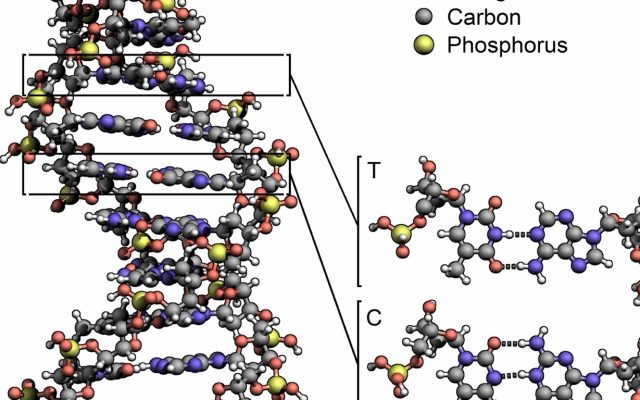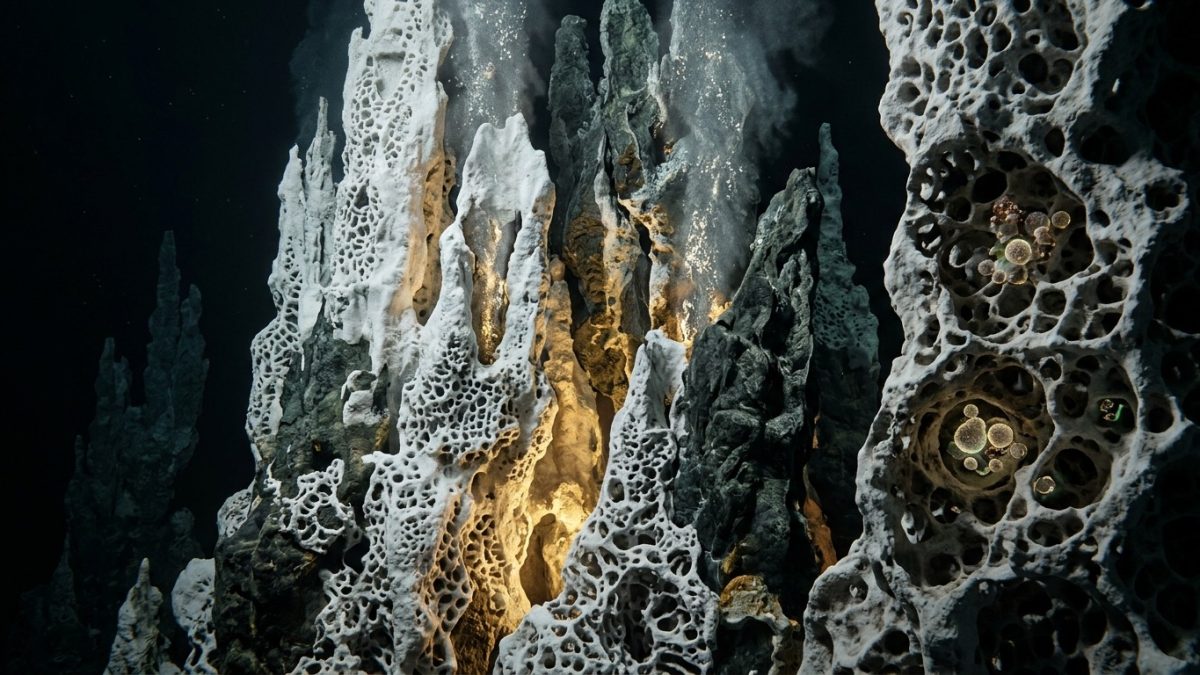
Four billion years ago, on a tumultuous, ocean-engulfed Earth under the faint young Sun, the most improbable transition in cosmic history occurred: non-living geochemical reactions crossed the threshold into self-sustaining, replicating biochemistry. Far from being an accidental stroke of lightning in a static primordial soup, the origin of life was an inevitable thermodynamic consequence of a planet striving to dissipate electrochemical disequilibrium across the porous labyrinth of deep-sea alkaline hydrothermal vents.
1. Far-From-Equilibrium Thermodynamics and the Dissipation of Planetary Potential
In classical thermodynamic equilibrium, physical systems inexorably decay toward maximum entropy, as dictated by the Second Law of Thermodynamics: $dS \ge \frac{dQ}{T}$. Life, however, is a quintessential non-equilibrium dissipative structure. As physicist Erwin Schrödinger famously postulated in 1944, a living organism avoids decay into thermodynamic equilibrium by continually drawing negative entropy ($\Delta S < 0$) from its surroundings, sustaining an internal state of low entropy and high molecular organization.
The primordial Hadean Earth was an immense geochemical electrochemical battery. The planet’s mantle and crust were rich in reduced iron, molecular hydrogen ($\text{H}_2$), and methane, while the ocean and atmosphere were heavily oxidized with volcanic carbon dioxide ($\text{CO}_2$) and sulfur dioxide ($\text{SO}_2$). The reduction of carbon dioxide by hydrogen gas to form methane and organic carboxylic acids is thermodynamically favored:
$$\text{CO}_2 + 4\text{H}_2 \to \text{CH}_4 + 2\text{H}_2\text{O} \quad (\Delta G^\circ = -131\text{ kJ/mol})$$However, despite the immense thermodynamic driving force ($\Delta G < 0$), this reaction faces an imposing kinetic activation barrier. Without specialized catalysts, dissolved carbon dioxide and dissolved hydrogen remain inert in ambient water. To bridge this barrier, nature required a sustained, continuous physical reactor possessing both transition-metal catalysts and a continuous flow of electrochemical energy.
2. Alkaline Hydrothermal Vents: The Geochemical Engine of Life
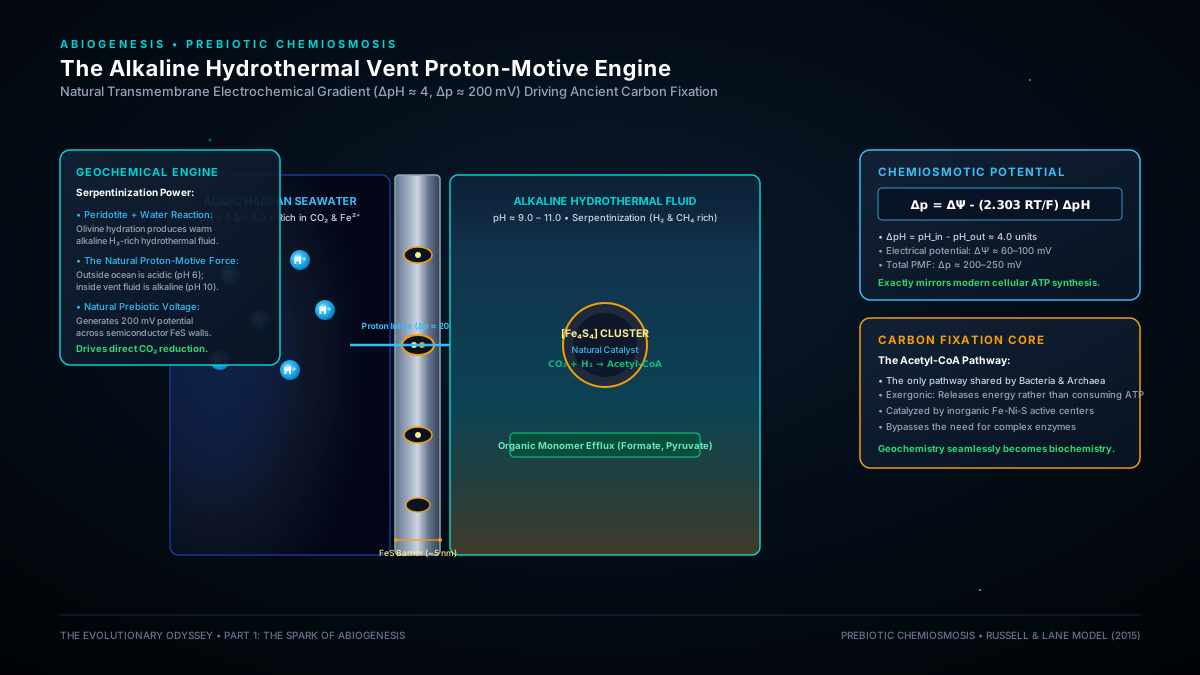
In the late 1980s, geochemist Michael Russell proposed a revolutionary paradigm: life did not originate in aerial tide pools or superheated volcanic black smokers, but within moderate-temperature submarine alkaline hydrothermal vents, analogous to the modern Lost City hydrothermal field discovered on the Mid-Atlantic Ridge.
These vents arise through serpentinization, an exothermic geochemical reaction in which ultramafic mantle rock (peridotite, rich in olivine) reacts with seawater at moderate temperatures ($100\text{–}150^\circ\text{C}$):
$$(\text{Mg},\text{Fe})_2\text{SiO}_4 + \text{H}_2\text{O} + \text{CO}_2 \to \text{Mg}_3\text{Si}_2\text{O}_5(\text{OH})_4 + \text{Mg(OH)}_2 + \text{Fe}_3\text{O}_4 + \text{H}_2$$Serpentinization charges the effluent fluid with immense quantities of molecular hydrogen ($\text{H}_2$) and creates a warm, highly alkaline solution ($\text{pH } 9\text{–}11$). When this alkaline hydrothermal fluid percolated upward into the ancient Hadean ocean—which was saturated with dissolved volcanic $\text{CO}_2$ rendering it mildly acidic ($\text{pH } 5.5\text{–}6.0$) and devoid of oxygen—an extraordinary precipitation reaction occurred. Dissolved ferrous iron ($\text{Fe}^{2+}$) in the ocean reacted with sulfide ($\text{HS}^-$) in the fluid to precipitate porous inorganic towers made of mackinawite ($\text{FeS}$) and greigite ($\text{Fe}_3\text{S}_4$).
These microporous chimney walls acted as natural, semi-conducting inorganic membranes only a few nanometers thick. On the alkaline interior, the hydroxide ion concentration was high; on the oceanic exterior, the hydronium ion concentration ($\text{H}_3\text{O}^+$) was hundreds of times greater. Across this mineral barrier spanned a natural proton concentration gradient of approximately $4\text{ to }5\text{ pH units}$:
$$\Delta p = \Delta \Psi – \frac{2.303 R T}{F} \Delta \text{pH} \approx 180\text{–}220\text{ mV}$$This natural proton-motive force ($\Delta p$) is strikingly identical in magnitude and sign to the chemiosmotic electrochemical gradient used by every living cell on Earth today to synthesize adenosine triphosphate (ATP) via ATP synthase. Before biological enzymes or genetic coding existed, the geology of the Hadean Earth provided a ready-made proton-gradient engine.
3. The RNA World: Bridging the Genotype-Phenotype Divide
A classic chicken-and-egg paradox long haunted origin-of-life biology: modern cells require nucleic acids (DNA) to store genetic instructions for synthesizing proteins, yet they require protein enzymes to replicate DNA. How could either emerge without the other?
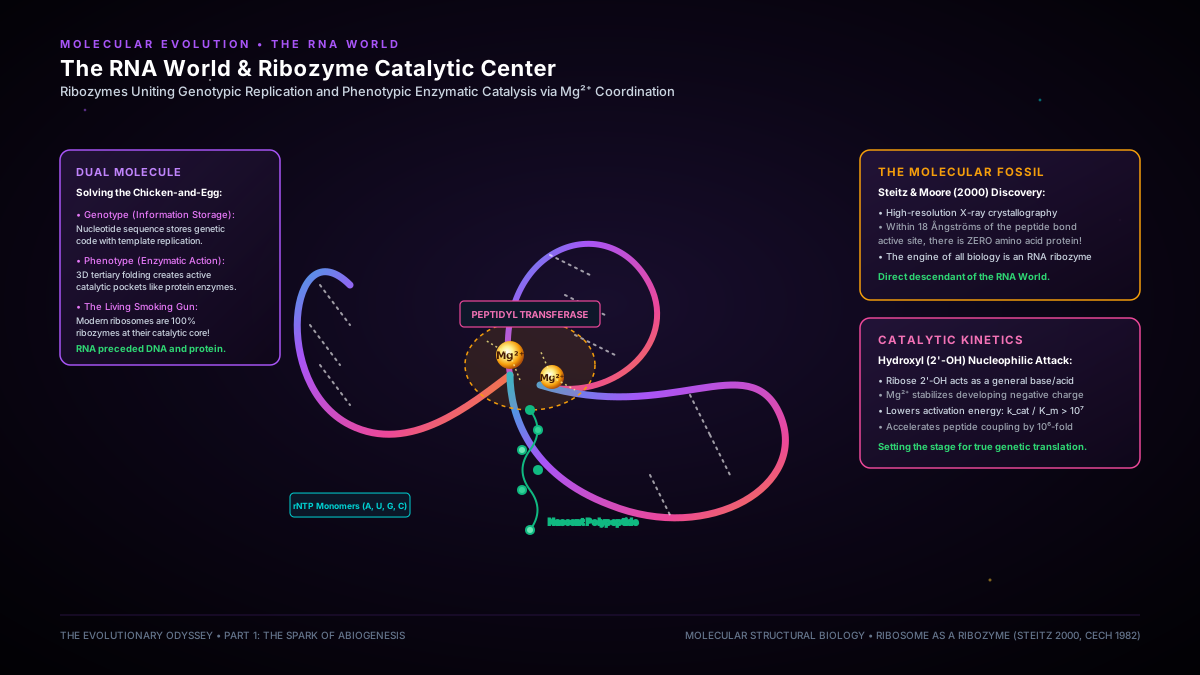
The resolution came with the discovery of ribozymes—RNA molecules possessing enzymatic catalytic capabilities—by Thomas Cech and Sidney Altman in the early 1980s, which earned them the 1989 Nobel Prize in Chemistry. Because ribonucleic acid (RNA) can simultaneously serve as an informational sequence (genotype) and fold into complex tertiary conformations capable of catalyzing chemical reactions (phenotype), it is universally accepted that an ancient RNA World preceded modern DNA-and-protein biochemistry.
The definitive molecular fossil confirming this epoch lies at the very heart of the contemporary ribosome. High-resolution X-ray crystallography of the large 50S ribosomal subunit revealed that the peptidyl transferase center—the universal engine that forms peptide bonds between amino acids—is composed entirely of catalytic ribosomal RNA (rRNA), with not a single amino acid residue within $18\text{ \AA}$ of the active site. The ribosome is, at its foundational core, a ribozyme.
In the presence of divalent cations such as magnesium ($\text{Mg}^{2+}$), RNA folds into precise catalytic clefts. Nucleophilic attack by a $3’\text{-hydroxyl}$ group on the activated $\alpha\text{-phosphate}$ of a complementary ribonucleotide allows RNA to self-assemble phosphodiester linkages, polymerizing functional chains without external protein machinery.

4. Prebiotic Encapsulation: The Genesis of the Protocell
While catalytic ribozymes could replicate inside hydrothermal rock pores, open water presented an insurmountable evolutionary dilemma: diffusion. In an unconstrained aqueous medium, newly replicated RNA molecules and their metabolic products would disperse instantly. Furthermore, a superior catalytic ribozyme would inadvertently share its metabolic advantage with parasitic, non-functional mutant RNA strands (“molecular parasites”).
To initiate genuine Darwinian natural selection, life required encapsulation—a semipermeable barrier linking an organism’s genotype to its own phenotype. The solution was the self-assembly of fatty acid protocells.
Unlike modern cellular membranes composed of complex diacyl phospholipids with near-zero spontaneous permeability, prebiotic membranes consisted of simple single-chain amphiphiles, such as oleic, lauric, and myristic acids. When fatty acids are suspended in water above their critical vesicle concentration (CVC) at neutral or slightly alkaline pH, they spontaneously aggregate into closed spherical bilayer vesicles. This self-assembly is driven by the hydrophobic effect: water molecules surrounding exposed nonpolar hydrocarbon tails are forced into highly ordered, hydrogen-bonded “clathrate cages” of low entropy ($-\Delta S$). Aggregation of the hydrocarbon tails into an interior membrane core releases these caged water molecules back into bulk solution, generating a massive gain in solvent entropy ($+\Delta S_{\text{solvent}}$):
$$\Delta G_{\text{assembly}} = \Delta H – T \Delta S < 0$$Crucially, single-chain fatty acid bilayers possess dynamic physical properties absent in modern membranes. Their high rate of lateral lipid flip-flop ($>100\text{ s}^{-1}$) creates transient structural defects, granting selective permeability. Small uncharged molecules and hydrophilic monomer precursors—such as ribose, amino acids, and activated nucleotide monophosphates—diffuse freely across the membrane into the protocell interior. In contrast, once inside, when ribozymes polymerize these monomers into long polyanionic RNA chains ($M_w > 1000\text{ Da}$), their bulky size and multiple negative charges prevent them from leaking out.
When additional fatty acid micelles are added to a solution of protocells, the vesicles incorporate the new lipids into their outer leaflet faster than their internal volume can expand through osmotic water influx. The resulting surface-to-volume mechanical tension forces the spherical protocell to distort into an elongated, thread-like tubular structure. Under gentle hydrodynamic agitation—such as ocean surf or vent currents—these pearling filaments spontaneously pinch off into daughter vesicles, dividing without any complex protein machinery while retaining their internal genetic payload.
Conclusion: The Threshold of Life
By $3.8\text{ billion years ago}$, all essential components of the prebiotic toolkit had coalesced. Deep within the electrochemical hearths of alkaline hydrothermal vents, inorganic iron-sulfur minerals catalyzed the reduction of carbon dioxide into primitive organics. Chemiosmotic proton gradients drove continuous thermodynamic disequilibrium. RNA ribozymes achieved both informational storage and catalytic polymer synthesis. And fatty acid protocells provided the physical boundary required for individual identity and natural selection.
The stage was set for the emergence of the single most pivotal organism in planetary history: the Last Universal Common Ancestor (LUCA). In Part 2, we will explore how phylogenomic archaeology reconstructs LUCA’s 355-gene minimal genome and decrypts the momentous divergence that split the tree of life into Bacteria and Archaea.
Key Academic Citations
- Russell, M. J., & Hall, A. J. (1997). The emergence of life from iron monosulphide bubbles at a submarine hydrothermal redox and pH front. Journal of the Geological Society, 154(3), 377–402.
- Martin, W., & Russell, M. J. (2003). On the origins of cells: a hypothesis for the evolutionary transitions from abiotic geochemistry to chemoautotrophic prokaryotes, and from prokaryotes to nucleated cells. Philosophical Transactions of the Royal Society of London. Series B: Biological Sciences, 358(1429), 59–85.
- Cech, T. R. (1986). A model for the RNA-catalyzed replication of RNA. Proceedings of the National Academy of Sciences, 83(12), 4360–4363.
- Szostak, J. W., Bartel, D. P., & Luisi, P. L. (2001). Synthesizing life. Nature, 409(6818), 387–390.
- Lane, N. (2015). The Vital Question: Why Is Life the Way It Is? Profile Books / W. W. Norton.