Rather than studying memory, perception, attention, and language as isolated modules, cognitive architectures seek a Unified Theory of Cognition. Exemplified by John Anderson’s ACT-R, these computational frameworks formalize how symbolic production rules interact with sub-symbolic neural activation, mapping seamlessly onto Daniel Kahneman’s dual-process architecture of the human mind.
1. Allen Newell’s Dream: Unified Theories of Cognition
In his landmark 1973 paper “You Can’t Play 20 Questions with Nature and Win”, cognitive science pioneer Allen Newell warned that psychology was fragmenting into isolated empirical micro-phenomena. Newell called for Unified Theories of Cognition (UTC)—single, integrated, end-to-end computational architectures capable of executing perception, associative memory recall, problem solving, language understanding, and motor execution within a single unified simulation.
2. The Architecture of ACT-R
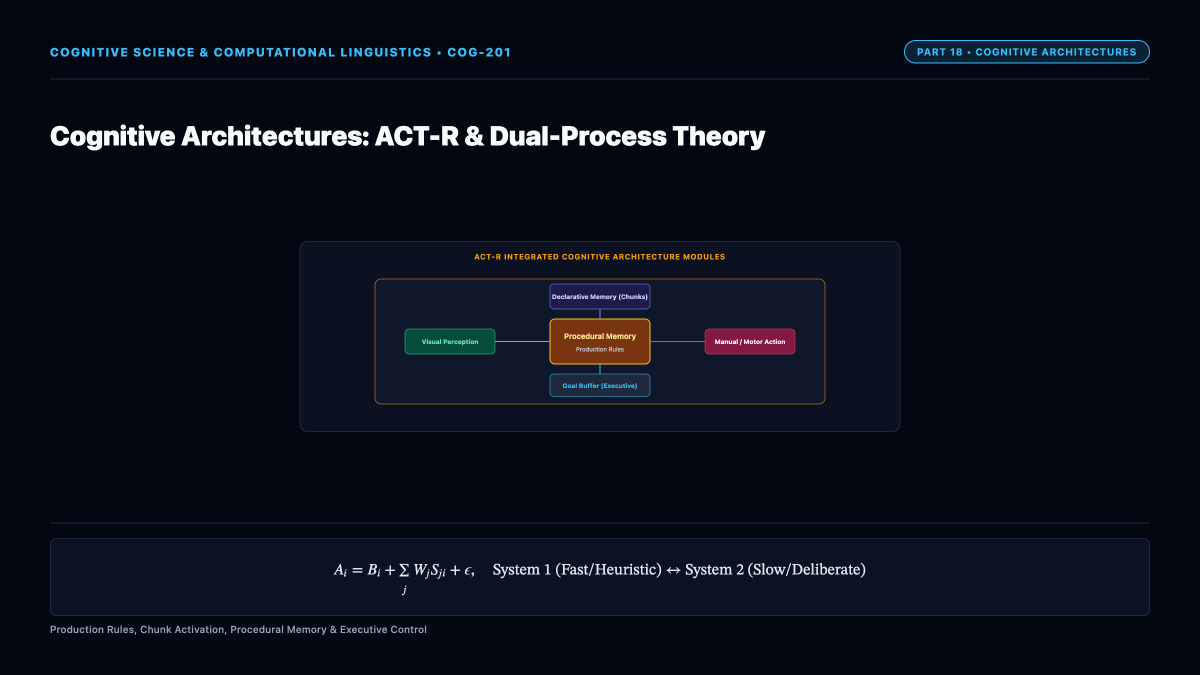
Developed over four decades by John R. Anderson at Carnegie Mellon University, ACT-R (Adaptive Control of Thought-Rational) is the most widely validated cognitive architecture in history. ACT-R bridges symbolic cognitive psychology with neurobiology by organizing the mind into modular processing systems interconnected by a central procedural matching engine.
The Modular Division of Memory:
- Declarative Memory: Stores explicit factual knowledge as structured symbolic units called chunks (e.g., ([ ext{isa: dog, name: Rover, color: brown} ])).
- Procedural Memory: Stores implicit procedural knowledge as production rules (IF-THEN condition-action pairings).
The Sub-Symbolic Mathematical Layer:
While the architecture is structurally symbolic, retrieval and execution are governed by an underlying sub-symbolic continuous dynamical system:
1. Base-Level Chunk Activation:
The accessibility of declarative chunk (i) depends on its activation (A_i), governed by power-law learning and temporal decay reflecting recency and frequency of practice:
[
A_i = B_i + sum_{j} W_j S_{ji} + psilon
]
where the base-level activation (B_i) is evaluated over all (n) past practice encounters at times (t_k):
[
B_i = lnleft( sum_{k=1}^n t_k^{-d}
ight)
]
where (d approx 0.5) is the universal power-law memory decay exponent. The second term represents attentional spreading from items currently held in working memory buffers ((W_j)) weighted by associative strengths ((S_{ji})).
2. Probability and Latency of Memory Recall:
Chunk (i) is retrieved only if its activation exceeds a retrieval threshold ( au). The probability of retrieval obeys a logistic distribution, and the retrieval time latency (T_i) decays exponentially with activation:
[
P_i = rac{1}{1 + e^{- (A_i – au) / s}}, quad T_i = F e^{-A_i}
]
3. Conflict Resolution via Production Utility:
When multiple production rules match the current state, the system executes the rule maximizing expected economic utility (U):
[
U = P cdot G – C + psilon
]
where (P) is the estimated probability of achieving goal (G), (C) is expected computational/temporal cost, and (psilon) is logistic exploration noise.
3. Daniel Kahneman’s Dual-Process Theory: System 1 vs System 2
In behavioral economics and modern cognitive psychology, Daniel Kahneman and Amos Tversky formalized human reasoning as an interplay between two distinct computational systems:
| Dimension | System 1 (Fast / Intuitive) | System 2 (Slow / Deliberative) |
|---|---|---|
| Speed & Effort | Millisecond, automatic, effortless | Slow, controlled, mentally taxing |
| Conscious Awareness | Unconscious, implicit heuristics | Explicit, meta-cognitive, voluntary |
| Computational Style | Pattern recognition, vector associative | Symbolic, sequential rule evaluation |
| Cognitive Limits | Susceptible to cognitive biases | Severely limited by working memory |
In computational cognitive modeling, System 1 maps directly onto sub-symbolic continuous associative mechanisms (such as dense neural word embeddings and instinctive heuristics), while System 2 corresponds to symbolic production rule execution and recursive search inside cognitive architectures like ACT-R and SOAR.