Human languages are not linear bead-strings of acoustic sounds, but hierarchically nested geometric trees governed by unconscious mathematical rules. From early phrase-structure grammars through X-bar theory to the modern Minimalist Program, generative syntax seeks to uncover the universal computational engine of the human faculty of language.
1. Constituency and Tree Structures
A fundamental discovery of modern syntax is that words group together into discrete structural units called constituents. Structural constituency is verified empirically through rigorous diagnostic tests:
- Movement: Only full constituents can be displaced to the sentence periphery (Topicalization: “[The weary travelers] arrived at midnight” ( o) “At midnight, [the weary travelers] arrived”).
- Pronominal Substitution: Constituents can be replaced by single pro-forms (“John read [the big red book]” ( o) “John read [it]”).
- Coordination: Only constituents of identical category can be joined by coordinating conjunctions (“She bought [an apple] and [a peach]”).
2. X-bar Theory: Universal Endocentric Architecture
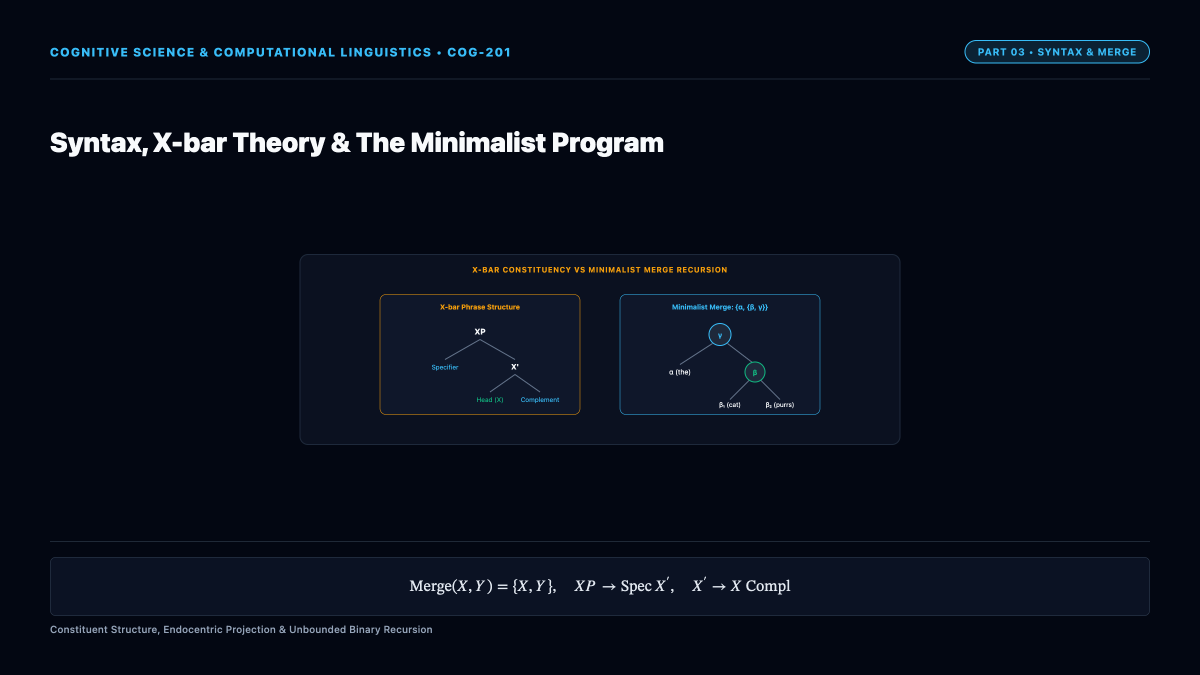
Early phrase structure rules suffered from extreme idiosyncratic redundancy ((S o NP VP, NP o ext{Det } N, VP o V NP)). In the 1970s, Ray Jackendoff and Chomsky formulated X-bar theory, demonstrating that every phrase in every human language conforms to an identical, endocentric structural blueprint organized across three hierarchical projection levels:
[
begin{aligned}
ext{Maximal Projection: } & XP o ext{Specifier } X’
ext{Intermediate Projection: } & X’ o X’ ext{ Adjunct} quad ext{or} quad X’ o ext{Adjunct } X’
ext{Core Projection: } & X’ o X^0 ext{ Complement}
nd{aligned}
]
where (X^0) is the lexical or functional head of the phrase (Noun (N), Verb (V), Adjective (A), Preposition (P), Determiner (D), Tense (T), or Complementizer (C)). The phrase inherits all its categorical features directly from its head (endocentricity).
3. Geometric Structural Relations: C-command and Government
Syntactic constraints, semantic variable binding, and case assignment operate not on linear word adjacency, but on hierarchical structural geometry. The preeminent syntactic relation is c-command (constituent-command):
Definition of C-command: Node (A) c-commands node (B) if and only if (A) does not dominate (B), (B) does not dominate (A), and the first branching node that dominates (A) also dominates (B).
C-command governs the core principles of Chomsky’s Binding Theory:
- Principle A: An anaphor (reflexive pronoun like himself, themselves) must be bound (c-commanded and co-indexed) within its local governing domain.
- Principle B: A pronominal (like him, her) must be free (not c-commanded by a co-indexed antecedent) within its local domain.
- Principle C: An R-expression (referential name like John, Barack Obama) must be universally free everywhere.
4. The Minimalist Program and the Primacy of Merge
In the 1990s, Chomsky launched the Minimalist Program, posing a radical question: Is the human language faculty an optimal, computationally perfect solution to connecting the conceptual-intentional (thought) and sensory-motor (sound/sign) interfaces?
Minimalism eliminated redundant theoretical machinery (Deep Structure, Surface Structure, Government) in favor of a single, conceptually necessary, unbounded recursive binary set-formation operator: Merge.
Given two syntactic objects (X) and (Y), Merge combines them into an unordered set labeled by one of the constituents:
[
ext{Merge}(X, Y) = { X, Y }
]
Merge manifests in two operational varieties:
- External Merge: Combines two independent syntactic items drawn from the lexical array, constructing basic thematic argument structures (( ext{Merge}(V, NP) = { V, NP })).
- Internal Merge (Move): Takes an element (Y) that is already contained within an existing syntactic object (X) and merges it to the root of (X):
[
ext{Merge}(Y, X) = { Y, X }
]
Internal Merge accounts for all movement phenomena, displaced interrogative wh-phrases, and displacement across natural languages without requiring separate transformational rules.