Classical cognitive science treated the human mind as disembodied software running arbitrarily on biological wetware. Embodied cognition shatters this Cartesian paradigm: human concepts, linguistic semantics, and abstract philosophical reasoning are deeply, fundamentally grounded in the evolutionary biology of the physical body and its sensorimotor interactions with the physical world.
1. The Symbol Grounding Problem (Harnad, 1990)
Consider a purely symbolic dictionary in an unknown foreign language (such as Chinese). If you look up an unfamiliar word, its definition is composed of other unfamiliar Chinese words. If you recursively look up those words, you will circle indefinitely within an ungrounded web of formal tokens. As cognitive scientist Stevan Harnad proved in his celebrated 1990 paper, formal syntactic symbol manipulation can never bootstrap intrinsic semantic meaning: the Symbol Grounding Problem.
For symbols to mean anything to a cognitive agent, their foundational representations must be grounded in continuous, analog, perceptual-sensorimotor experiences of the physical organism interacting with its environment.
2. Lakoff and Johnson’s Conceptual Metaphor Theory (CMT)
In their monumental 1980 work “Metaphors We Live By”, linguist George Lakoff and philosopher Mark Johnson demonstrated that metaphor is not an ornamental linguistic flourish of poets; it is the fundamental architectural mechanism of human abstract thought.
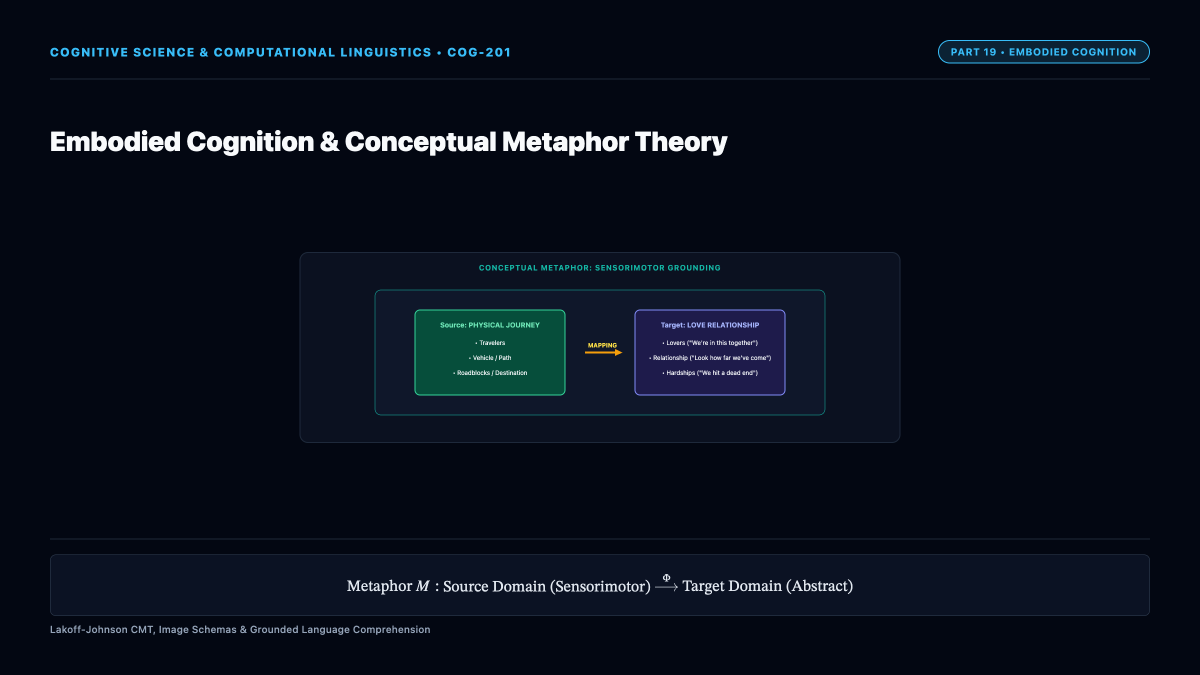
A Conceptual Metaphor is defined as a systematic mathematical cross-domain projection mapping an embodied, physical source domain onto an abstract, non-physical target domain:
[
Phi: ext{Source Domain (Concrete/Sensorimotor)} longrightarrow ext{Target Domain (Abstract/Cognitive)}
]
Foundational Conceptual Metaphors:
- ARGUMENT IS WAR:
- Your claims are indefensible.
- He attacked every weak point in my argument.
- Her criticism was right on target.
- I demolished his hypothesis.
The physical combat schema of warfare structures the entire conceptual apparatus of intellectual dispute.
- TIME IS MONEY:
- You are wasting my time.
- This shortcut will save you hours.
- I have invested a lot of time in this project.
The economic framework of quantifiable currency is mapped onto the experiential flow of temporal duration.
- LOVE IS A JOURNEY:
- Look how far we’ve come.
- We are at a crossroads.
- This relationship is in a dead-end street.
3. Image Schemas and Somatosensory Motor Simulation
Conceptual metaphors do not emerge arbitrarily; they are anchored by pre-conceptual image schemas (Mark Johnson)—dynamic spatial structures abstracted from infant sensorimotor bodily experience:
- CONTAINER Schema (Inside, Boundary, Outside): Derived from the physical body as an enclosure that ingests food and expels matter. Grounds logical syllogisms, set theory inclusion, and emotional states (“falling into love”, “stepping out of depression”).
- SOURCE-PATH-GOAL Schema: Derived from physical bodily locomotion from point A to point B. Grounds teleological reasoning, life goals, and algorithms.
- UP-DOWN Orientation: Derived from gravitational verticality (happy/healthy is UP, sad/sick is DOWN: “My spirits soared”, “He fell ill”).
4. Neuroscientific Validation: Somatotopic Motor Resonance
Modern functional neuroimaging (fMRI) provides indisputable empirical proof of embodied cognition. Hauk, Johnsrude, and Pulvermüller (2004) placed human participants in fMRI scanners while reading action verbs:
- Reading the word “kick” selectively activates the leg regions of the primary motor cortex.
- Reading “pick” or “grasp” activates the hand/finger areas of the motor cortex.
- Reading “lick” activates the premotor mouth/tongue representation.
Language comprehension is not an abstract symbolic lookup; it is a rapid, unconscious mental motor simulation of the physical actions depicted in the text.