When the Transformer architecture is scaled across orders of magnitude in parameters, compute, and dataset volume, quantitative expansion triggers qualitative cognitive breakthroughs. Large Language Models (LLMs) transition from statistical text predictors to versatile cognitive engines capable of zero-shot transfer, in-context meta-learning, and multi-step reasoning.
1. Autoregressive Causal Language Modeling
Modern decoder-only Large Language Models (such as GPT-4, LLaMA, and Gemini) are trained on massive multi-trillion-token internet corpora using the self-supervised causal language modeling objective: minimizing the cross-entropy loss over next-token prediction:
[
mathcal{L}( heta) = -rac{1}{T} sum_{t=1}^T ln P_ heta(x_t mid x_1, dots, x_{t-1})
]
To prevent information leaking from future tokens during parallel GPU matrix multiplication, the self-attention weights are masked by an upper-triangular causal attention mask where (M_{ij} = -infty) for all (j > i).
2. Empirical Scaling Laws: Kaplan vs Chinchilla
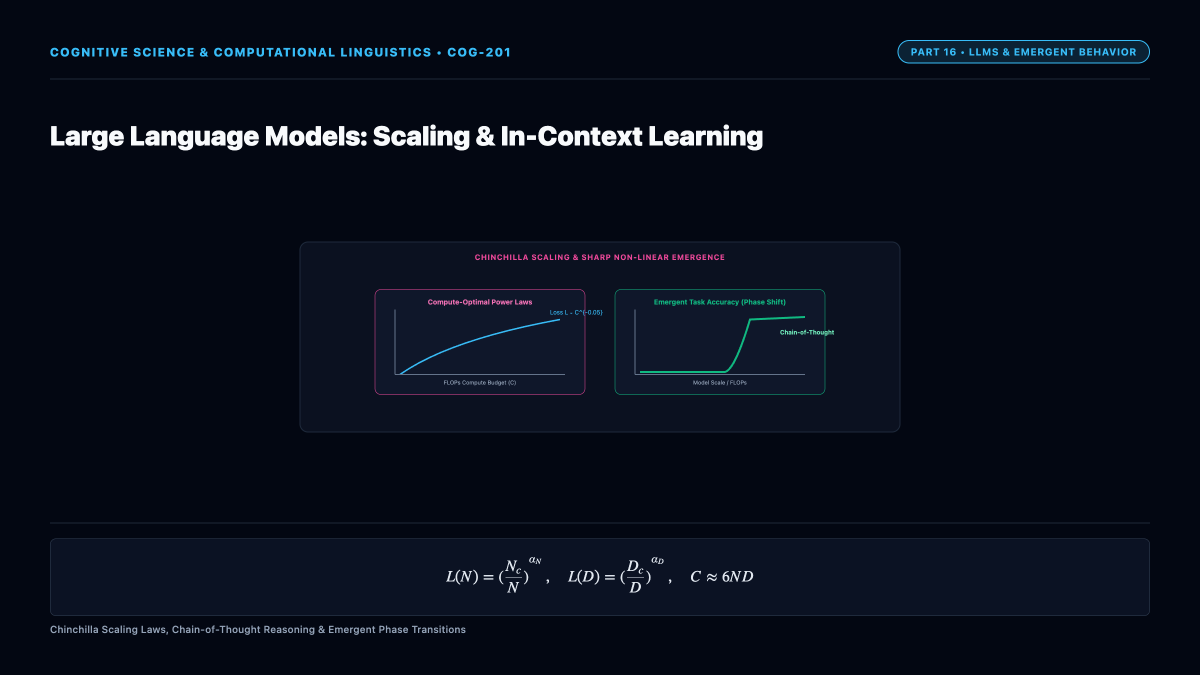
In 2020, Jared Kaplan et al. (OpenAI) demonstrated that cross-entropy loss follows strict, smooth power-law relationships with parameter count (N), dataset size (D), and training compute budget (C approx 6 N D):
[
L(N) = left( rac{N_c}{N}
ight)^{alpha_N}, quad L(D) = left( rac{D_c}{D}
ight)^{alpha_D}, quad L(C) = left( rac{C_c}{C}
ight)^{alpha_C}
]
Kaplan’s initial analysis suggested that allocating compute preferentially toward model parameters (N) was optimal ((N propto C^{0.73}, D propto C^{0.27})).
In 2022, Jordan Hoffmann et al. (DeepMind) corrected this paradigm with the Chinchilla Scaling Laws. Demonstrating that Kaplan’s models were severely undertrained, DeepMind proved that for compute-optimal training, model size and token count should scale symmetrically in equal proportions:
[
N_{ ext{opt}} propto C^{0.5}, quad D_{ ext{opt}} propto C^{0.5}
]
For every doubling of model parameters, the training dataset volume must also double. This empirical law directly informed the training of LLaMA, Mistral, and modern hyper-efficient compact foundational models.
3. In-Context Learning and Implicit Bayesian Inference
The defining capability of LLMs is In-Context Learning (ICL) (Brown et al., 2020). When provided with a few demonstration input-output pairs inside the prompt prompt context:
[
ext{Prompt: } [ (x_1, y_1), (x_2, y_2), dots, (x_k, y_k), x_{ ext{test}} ]
]
the model generates the correct response (y_{ ext{test}}) without any gradient updates or parameter fine-tuning. Theoretical analysis (von Oswald et al., 2023; Dai et al., 2023) demonstrates that during the forward pass, self-attention layers implicitly implement implicit gradient descent—updating internal activation vectors as if performing meta-optimization in latent weight space.
4. Emergent Abilities and Chain-of-Thought (CoT) Reasoning
Wei et al. (2022) documented that while per-token cross-entropy loss scales smoothly and predictably, performance on complex cognitive tasks (multi-digit arithmetic, symbolic logic, legal reasoning) exhibits abrupt, non-linear emergence: near-zero random accuracy below a critical compute threshold ((sim 10^{22} – 10^{24}) FLOPs), followed by sudden discontinuous jumps to human-level mastery.
This reasoning capacity is catalyzed by Chain-of-Thought (CoT) Prompting (Kojima et al., 2022). By prompting the model with intermediate reasoning steps (“Let’s think step by step”), the sequential generation of tokens allows the Transformer to allocate additional internal attention computation steps per reasoning sub-problem, transforming autoregressive generation into dynamic system-2 cognitive deliberation.