Natural language comprehension cannot be reduced solely to the formal truth conditions of declarative sentences. Communication is an active social coordination problem where speakers use context, world knowledge, and mutual expectations of rationality to convey meanings far richer than literal semantic syntax. Pragmatics investigates the profound gap between what is literally said and what is communicated.
1. Austin and Searle’s Speech Act Theory
In his 1962 lectures “How to Do Things with Words”, Oxford philosopher J.L. Austin destroyed the “descriptive fallacy”—the mistaken belief that language serves solely to state factual propositions that are either true or false. Instead, many utterances are performatives: speaking is itself a physical act that alters institutional or social reality (such as christening a ship, promising, or declaring marriage).
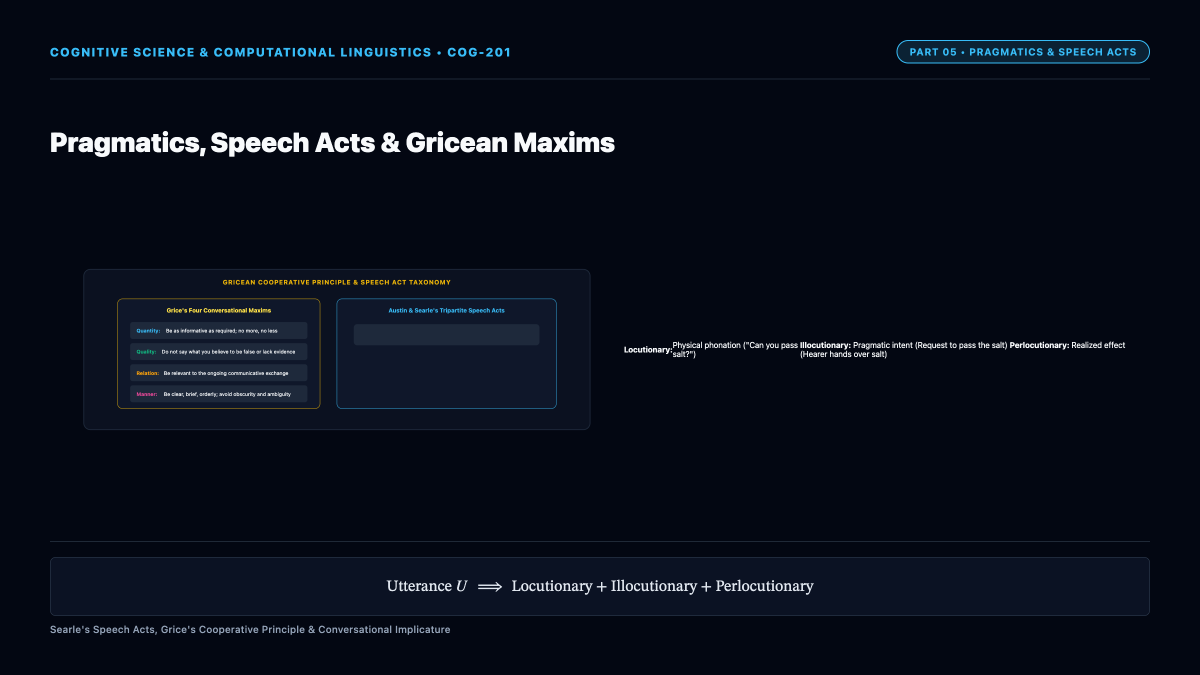
Austin and subsequent formalizer John Searle identified three distinct simultaneous acts performed in every linguistic utterance:
- Locutionary Act: The basic physical act of phonating a syntactically and semantically well-formed expression with determinate sense and reference (e.g., uttering the acoustic wave “The window is open”).
- Illocutionary Act: The pragmatic communicative force or intent embodied in the utterance (e.g., a statement of fact, an indirect request to close the window, or a warning of an approaching cold draft).
- Perlocutionary Act: The actual psychological or behavioral consequence realized in the hearer (e.g., convincing the hearer, alarming them, or inducing them to stand up and close the window).
Searle classified all illocutionary speech acts into five universal taxonomy classes based on their direction of fit between words and the world:
- Assertives: Commit the speaker to the truth of the expressed proposition (words-to-world fit; e.g., stating, concluding, hypothesizing).
- Directives: Attempts by the speaker to get the hearer to perform an action (world-to-words fit; e.g., commanding, requesting, pleading).
- Commissives: Commit the speaker to a future course of action (world-to-words fit; e.g., promising, threatening, vowing).
- Expressives: Express a psychological state regarding an existing state of affairs (null direction of fit; e.g., apologizing, thanking, congratulating).
- Declarations: Bring about immediate institutional correspondence between propositional content and reality by the very act of speaking (bidirectional world-words fit; e.g., declaring war, firing an employee).
2. Paul Grice’s Cooperative Principle and Conversational Maxims
How do hearers infer an indirect request from a literal assertion? In 1975, philosopher H. Paul Grice demonstrated that rational conversation is anchored by an overarching assumption of mutual cooperation:
The Cooperative Principle: “Make your conversational contribution such as is required, at the stage at which it occurs, by the accepted purpose or direction of the talk exchange in which you are engaged.”
Grice articulated four foundational sub-maxims regulating rational discourse:
- Maxim of Quantity:
- Make your contribution as informative as is required for current purposes.
- Do not make your contribution more informative than is required.
- Maxim of Quality:
- Do not say what you believe to be false.
- Do not say that for which you lack adequate evidence.
- Maxim of Relation (Relevance):
- Be relevant to the ongoing communicative exchange.
- Maxim of Manner:
- Avoid obscurity of expression.
- Avoid ambiguity.
- Be brief (avoid unnecessary prolixity).
- Be orderly.
3. Conversational Implicatures and Flouting
The true genius of the Gricean framework is that communicators do not merely obey these maxims; they deliberately, blatantly violate (flout) them to generate conversational implicatures.
When a speaker flouts a maxim while maintaining apparent adherence to the overarching Cooperative Principle, the hearer engages in abductive pragmatic reasoning to reconcile the apparent violation with conversational rationality. Classic categories of conversational implicature include:
- Irony and Sarcasm (Flouting Quality): Blatantly stating a proposition known by both parties to be absurdly false (e.g., stating “What delightful weather” during a torrential thunderstorm).
- Tautology (Flouting Quantity): Stating an uninformative tautology (e.g., “War is war”) implicates that certain unavoidable atrocities must be stoically accepted.
- Scalar Implicature (Quantity): Given an informational scale of semantic strength (langle ext{all}, ext{most}, ext{many}, ext{some}
angle), asserting the weaker term “John ate some of the cookies” conversationally implicates the negation of the stronger term (“John did not eat all of the cookies”), because if he had eaten all, the Maxim of Quantity would have mandated asserting the stronger claim.