Where and how does the human brain instantiate the complex computational machinery of human language? Moving beyond 19th-century aphasiology, modern cognitive neuroscience unifies electrophysiology, diffusion tensor imaging, and functional neuroimaging into the Dual-Stream Model—deciphering how acoustic waves transform into conceptual meaning and motor speech.
1. The Classical Aphasiology Model: Broca, Wernicke, and Lichtheim
The neurobiology of language began in the 19th century with post-mortem lesion studies of brain-damaged patients:
- Paul Broca (1861): Discovered that damage to the posterior inferior frontal gyrus (Brodmann Areas 44/45, Broca’s area) in the left hemisphere causes expressive (non-fluent) aphasia: speech production is halting, agrammatic, and severely impaired, while comprehension remains relatively intact.
- Carl Wernicke (1874): Discovered that lesions to the posterior superior temporal gyrus (Brodmann Area 22, Wernicke’s area) cause receptive (fluent) aphasia: patients produce effortless, grammatically fluent speech that is completely devoid of semantic coherence (word salad), paired with profound comprehension deficits.
- The Wernicke-Lichtheim-Geschwind Model: Hypothesized a simple linear reflex arc: auditory signals enter primary auditory cortex, are recognized in Wernicke’s area, travel along a thick subcortical white-matter tract called the arcuate fasciculus to Broca’s area for motor articulation planning, and execute via the primary motor strip. Lesions disconnecting the arcuate fasciculus produce conduction aphasia (preserved comprehension and spontaneous speech, but catastrophic inability to repeat phrases).
2. The Modern Paradigm: Hickok and Poeppel’s Dual-Stream Model
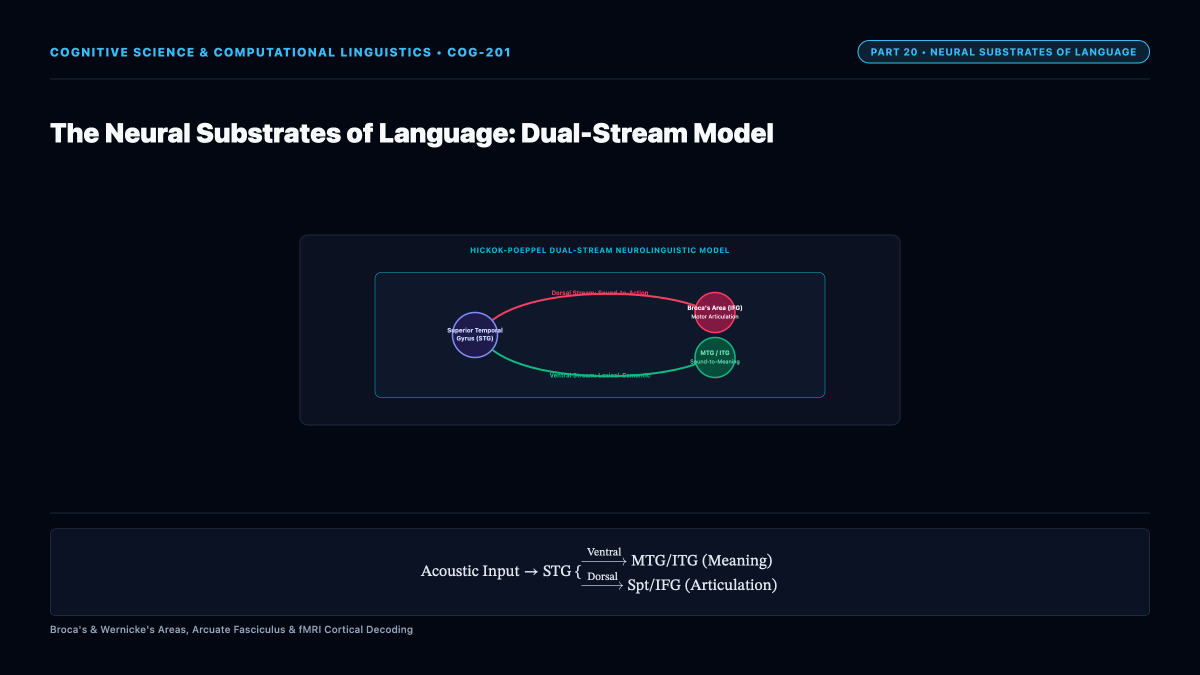
Modern fMRI and intra-operative electrocorticography demonstrated that the classical linear reflex arc is an oversimplification. In 2007, Gregory Hickok and David Poeppel formulated the Dual-Stream Model of Speech Processing, establishing a deep anatomical and functional dichotomy in how linguistic sound is processed beyond the auditory cortex:
[
ext{Spectrotemporal Analysis (A1)} longrightarrow ext{Phonological Processing (STG)} begin{cases}
xrightarrow{ ext{Ventral Stream}} ext{Sound-to-Meaning (Bilateral)}
xrightarrow{ ext{Dorsal Stream}} ext{Sound-to-Action (Left Hem.)}
nd{cases}
]
1. The Ventral Stream (“What” Pathway): Sound-to-Meaning
Projects ventrolaterally along the temporal lobe, engaging the Middle Temporal Gyrus (MTG), Inferior Temporal Gyrus (ITG), and anterior temporal pole:
- Maps acoustic phonological representations onto lexical-conceptual semantic networks.
- Organized bilaterally across both left and right hemispheres (accounting for why unilateral left-hemisphere strokes rarely produce complete semantic deafness).
- Operates over slow, combinatoric linguistic timescales ((sim 150 – 300 ext{ ms})), coordinating with cross-modal semantic hubs in the anterior temporal lobes.
2. The Dorsal Stream (“How / Where” Pathway): Sound-to-Action
Projects dorsally along the parieto-frontal interface, traversing the Sylvian parietal-temporal area (Area Spt) and terminating in Broca’s area (pars opercularis) and the premotor cortex:
- Maps acoustic speech representations onto frontal motor programs for vocal tract articulation.
- Strictly left-hemisphere dominant.
- Operates over fast temporal windows ((sim 20 – 50 ext{ ms})), mediating auditory-motor integration, verbal working memory (Baddeley’s phonological loop), and immediate speech shadowing.
3. Diffusion Tensor Imaging (DTI) and White-Matter Tractography
Diffusion MRI visualizes the microscopic anisotropic diffusion of water molecules along myelinated neuronal axon bundles in the living brain. DTI confirms that the Dual-Stream model is physically wired by two massive structural superhighways:
- The Arcuate Fasciculus and Superior Longitudinal Fasciculus (SLF): Structural substrate of the dorsal stream, providing direct reciprocal connectivity between temporal auditory regions and frontal motor speech centers.
- The Extreme Capsule and Inferior Frontal-Occipital Fasciculus (IFOF): Structural substrate of the ventral stream, mediating long-range communication between visual/auditory sensory regions and semantic storage networks.
4. Semantic Brain Decoding and fMRI Generative Reconstruction
The contemporary frontier of cognitive neurolinguistics is continuous semantic reconstruction. In 2023, Tang et al. (University of Texas at Austin) combined high-field fMRI recording with deep Transformer language models to achieve non-invasive semantic language decoding.
By recording blood-oxygen-level-dependent (BOLD) cortical activations while human participants listened to hours of narrative audiobooks, researchers trained a linearized encoding model mapping cortical voxels to Transformer latent embedding spaces. When subjects subsequently listened to novel audio, or even imagined telling a story in silence, the generative decoder successfully reconstructed the semantic gist of their continuous thoughts into natural language text without invasive brain implants.
From 19th-century post-mortem brains to non-invasive fMRI Transformer decoders, cognitive science and computational linguistics converge on a profound realization: the symbolic and probabilistic structures of language are physical properties of human neural computation.