How does the human biological brain process language in real time? Psycholinguistics bridges abstract theoretical linguistics with neurobiology and cognitive psychology. By tracking millisecond-by-millisecond ocular saccades and electrophysiological brain waves, cognitive science reveals that human sentence processing is an incremental, predictive, and probabilistic cognitive endeavor.
1. Incremental Sentence Processing and Garden-Path Sentences
Linguistic comprehension does not wait for a sentence to finish before building its syntactic parse. The human language faculty operates incrementally: interpreting acoustic or visual inputs word-by-word, immediately integrating each new token into an evolving hierarchical representation.
This relentless incrementalism exposes the parser to severe local structural misinterpretations, dramatically demonstrated by garden-path sentences:
[
ext{“The horse raced past the barn fell.”}
]
Upon encountering “raced”, the human parser overwhelmingly prefers the simpler, non-reduced main clause active past tense interpretation (“The horse was racing”) due to the Minimal Attachment and Late Closure heuristics (Lyn Frazier’s Garden-Path Model). When the matrix verb “fell” is encountered, the initial parse crashes catastrophically. The reader is forced to engage in conscious syntactic reanalysis, recognizing that “raced past the barn” was a reduced passive relative clause modifying “The horse” (meaning: “The horse [that was] raced past the barn fell”).
2. Saccadic Eye-Tracking: Reading Dynamics in Milliseconds
Eye-tracking during reading measures the physical mechanics of information acquisition:
- Fixations: Brief pauses where the fovea remains stationary on a word (typically (200 – 250 ext{ ms})).
- Saccades: Rapid ballistic jumps between fixations ((20 – 35 ext{ ms})), during which visual intake is suppressed.
- Regressions: Backwards saccades to earlier words ((approx 10 – 15%) of eye movements in normal reading), spiking sharply whenever syntactic or semantic processing breakdown occurs.
In Hale (2001) and Levy’s (2008) Surprisal Theory, the processing difficulty experienced at word (w_k) is strictly proportional to its information-theoretic negative log probability given preceding sentence context:
[
ext{Surprisal}(w_k) = -log_2 P(w_k mid w_1, dots, w_{k-1})
]
Spikes in surprisal predict longer first-fixation durations, elevated total reading times, and a higher probability of regressive saccades.
3. Event-Related Potentials (ERPs): N400 and P600 Waveforms
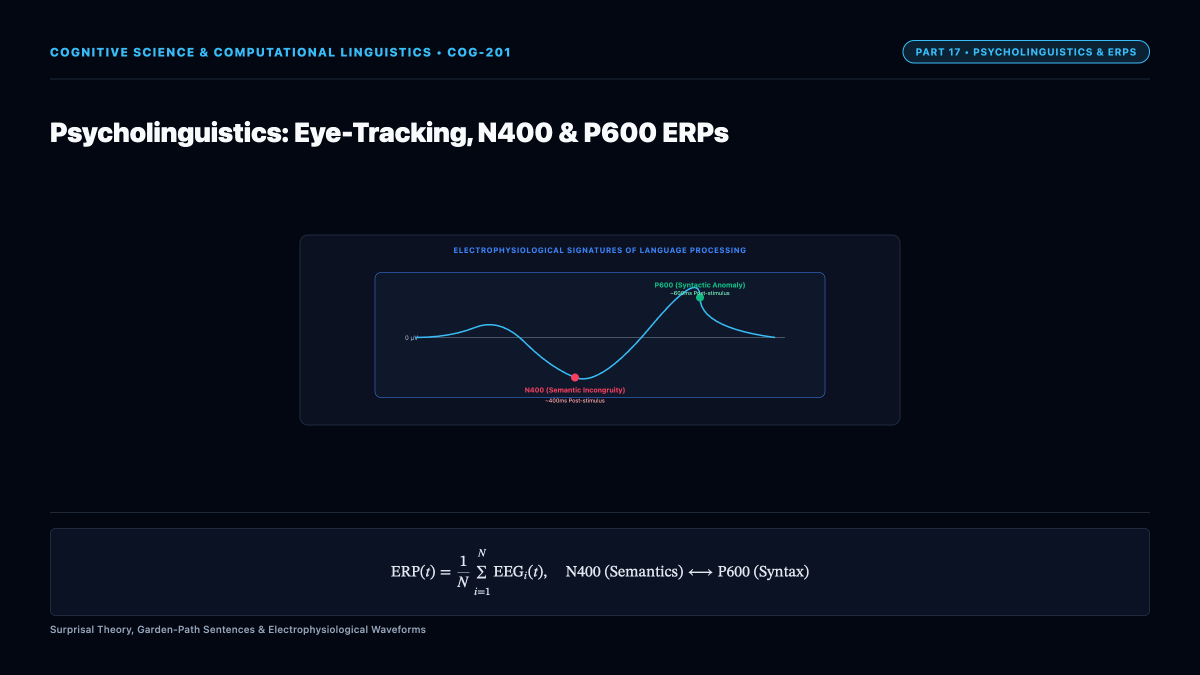
Electroencephalography (EEG) tracks post-synaptic dendritic currents across the scalp. By averaging raw EEG epochs time-locked to the presentation of critical stimulus words, cognitive scientists extract Event-Related Potentials (ERPs).
Two ERP components dominate cognitive neurolinguistics:
1. The N400 Component (Semantic Integration)
Discovered by Marta Kutas and Steven Hillyard in 1980, the N400 is a negative-going deflection that peaks approximately (400 ext{ ms}) post-stimulus onset, exhibiting a centroparietal scalp distribution:
- Elicited robustly by semantically anomalous or unexpected words in a sentence context:
[
ext{“He spread the warm bread with socks.” (Massive N400)}
] - The amplitude of the N400 scales inversely with the cloze probability (the percentage of human respondents who would predict that word in context). It indexes the cognitive ease of accessing and integrating a lexical concept into the ongoing mental model.
2. The P600 Component (Syntactic Repair)
Discovered by Lee Osterhout and Phillip Holcomb (1992), the P600 is a positive-going deflection that emerges around (500 ext{ ms}) and peaks near (600 ext{ ms}), localized across posterior scalp electrodes:
- Elicited by outright syntactic violations (e.g., subject-verb agreement errors: “The cats *eats the fish”, or phrase structure violations: “The child threw the toy on *the”).
- Triggered strongly by the disambiguating word in garden-path sentences (e.g., encountering “fell” in the horse-barn example).
- The P600 reflects the cognitive cost of syntactic reanalysis, structural repair, and grammatical well-formedness evaluation.
The neurofunctional dissociation between N400 (semantic content) and P600 (syntactic structure) provides definitive physiological evidence for dual, modular cognitive processing streams in human linguistic competence.