How is semantic knowledge organized in the human mental lexicon? In cognitive psychology and symbolic artificial intelligence, words are not isolated dictionary entries; they form a dense, interconnected taxonomic graph of conceptual nodes. George Miller’s Princeton WordNet pioneered the ontological formalization of lexical semantics, enabling mathematical calculation of semantic relatedness.
1. Lexical Relations in the Mental Lexicon
Lexical semantics investigates the internal structure of words and the systematic semantic relationships that bind them together:
- Synonymy: Symmetric semantic equivalence between distinct word forms in specific contexts (( ext{couch} approx ext{sofa})). True absolute synonymy is extraordinarily rare due to register, dialect, and pragmatic connotations.
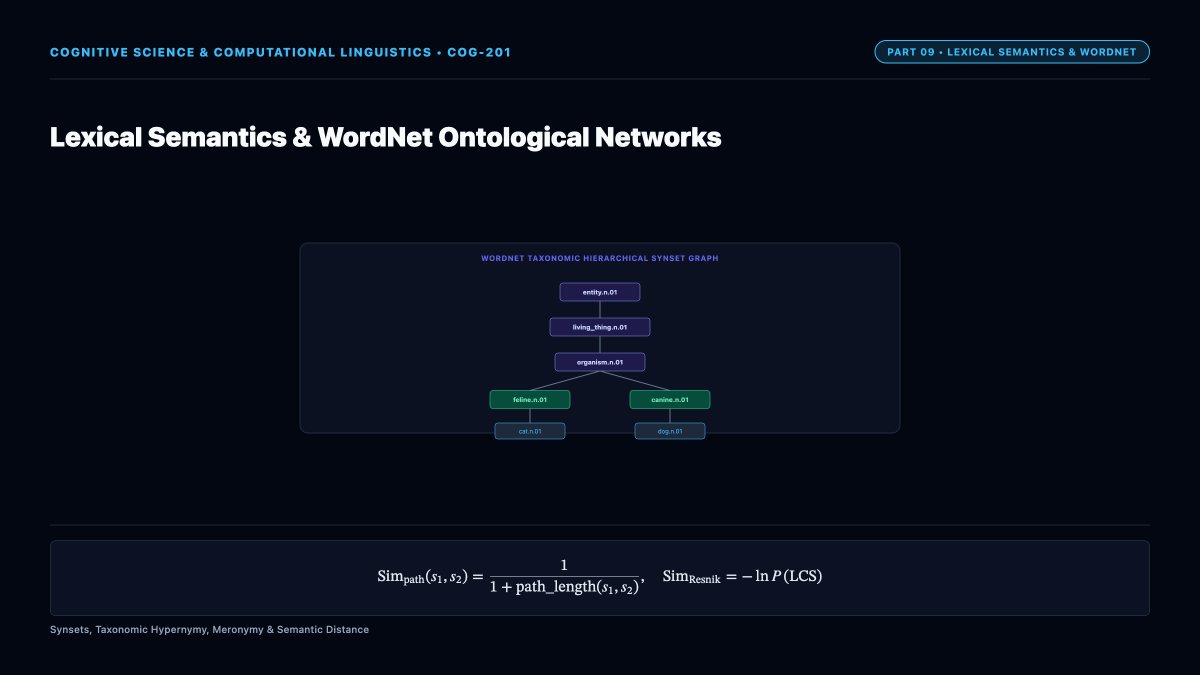
- Hyponymy and Hypernymy (IS-A Relation): Taxonomic inclusion between a specific subordinate concept (hyponym) and a broader superordinate concept (hypernym). For example, robin is a hyponym of bird, and bird is a hypernym of robin. Hypernymy is transitive and asymmetric, forming directed acyclic taxonomic trees.
- Meronymy and Holonymy (HAS-A Relation): Part-whole hierarchical relations. A wheel is a meronym of a bicycle (part-meronym), carbon is a meronym of steel (substance-meronym), and a player is a meronym of a team (member-meronym).
- Antonymy: Semantic opposition along a binary dimension. Antonyms divide into gradable opposites (hot / cold, admitting intermediate continuous scales), complementary opposites (alive / dead, exhaustive binary partition), and converse relations (buy / sell, alternative relational perspectives).
2. The Architecture of Princeton WordNet
Developed at Princeton University beginning in 1985 under the direction of cognitive psychologist George A. Miller, WordNet is a large-scale computational lexical database for English. Its foundational structural innovation is the synset (synonym set)—a cluster of cognitive synonyms representing a single unambiguous lexical concept.
For example, the noun bank maps to multiple distinct synsets:
bank.n.01: “sloping land (especially the slope beside a body of water)” ( o) Synonyms: ({ ext{bank} }).bank.n.02: “a financial institution that accepts deposits and channels the money into lending activities” ( o) Synonyms: ({ ext{depository financial institution}, ext{bank}, ext{banking company} }).
WordNet organizes over (117,000) synsets interconnected by explicit semantic relation pointers, creating a massive directed graph spanning nouns, verbs, adjectives, and adverbs.
3. Mathematical Semantic Similarity Metrics on Taxonomic Graphs
Given the hierarchical hypernym tree of WordNet, the semantic relatedness between two concepts (s_1) and (s_2) can be calculated quantitatively using topological graph theory:
1. Path-Based Distance
The simplest heuristic counts the shortest path length ( ext{len}(s_1, s_2)) along hypernym/hyponym edges:
[
ext{Sim}_{ ext{path}}(s_1, s_2) = rac{1}{1 + ext{len}(s_1, s_2)}
]
2. Resnik Information Content (IC) Metric
Path-length metrics assume all taxonomic links represent uniform semantic distances. In reality, links high in the taxonomy (e.g., between entity and object) span vast semantic gulfs, whereas links deep in the tree (between husky and terrier) are subtle. Philip Resnik (1995) solved this by grounding graph topology in corpus statistics via Information Content (IC):
[
ext{IC}(s) = -ln P(s)
]
where (P(s)) is the probability of encountering an instance of concept (s) in a text corpus. The semantic similarity between two concepts is defined as the information content of their Lowest Common Subsumer (LCS)—the most specific shared ancestor in the taxonomy:
[
ext{Sim}_{ ext{Resnik}}(s_1, s_2) = ext{IC}( ext{LCS}(s_1, s_2)) = -ln P( ext{LCS}(s_1, s_2))
]
3. Jiang-Conrath Distance
Jiang and Conrath (1997) unified link distance and information content by subtracting the shared information from the sum of individual information contents:
[
ext{Dist}_{ ext{JC}}(s_1, s_2) = ext{IC}(s_1) + ext{IC}(s_2) – 2 cdot ext{IC}( ext{LCS}(s_1, s_2))
]
These topological metrics provided the earliest formal mathematical algorithms for automated Word Sense Disambiguation (WSD), essay scoring, and question answering systems.