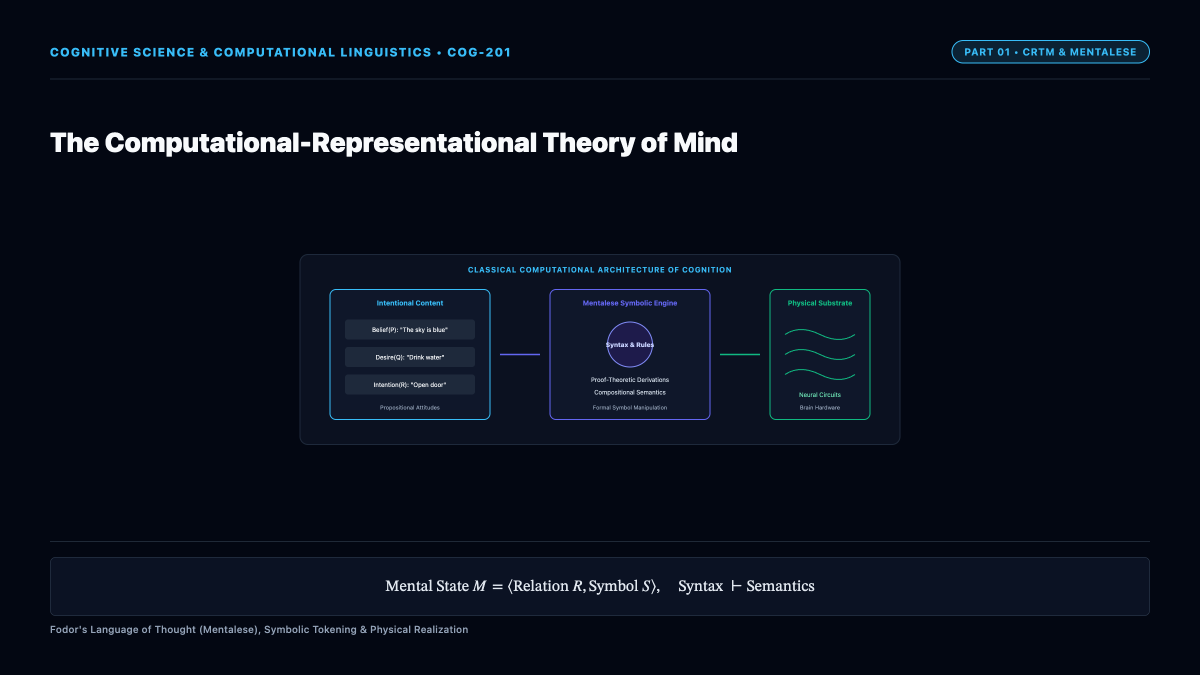
At the epicenter of classical cognitive science lies a revolutionary thesis: thinking is an act of mechanical computation performed over symbolic mental representations. Synthesizing formal mathematical logic, Turing computability, and philosophical functionalism, the Computational-Representational Theory of Mind (CRTM) resolves Descartes’ historic dualism by demonstrating how physical neural matter can embody semantic meaning.
1. The Cognitive Revolution and Functionalism
Prior to the late 1950s, experimental psychology was dominated by radical behaviorism, which dogmatically treated the mind as an unobservable “black box” and restricted scientific discourse strictly to measurable stimuli and motor responses. The cognitive revolution—spearheaded by Noam Chomsky, George Miller, Allen Newell, and Herbert Simon—reasserted the necessity of internal mental states.
Crucially, cognitive science grounds itself in functionalism: mental states (such as believing that it is raining, desiring an apple, or fearing a lion) are not identical to specific neurobiological structures (the type-identity theory), nor are they mere dispositions to behave. Instead, a mental state is defined entirely by its functional role—its causal relations to sensory inputs, behavioral motor outputs, and other mental states:
[
ext{Mental State } M_i = mathcal{F}left( ext{Inputs } I, ext{Other States } { M_j }, ext{Outputs } O
ight)
]
Functionalism establishes the doctrine of multiple realizability: just as the algorithm for long division can be executed on silicon microchips, mechanical gear trains, or biological brains, mental processes are software programs that can be physically realized on radically diverse physical hardware substrates.
2. Propositional Attitudes and Intentionality
Common-sense folk psychology successfully predicts human behavior using propositional attitudes. A propositional attitude is an intentional state composed of a psychological mode (such as Believing, Desiring, Hoping, or Fearing) directed toward a truth-evaluable proposition (P):
[
ext{Attitude} = ext{Mode}(P), quad ext{e.g., } ext{Belief}( ext{“The library closes at 9 PM”})
]
Intentionality—the property of mental representations to be about states of affairs in the external world (Brentano’s problem)—demands an explanation of how physical mechanisms can respect truth values. If physical states are governed exclusively by blind electrodynamic laws, how can mental transitions track logical entailment?
3. Fodor’s Language of Thought Hypothesis (LOTH)
Jerry Fodor formulated the definitive classical answer: the Language of Thought Hypothesis (LOTH). Thinking does not occur in natural spoken languages (such as English or Bengali), which are fraught with indexicals, ambiguities, and ellipses. Rather, human cognition operates in an innate, internal, non-acoustic mental language called Mentalese.
Mentalese possesses three essential structural properties:
- Productivity: An infinite number of novel thoughts can be generated from a finite vocabulary of mental symbols through recursive syntactic composition.
- Systematicity: The capacity to comprehend the thought “John loves Mary” intrinsically implies the cognitive capacity to comprehend “Mary loves John.” This systematicity is inexplicable under connectionist pattern associations without compositional constituent syntax.
- Compositionality: The semantic meaning of a complex Mentalese expression is a strict function of the meanings of its syntactic parts and the formal rules used to combine them:
[
llbracket phi(A, B)
rbracket = mathcal{G}left( llbracket A
rbracket, llbracket B
rbracket
ight)
]
4. The Syntactic Engine That Drives Semantics
The crowning achievement of CRTM is its unification of proof theory and physical mechanism. As philosopher John Haugeland famously summarized: “If you take care of the syntax, the semantics will take care of itself.”
In formal deductive logic, formal derivation rules (such as Modus Ponens: ({ P, P o Q } dash Q)) operate purely on the physical shape (syntax) of symbols, completely blind to their real-world interpretation. Yet, provided the inference rules are truth-preserving (sound), syntactic transformations faithfully mirror semantic truths.
In the brain, neurons act as the physical tokens of Mentalese symbols. The causal mechanical transitions of these neural tokens mirror the formal proof-theoretic deductions of logic. Thus, the physical brain operates as a syntactic engine whose mechanical operations faithfully preserve intentional semantic content.