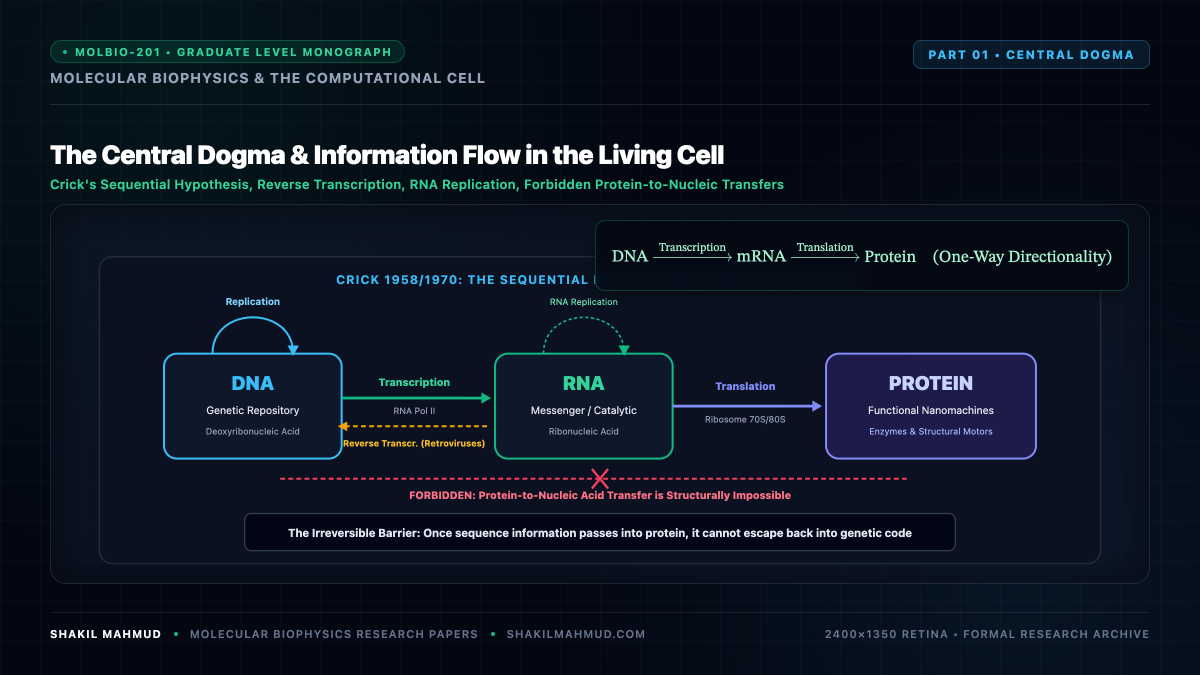
At the conceptual epicenter of modern molecular biophysics lies Francis Crick’s 1958 formulation of the Central Dogma of Molecular Biology. Far from being a mere biological aphorism, the Central Dogma represents a rigorous physical and mathematical statement regarding the non-invertibility of sequential symbolic information transfer across stereochemical substrates in non-equilibrium biological systems.
1. Crick’s Sequential Hypothesis & The Topology of Information Transfer
In his 1958 paper and subsequent 1970 clarification in Nature, Francis Crick articulated the Central Dogma as a formal constraint on information flow between three classes of biopolymers: DNA, RNA, and Protein. Denoting the transfer of sequence information from polymer $X$ to polymer $Y$ as $X to Y$, the nine theoretically conceivable permutations partition into three distinct physical classes:
- General Transfers (Universal across all known life):
- $text{DNA} to text{DNA}$ (Replication via DNA-dependent DNA polymerases).
- $text{DNA} to text{RNA}$ (Transcription via RNA polymerases).
- $text{RNA} to text{Protein}$ (Translation mediated by the ribonucleoprotein ribosome nanomachinery).
- Special Transfers (Observed in viral and specialized cellular contexts):
- $text{RNA} to text{RNA}$ (RNA replication via viral RNA-dependent RNA replicases).
- $text{RNA} to text{DNA}$ (Reverse transcription via RNA-dependent DNA polymerases / retroviruses).
- $text{DNA} to text{Protein}$ (Cell-free direct in vitro translation under non-physiological ribosomal perturbations).
- Forbidden / Unknown Transfers (Thermodynamically and mechanistically precluded):
- $text{Protein} to text{Protein}$
- $text{Protein} to text{RNA}$
- $text{Protein} to text{DNA}$
Crick’s profound insight was not simply that DNA makes RNA and RNA makes protein; rather, it was the structural assertion that once information has passed into protein, it cannot get out again. The transfer of detailed residue-by-residue sequence from protein back into nucleic acid is stereochemically and evolutionarily impossible.
2. Information Theory in the Cell: Shannon Channel Capacity
A cellular genome represents a physical communication channel transmitting message sequences through time (replication) and across spatial cellular compartments (transcription and translation). Let the alphabet of nucleic acids be $mathcal{A}_{text{NA}} = {text{A}, text{C}, text{G}, text{T}}$ with cardinality $|mathcal{A}_{text{NA}}| = 4$, and the amino acid alphabet be $mathcal{A}_{text{AA}}$ with cardinality $|mathcal{A}_{text{AA}}| = 20$ (supplemented by translation termination stop signals).
The maximum Shannon information capacity per nucleotide base is given by:
[
C_{text{base}} = log_2(4) = 2 text{ bits/base}
]
Because proteins require an alphabet of at least $20$ functional building blocks, a singlet code ($4^1 = 4$) or doublet code ($4^2 = 16$) possesses insufficient combinatorial variety. A triplet codon ($4^3 = 64$) provides $64$ permutations, yielding an information content per triplet of:
[
C_{text{codon}} = 3 times 2 = 6 text{ bits/codon}
]
Since $log_2(20) approx 4.32 text{ bits}$, the canonical genetic code contains redundant capacity:
[
Delta I = 6 – 4.32 = 1.68 text{ bits of degeneracy per codon}
]
This Shannon degeneracy is mapped systematically onto the third base of each codon—the crystallographic wobble position formulated by Crick, wherein non-standard Watson-Crick hydrogen bonding (e.g., G-U, I-U, I-C, I-A) buffers the cellular translation apparatus against silent point mutations.
3. Thermodynamics of One-Way Information Translation
Why is $text{Protein} to text{Nucleic Acid}$ physically forbidden? The irreversibility of translation is rooted in the thermodynamics of stereochemical folding and covalent synthesis:
[
Delta G_{text{folding}} = Delta H_{text{conformational}} – T Delta S_{text{hydrophobic}}
]
When an mRNA transcript is translated into a nascent polypeptide, the one-dimensional primary amino acid sequence undergoes spontaneous non-covalent collapse into a complex three-dimensional tertiary structure driven by the hydrophobic effect, hydrogen-bonding networks, and van der Waals packing. In this folded state, internal side-chains are completely buried within the hydrophobic core, shielded from any physical contact with template-synthesizing enzymes.
Furthermore, reverse translation would require a molecular motor capable of:
1. Progressively unfolding every tertiary domain against substantial thermodynamic barriers ($Delta G sim 10text{–}50 ; k_B T$).
2. Scanning the 20 chemically disparate side chains with sub-angstrom spatial fidelity.
3. Synthesizing a specific 3-base ribonucleotide triplet for each amino acid in the complete absence of a stereochemical template matching mechanism.
Because no template pairing exists between polypeptide side-chains and nucleotide bases (unlike the reciprocal purine-pyrimidine hydrogen bonding of Watson-Crick base pairs), translation is an informational dissipative sink. The arrow of molecular information flow is an irreversible thermodynamic consequence of biological macromolecular architecture.
4. The Eigen Error Catastrophe Threshold
How faithfully must biological information channels operate to prevent mutational extinction? In 1971, physical chemist Manfred Eigen formulated the definitive theory of molecular quasispecies and error thresholds.
Consider a self-replicating genome of length $L$ nucleotides, undergoing replication with a per-base mutation error probability $mu$. The fidelity of reproducing an error-free master sequence is:
[
Q_0 = (1 – mu)^L approx e^{-mu L}
]
If the master sequence possesses a selective fitness advantage $sigma_0$ relative to the average fitness of all mutant quasispecies variants $bar{sigma}_{text{mutants}}$, the master sequence can only be maintained by Darwinian selection if:
[
Q_0 sigma_0 > bar{sigma} implies e^{-mu L} sigma > 1
]
Taking the natural logarithm yields the celebrated Eigen Error Threshold:
[
L_{max} < frac{ln sigma_0}{mu} quad text{or equivalently} quad mu < frac{ln sigma_0}{L}
]
If the mutation rate exceeds this critical threshold, genetic information dissolves into an amorphous, non-functional genomic drift—a phenomenon known as the Error Catastrophe. This thermodynamic and informational limit dictated the early evolution of life: primitive ribozyme-based RNA genomes could not expand beyond $sim 100text{–}200$ nucleotides until high-fidelity proofreading protein polymerases evolved, unlocking the multi-megabase architectures of prokaryotic and eukaryotic life.