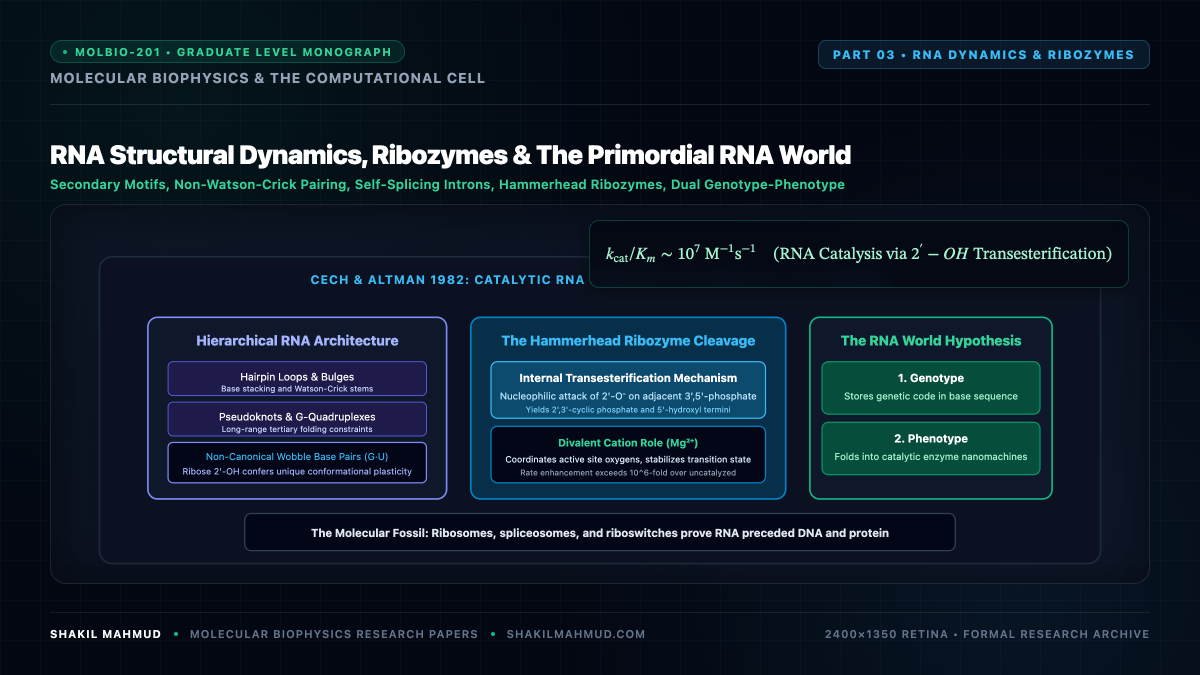
Unlike the rigid double-helical architecture of DNA, ribonucleic acid (RNA) possesses extraordinary conformational plasticity. Possessing a 2′-hydroxyl group on its ribose sugar ring, RNA functions simultaneously as an informational storage medium and as a complex catalytic tertiary enzyme—a dual property that resolves the ancient chicken-and-egg paradox of life’s origin through the RNA World Hypothesis.
1. Thermodynamics of RNA Secondary Structure: The Nearest-Neighbor Model
An RNA molecule of sequence $S = (s_1, s_2, dots, s_n)$ with $s_i in {text{A}, text{C}, text{G}, text{U}}$ folds spontaneously into planar secondary structure motifs: base pairs, hairpin loops, internal bulges, multi-branch junction loops, and pseudoknots. The canonical base-pairing set includes standard Watson-Crick pairs ($text{G}cdottext{C}, text{A}cdottext{U}$) and the versatile wobble pair ($text{G}cdottext{U}$).
According to the Turner Nearest-Neighbor Energy Model, the free energy $Delta G^circ$ of an RNA secondary structure $sigma$ is calculated as the sum of local sequence-dependent base-stacking doublets and loop entropic penalties:
[
Delta G^circ(sigma) = sum_{text{stacks}} Delta G^circ_{text{stack}}(s_i s_{i+1} / s_j s_{j-1}) + sum_{text{loops}} Delta G^circ_{text{loop}}(text{type}, text{length})
]
The statistical ensemble of all accessible secondary structures is described by the McCaskill Partition Function $Z$:
[
Z = sum_{sigma in Omega} expleft(-frac{Delta G^circ(sigma)}{k_B T}right)
]
The thermodynamic base-pairing probability $p_{ij}$ that nucleotide $i$ pairs with nucleotide $j$ is calculated via dynamic programming across the partition function:
[
p_{ij} = frac{Z_{1, i-1} cdot Z^B_{i, j} cdot Z_{j+1, n} cdot exp(-Delta G_{ij}/k_B T)}{Z}
]
2. Tertiary Motifs & Divalent Cation Electrostatics
Because the sugar-phosphate backbone of RNA carries a dense line of negative charges (one formal charge per phosphate, linear charge spacing $b approx 0.58 text{ nm}$), tertiary folding encounters severe electrostatic repulsion. According to Manning Counterion Condensation and Poisson-Boltzmann electrostatics, stable tertiary folding strictly requires divalent cations, predominantly $text{Mg}^{2+}$.
Hydrated magnesium ions ($text{Mg(H}_2text{O)}_6^{2+}$) stabilize RNA tertiary architectures through two distinct modes:
- Diffuse Screening: Cloud electrostatics neutralizing backbone repulsion and lowering the Debye length $kappa^{-1}$.
- Site-Specific Coordination: Direct inner-sphere coordination where magnesium water shells are partially exchanged for phosphate oxygens or heterocyclic nitrogen atoms (e.g., in G-quartets, A-minor motifs, and tetraloop-receptor junctions).
3. Ribozyme Catalytic Mechanisms: The Hammerhead Model
In 1982, Thomas Cech and Sidney Altman independently discovered catalytic RNAs (Ribozymes), overturning the dogma that only proteins could catalyze biochemical reactions. Ribozymes achieve catalytic rate enhancements exceeding $10^6text{–}10^{11}$ through classical chemical strategies:
- Acid-Base Catalysis: Utilizing the shifted $text{p}K_a$ values of specific adenosine and cytosine bases within hydrophobic pockets (shifting towards neutrality $text{p}K_a approx 7.0$).
- Transition State Electrostatic Stabilization: Coordinated $text{Mg}^{2+}$ ions polarizing the carbonyl/phosphate oxygens, stabilizing the trigonal bipyramidal phosphorane transition state during nucleophilic attack.
- Entropic Trapping & In-Line Positioning: Aligning the attacking $2’$-oxygen, the scissile phosphorus atom, and the $5’$-leaving oxygen in a strict colinear $180^circ$ attack trajectory:
[
angle(text{O}2′ – text{P} – text{O}5′) approx 180^circ
]
4. The Primordial RNA World Hypothesis
The duality of RNA—capable of both carrying genetic information (analogous to DNA) and performing catalytic chemical transformations (analogous to protein enzymes)—provides the primary mechanistic model for abiogenesis.
In the hypothetical RNA World (proposed by Walter Gilbert in 1986):
[
text{Prebiotic Chemistry} longrightarrow text{Self-Replicating Ribozymes} longrightarrow text{Ribosome / Peptide World} longrightarrow text{DNA Epigenetic Takeover}
]
Modern in vitro directed evolution experiments (such as the Joyce and Robertson ribozyme replicases) demonstrate that artificial RNA enzymes can accurately replicate RNA templates approaching their own length, providing tangible empirical validation for RNA as the computational and metabolic engine of the ancestral biosphere.