Across the twenty treatises of this series, we have journeyed from the single qubit on the Bloch sphere to the topological braid groups of non-Abelian anyons and the algorithmic shattering of global cryptography. Now, we arrive at the ultimate technological synthesis: The Fault-Tolerant Quantum Computer. Transitioning from the fragile, noisy heuristic devices of today to an architecturally scalable fault-tolerant machine requires synchronizing quantum error correction, real-time cryogenic FPGA decoders, and Magic State Distillation into a unified, coherent computational engine capable of expanding human epistemology into previously uncomputable domains.
1. The Complete Fault-Tolerant Stack
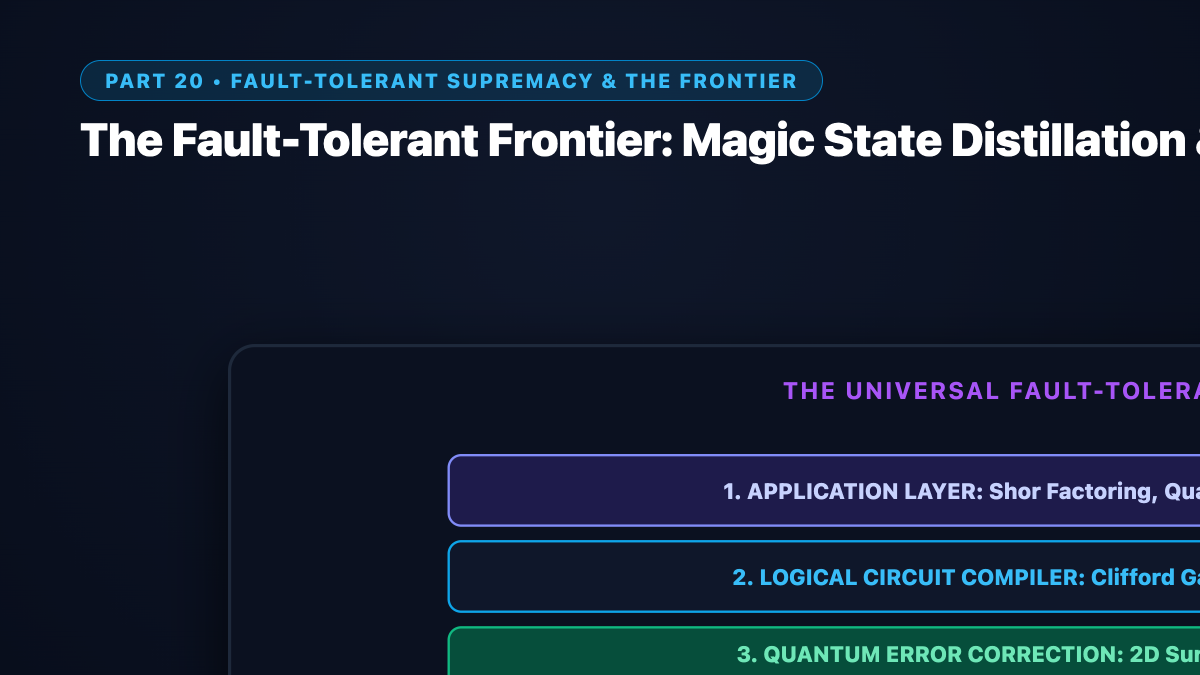
A fault-tolerant quantum computer is not merely a quantum chip; it is an integrated multi-tier computational hierarchy spanning six orders of magnitude in temperature:
- Physical Execution Layer ($10 text{ mK}$ – $4 text{ K}$): Superconducting transmons, trapped ions, or silicon quantum dots inside the mixing chamber of a cryogenic dilution refrigerator, undergoing microwave driving and laser pulses.
- Cryogenic Control Interface ($4 text{ K}$ – $77 text{ K}$): Cryo-CMOS multiplexers, low-noise amplifiers (HEMTs), and superconducting parametric amplifiers (JTWPAs) routing thousands of microwave lines with minimal thermal dissipation.
- Real-Time Syndrome Decoding Layer (Room Temperature / FPGA): High-speed FPGA clusters and ASICs running Blossom Minimum-Weight Perfect Matching (MWPM) or Union-Find decoders within the strict microsecond coherence budget ($tau_{decode} < 1 text{ }mutext{s}$) to track and neutralize error chains.
- Logical Abstraction Layer: Stabilizer operations orchestrating logical Clifford gates and lattice surgery merges/splits across planar surface codes.
- Magic State Distillation Factory: Dedicated zones of the quantum processor purifying non-Clifford states to inject universal quantum logic.
- Application & Compilation Layer: High-level quantum programming languages (Qiskit, Cirq, Q#) compiling algorithms into Clifford+$T$ sequences optimized for minimal $T$-depth.
2. Magic State Distillation: The Fuel of Universal Logic
By the Eastin-Knill theorem, surface codes cannot execute the non-Clifford $T$ gate ($pi/8$ phase gate) transversally. To bypass this barrier without compromising fault-tolerance, the processor employs Magic State Distillation, pioneered by Sergey Bravyi and Alexei Kitaev (2005).
The standard 15-to-1 distillation protocol consumes $15$ noisy, low-fidelity target states:
[
|Trangle = cosleft(frac{pi}{8}right)|0rangle + sinleft(frac{pi}{8}right)|1rangle = frac{1}{sqrt{2}}left(|0rangle + e^{ipi/4}|1rangleright)
]
having physical error rate $epsilon$. These 15 states are processed through an encoding stabilizer circuit based on the Reed-Muller $[[15, 1, 3]]$ code. Measuring the stabilizers projects out errors: if no error is detected, the protocol outputs a single purified magic state with an exponentially suppressed error rate:
[
epsilon_{out} = 35 epsilon^3 + mathcal{O}(epsilon^4)
]
By cascading distillation rounds, logical error rates are driven below $10^{-15}$. However, this purification factory consumes up to $90%$ of the total physical qubits and execution time in an error-corrected computer, highlighting magic state optimization as the central frontier of quantum software engineering.
3. Quantum Supremacy and Beyond: Benchmarking Quantum Advantage
In 2019, Google Quantum AI achieved the milestone of Quantum Supremacy using the 53-qubit Sycamore processor, executing a Random Circuit Sampling (RCS) benchmark in $200 text{ seconds}$ that was estimated to require $10,000 text{ years}$ on the world’s most powerful classical supercomputer (Summit). Subsequent experiments by USTC using the photonic processor Jiuzhang (Gaussian Boson Sampling) and superconducting processor Zuchongzhi further extended these classical computational frontiers.
While RCS demonstrated that quantum processors can perform tasks fundamentally beyond the reach of classical Turing machines, the modern objective has shifted to Quantum Utility and Advantage: solving mathematically structured, economically valuable problems—such as simulating the FeMoco nitrogenase active site for synthetic fertilizers, designing solid-state battery electrolytes, or simulating high-$T_c$ cuprate superconductivity.
| Epoch | Physical Qubits | Logical Qubits | Scientific & Industrial Capability |
|---|---|---|---|
| NISQ Era (Current) | $10^2 text{–} 10^3$ | $0$ (Uncorrected) | Heuristic VQE, QAOA, quantum supremacy demonstrations, quantum sensor benchmarks. |
| Early Fault-Tolerance (2026–2030) | $10^4 text{–} 10^5$ | $10 text{–} 100$ | First error-corrected chemistry simulations, quantum dynamics of small strongly correlated materials. |
| Industrial Quantum Advantage (2030+) | $10^6 text{–} 10^7$ | $1,000 text{–} 10,000$ | Shor’s factoring cracking 2048-bit RSA, exact carbon-fixation enzyme design, Room-Temperature superconductivity discovery. |
4. Epistemological Reflection: The Nature of Quantum Computation
Quantum computing is more than an exponential acceleration of matrix arithmetic; it represents a fundamental redefinition of what constitutes computation. For over a century, computational theory rested on the Church-Turing thesis: any physically realizable computer can be simulated with at most polynomial slowdown by a universal Turing machine. Quantum Information theory disproved the Extended Church-Turing thesis, demonstrating that the universe itself computes via linear algebra over high-dimensional complex Hilbert spaces.
As we construct architectures that manipulate quantum entanglement across millions of degrees of freedom, we are not merely building faster machines. We are building looking glasses into the deepest, unobservable textures of quantum reality—bridging the abstract mathematics of Hilbert space with the tangible future of human civilization.