While quantum computers threaten modern asymmetric cryptography through Shor’s algorithm, quantum mechanics simultaneously provides the ultimate countermeasure: Quantum Key Distribution (QKD). Unlike classical cryptography—whose security relies on unproven computational complexity conjectures—QKD derives its security from the fundamental laws of quantum physics: the Heisenberg Uncertainty Principle, the No-Cloning Theorem, and the monogamy of entanglement. Any attempt by an eavesdropper to measure a quantum communication channel irrevocably perturbs the physical state, guaranteeing detection with mathematical certainty.
1. The BB84 Protocol: Conjugate Basis Encoding
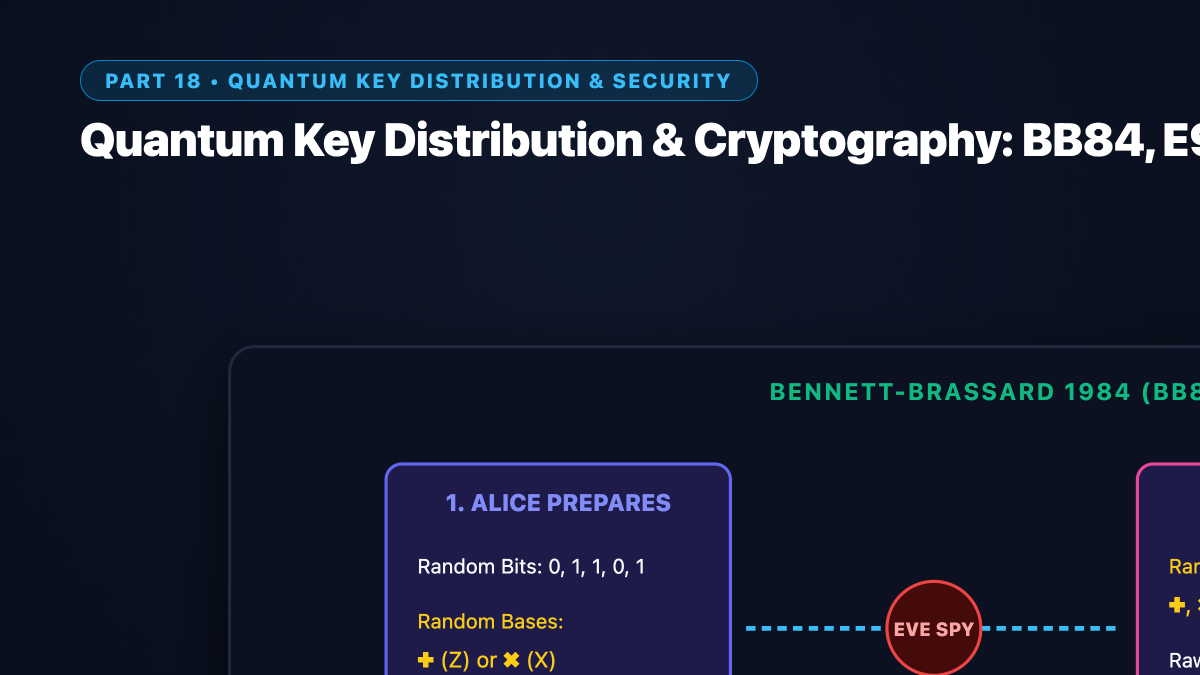
Proposed in 1984 by Charles Bennett and Gilles Brassard, the BB84 Protocol allows two distant parties (Alice and Bob) to establish a shared, secret cryptographic key over an unauthenticated quantum channel paired with an authenticated classical channel.
The Four Non-Orthogonal States
Alice encodes random classical bits using single photons polarized in one of two mutually unbiased conjugate bases:
- Rectilinear / Computational Basis ($mathcal{Z}$):
[
|0rangle equiv |Hrangle text{ (Horizontal)}, quad |1rangle equiv |Vrangle text{ (Vertical)}
] - Diagonal / Hadamard Basis ($mathcal{X}$):
[
|+rangle = frac{|0rangle + |1rangle}{sqrt{2}} equiv |+45^circrangle, quad |-rangle = frac{|0rangle – |1rangle}{sqrt{2}} equiv |-45^circrangle
]
The Four Stages of BB84 Execution:
- Quantum Transmission: For each bit, Alice randomly chooses a bit value ($0$ or $1$) and a basis ($mathcal{Z}$ or $mathcal{X}$), transmitting the corresponding polarized photon over an optical fiber.
- Bob’s Measurement: For each arriving photon, Bob independently chooses a measurement basis ($mathcal{Z}$ or $mathcal{X}$) at random and records the detector outcome.
- Basis Sifting: Over the classical channel, Alice and Bob publicly announce their chosen bases (without revealing bit values). They retain only the bits where their bases matched, discarding roughly $50%$ of the data. This shared sequence is the sifted key.
- Eavesdropping Detection: Alice and Bob publicly compare a random subset of their sifted bits to calculate the Quantum Bit Error Rate (QBER):
[
text{QBER} = frac{N_{errors}}{N_{tested}}
]
Suppose an eavesdropper (Eve) executes an Intercept-Resend attack: she intercepts Alice’s photon, measures it in a randomly chosen basis, and forwards a newly prepared photon to Bob.
- With probability $1/2$, Eve chooses the same basis as Alice and does not disturb the state.
- With probability $1/2$, Eve chooses the wrong basis. In that case, when Bob measures in Alice’s basis, he obtains the wrong bit with probability $1/2$.
The total error rate introduced by Eve across the sifted key is:
[
text{QBER}_{Eve} = frac{1}{2} times frac{1}{2} = 25%
]
If the measured QBER is below the Shor-Preskill security threshold ($text{QBER} < 11%$), Alice and Bob apply classical Cascade error reconciliation and privacy amplification (using universal hash functions) to distill a completely secure shorter key. If $text{QBER} ge 11%$, they abort the protocol.
2. The Ekert91 Protocol: Entanglement and Bell Validation
In 1991, Artur Ekert introduced an entanglement-based QKD scheme (E91) that eliminates the trust required in the photon source. An entangled photon pair source emits Bell pairs:
[
|Phi^+rangle = frac{|00rangle + |11rangle}{sqrt{2}}
]
Alice and Bob measure their incoming photons along randomly selected angles $theta_A in {0, frac{pi}{8}, frac{pi}{4}}$ and $theta_B in {frac{pi}{8}, frac{pi}{4}, frac{3pi}{8}}$.
The subsets of measurements where their analyzer angles align form the secret key. Crucially, the non-aligned measurement outcomes are used to evaluate the Clauser-Horne-Shimony-Holt (CHSH) correlation quantity:
[
S = |E(a_1, b_1) – E(a_1, b_2) + E(a_2, b_1) + E(a_2, b_2)|
]
If $S = 2sqrt{2} approx 2.828$, the monogamy of entanglement guarantees that the photon pairs share zero correlation with any third system (Eve). Any eavesdropping attack inevitably reduces $S le 2$, providing mathematical proof of device-independent security!
3. Quantum Repeaters and The Quantum Internet
Because the No-Cloning theorem forbids optical amplification (like erbium-doped fiber amplifiers EDFA), single photons attenuate exponentially in optical fiber: $I(L) = I_0 e^{-alpha L}$ (with attenuation $alpha approx 0.2 text{ dB/km}$ at $1550 text{ nm}$). Beyond $approx 100 text{–} 200 text{ km}$, direct QKD becomes impractically slow.
To span continental and planetary distances, quantum communication utilizes Quantum Repeaters based on the Briegel-Dur-Cirac-Zoller (BDCZ) protocol:
- Short fiber links create entangled pairs stored in atomic quantum memories.
- Entanglement Swapping: Performing a joint Bell-state measurement (BSM) on intermediate memories entangles the remote end-nodes without the photons ever traveling between them directly.
- Entanglement Purification: Distills high-fidelity entangled pairs from multiple noisy pairs.
Complementing fiber repeaters, China’s Micius Satellite established satellite-to-ground entanglement distribution over $1,200 text{ km}$, laying the foundations for a space-based global Quantum Internet.