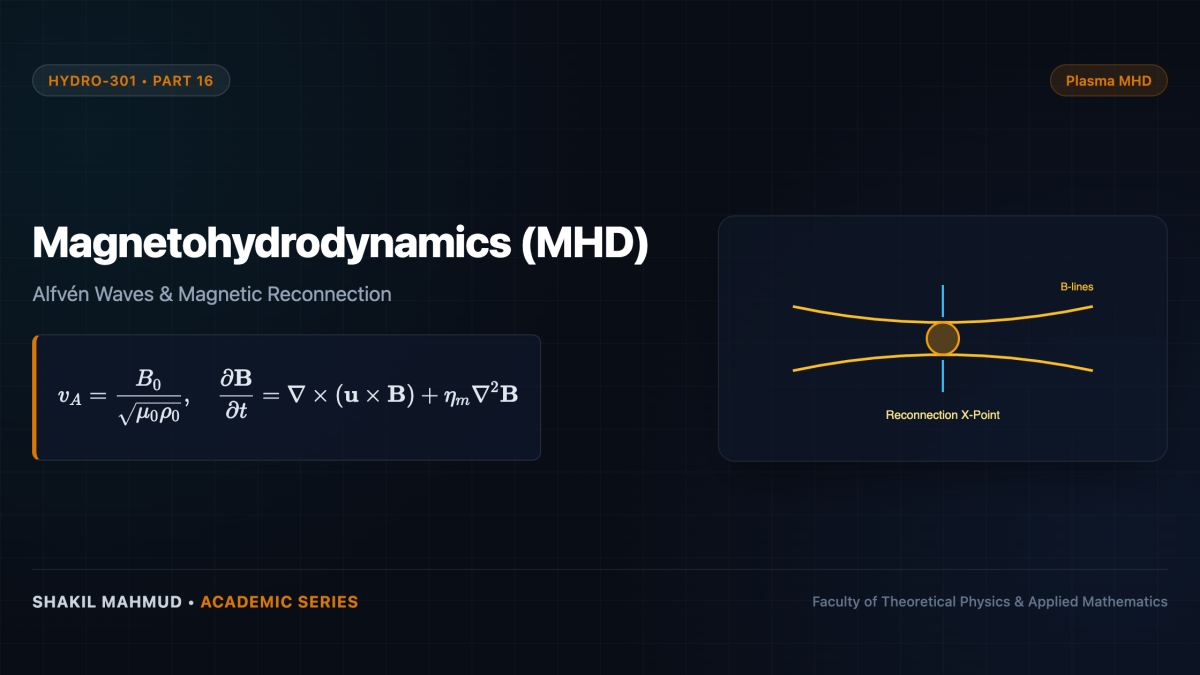
When an electrically conducting fluid (such as an astrophysical plasma, liquid metal coolant, or thermonuclear fusion plasma) moves through a magnetic field, fluid mechanics and Maxwell’s electrodynamics merge into a single unified discipline: Magnetohydrodynamics (MHD). The magnetic field exerts Lorentz forces that act as fluid tensions and pressures, while fluid motions stretch, twist, and reconnect magnetic lines of force.
1. The Governing Equations of Ideal MHD
Under the magnetohydrodynamic approximation (non-relativistic flow (u ll c), displacement current neglected (partial mathbf{E}/partial t approx mathbf{0}), and quasi-neutrality), Ohm’s law relates current density (mathbf{J}) to electric and magnetic fields:
[
mathbf{J} = sigma (mathbf{E} + mathbf{u} imes mathbf{B})
]
where (sigma) is the electrical conductivity. Using Ampère’s Law ((
abla imes mathbf{B} = mu_0 mathbf{J})) to eliminate (mathbf{J}) and Faraday’s Law ((
abla imes mathbf{E} = -partialmathbf{B}/partial t)) yields the fundamental MHD magnetic induction equation:
[
rac{partial mathbf{B}}{partial t} =
abla imes (mathbf{u} imes mathbf{B}) + ta_m
abla^2 mathbf{B}
]
where (ta_m = 1 / (mu_0 sigma)) is the magnetic diffusivity (([ta_m] = ext{m}^2/ ext{s})). The non-dimensional ratio of convective advection to magnetic diffusion defines the Magnetic Reynolds Number ((mathrm{Rm})):
[
mathrm{Rm} = rac{U L}{ta_m} = mu_0 sigma U L
]
2. Alfvén’s Flux Freezing Theorem
In the limit of a perfectly conducting fluid ((sigma o infty implies ta_m o 0)), (mathrm{Rm} o infty). The induction equation collapses to the ideal convective limit:
[
rac{partial mathbf{B}}{partial t} =
abla imes (mathbf{u} imes mathbf{B})
]
This is mathematically identical to the Helmholtz vorticity transport equation in an inviscid fluid. In 1942, Hannes Alfvén derived his celebrated Flux Freezing Theorem:
Theorem: In an ideal, perfectly conducting plasma, magnetic field lines are topologically “frozen” into the fluid material. Fluid elements attached to a given magnetic line of force remain attached to that same line for all eternity; the magnetic flux (Phi_B = iint mathbf{B} cdot dmathbf{A}) threading any closed material contour is strictly conserved over time.
3. Magnetic Stress Tensor: Pressure vs. Tension
The Lorentz body force (mathbf{J} imes mathbf{B}) acting on the fluid element decomposes via vector identities into two distinct mechanical stresses:
[
mathbf{J} imes mathbf{B} = rac{1}{mu_0}(
abla imes mathbf{B}) imes mathbf{B} = –
ablaleft( rac{B^2}{2mu_0}
ight) + rac{1}{mu_0}(mathbf{B} cdot
abla)mathbf{B}
]
Integrating this into the momentum balance:
[
ho rac{Dmathbf{u}}{Dt} = –
ablaleft( p + rac{B^2}{2mu_0}
ight) + rac{1}{mu_0}(mathbf{B} cdot
abla)mathbf{B} + mu
abla^2 mathbf{u}
]
- Magnetic Pressure ((p_B = rac{B^2}{2mu_0})): Isotropic pressure acting perpendicular to magnetic field lines, attempting to push field lines apart. The ratio of thermal gas pressure to magnetic pressure is the dimensionless plasma beta ((beta_{ ext{plasma}} = p / p_B)).
- Magnetic Tension ((rac{1}{mu_0}(mathbf{B} cdot
abla)mathbf{B})): Acts as a restorative mechanical tension along field lines, resisting bending exactly like plucked guitar strings.
4. Alfvén Waves and Magneto-Acoustic Modes
Because magnetic field lines possess both tension (restorative force) and plasma inertia (mass per unit length (
ho)), perturbing a magnetic field line excites transverse shear waves that propagate along field lines—Alfvén Waves—discovered by Hannes Alfvén (Nobel Prize 1970). The wave phase velocity is:
[
v_A = rac{B_0}{sqrt{mu_0
ho_0}}
]
In compressible MHD, combining magnetic forces with acoustic compressibility yields three distinct wave branches:
- Shear Alfvén Waves: Transverse, non-compressive ((
abla cdot mathbf{u} = 0)), propagating strictly along (mathbf{B}_0) at speed (v_A cos heta). - Fast Magnetosonic Waves: Compressive modes where thermal gas pressure and magnetic pressure oscillate in phase, propagating at speed (v_{ ext{fast}} approx sqrt{v_A^2 + a_s^2}).
- Slow Magnetosonic Waves: Compressive modes where thermal and magnetic pressures oscillate out of phase.
5. Magnetic Reconnection: Explosive Topology Changes
While Alfvén’s theorem forbids magnetic lines from breaking in ideal plasmas, in thin current sheets where spatial gradients are immense, finite resistivity (ta_m) breaks the flux-freezing constraint. Magnetic field lines of opposing polarity are driven together into an X-point configuration.
The field lines sever, cross-connect, and spring violently apart via magnetic tension, converting colossal amounts of stored magnetic energy into kinetic plasma jets, relativistic particle acceleration, and thermal radiation within minutes. Magnetic reconnection powers solar flares, coronal mass ejections (CMEs), geomagnetic storms in Earth’s magnetosphere, and sawtooth crashes in Tokamak fusion reactors.